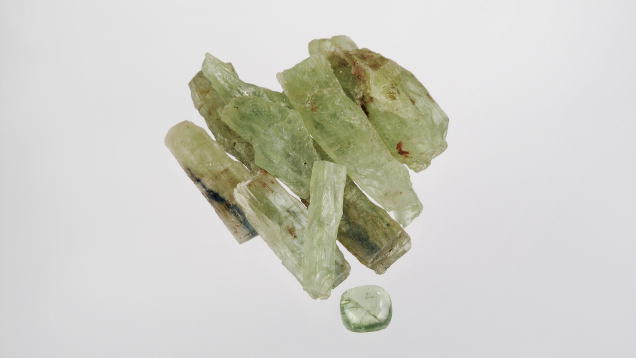
At the Riverpark Inn show in Tucson, gem dealer Tom Schneider (San Diego, California) exhibited a parcel of kyanite displaying an unusual saturated yellowish green color (figure 1). Mr. Schneider said he purchased several kilograms of the material in Arusha, Tanzania, its stated country of origin. While greenish blue, blue, and orange kyanite from Tanzania have been previously documented (Winter 2004 GNI, pp. 341–342; Summer 2009 GNI, pp. 146–147), this would be the first vibrantly colored yellowish green material from there. Yellowish green kyanite from Brazil has been previously reported (Winter 2001 GNI, pp. 337–338), but it had a light color and lacked the strong saturation of the material from Tanzania.
A cushion cabochon fashioned from one of the rough crystals was examined in the Carlsbad laboratory and exhibited the following properties: an RI of 1.719–1.731, a hydrostatic SG of 3.70, and no reaction to short- or long-wave UV radiation. These physical properties were consistent with those published for kyanite. This identification was confirmed by Raman spectroscopy.
Microscopic examination revealed several transparent crystals, fine particles, numerous fractures, and cleavages. Trapped in several cracks was an epigenetic reddish brown mineral residue. It is also notable that a small percentage of the rough crystals examined showed narrow blue color zones.

To determine the cause of the yellowish green color, we collected a visible spectrum using a UV-Vis-NIR scanning spectrophotometer (figure 2). This revealed prominent features located in the visible region at 432 and 445 nm. These features have been attributed to Fe 3+ in kyanite (R.G. Burns, Mineralogical Applications of Crystal Field Theory , 2nd ed., 1993, Cambridge University Press). LA-ICP-MS measurements collected on the cushion cabochon confirmed a high concentration of iron—more than 20,400 ppmw, consistent with the saturated yellowish green color.
This new supply of vibrant yellowish green material from Tanzania presents an inexpensive option for unusual ornamental gem materials.
At the Riverpark Inn show in Tucson, gem dealer Tom Schneider (San Diego, California) exhibited a parcel of kyanite displaying an unusual saturated yellowish green color (figure 1). Mr. Schneider said he purchased several kilograms of the material in Arusha, Tanzania, its stated country of origin. While greenish blue, blue, and orange kyanite from Tanzania have been previously documented (Winter 2004 GNI, pp. 341–342; Summer 2009 GNI, pp. 146–147), this would be the first vibrantly colored yellowish green material from there. Yellowish green kyanite from Brazil has been previously reported (Winter 2001 GNI, pp. 337–338), but it had a light color and lacked the strong saturation of the material from Tanzania.
A cushion cabochon fashioned from one of the rough crystals was examined in the Carlsbad laboratory and exhibited the following properties: an RI of 1.719–1.731, a hydrostatic SG of 3.70, and no reaction to short- or long-wave UV radiation. These physical properties were consistent with those published for kyanite. This identification was confirmed by Raman spectroscopy.
Microscopic examination revealed several transparent crystals, fine particles, numerous fractures, and cleavages. Trapped in several cracks was an epigenetic reddish brown mineral residue. It is also notable that a small percentage of the rough crystals examined showed narrow blue color zones.
To determine the cause of the yellowish green color, we collected a visible spectrum using a UV-Vis-NIR scanning spectrophotometer (figure 2). This revealed prominent features located in the visible region at 432 and 445 nm. These features have been attributed to Fe 3+ in kyanite (R.G. Burns, Mineralogical Applications of Crystal Field Theory , 2nd ed., 1993, Cambridge University Press). LA-ICP-MS measurements collected on the cushion cabochon confirmed a high concentration of iron—more than 20,400 ppmw, consistent with the saturated yellowish green color.
This new supply of vibrant yellowish green material from Tanzania presents an inexpensive option for unusual ornamental gem materials.