
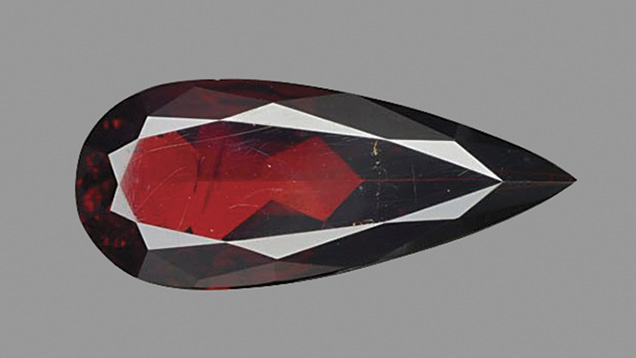
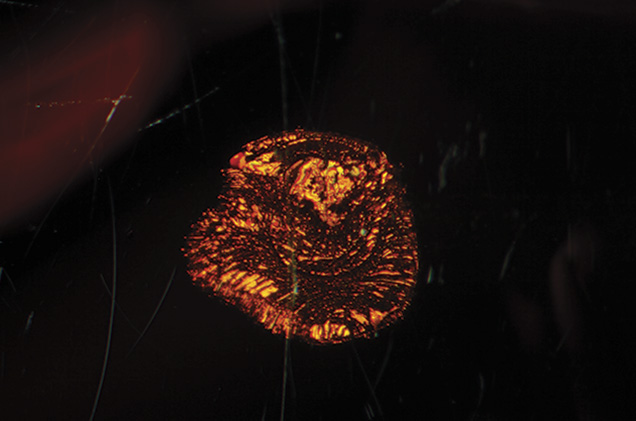
Recently the Carlsbad laboratory examined a 3.97 ct transparent brownish red pear-shaped modified brilliant for identification service (figure 1). Standard gemological testing revealed a refractive index that was over the limit of the RI liquid and a specific gravity (obtained hydrostatically) of 3.96. There was no fluorescence observed with exposure to long- and short-wave UV light. The stone also displayed an adamantine luster and a uniaxial optic figure when examined with polarized light. Microscopic examination with a fiber-optic light source showed fine needles and a large reflective decrepitation halo surrounding a negative crystal. Examination also revealed that the decrepitation halo was perpendicular to the optic-axis direction, suggesting the stone had basal cleavage (figure 2).
Raman spectroscopy and X-ray powder diffraction conclusively identified the stone as wurtzite. EDXRF analysis detected zinc and sulfur, which further supported this identification.
Wurtzite, a polymorph of sphalerite, commonly occurs in hydrothermal vein deposits associated with barite and sphalerite. Facet-grade wurtzite has been reported to occur in Merelani, Tanzania (Winter 2013 GNI, p. 261). This is the first wurtzite examined by the GIA laboratory.
Recently the Carlsbad laboratory examined a 3.97 ct transparent brownish red pear-shaped modified brilliant for identification service (figure 1). Standard gemological testing revealed a refractive index that was over the limit of the RI liquid and a specific gravity (obtained hydrostatically) of 3.96. There was no fluorescence observed with exposure to long- and short-wave UV light. The stone also displayed an adamantine luster and a uniaxial optic figure when examined with polarized light. Microscopic examination with a fiber-optic light source showed fine needles and a large reflective decrepitation halo surrounding a negative crystal. Examination also revealed that the decrepitation halo was perpendicular to the optic-axis direction, suggesting the stone had basal cleavage (figure 2).
Raman spectroscopy and X-ray powder diffraction conclusively identified the stone as wurtzite. EDXRF analysis detected zinc and sulfur, which further supported this identification.
Wurtzite, a polymorph of sphalerite, commonly occurs in hydrothermal vein deposits associated with barite and sphalerite. Facet-grade wurtzite has been reported to occur in Merelani, Tanzania (Winter 2013 GNI, p. 261). This is the first wurtzite examined by the GIA laboratory.