
Turquoise
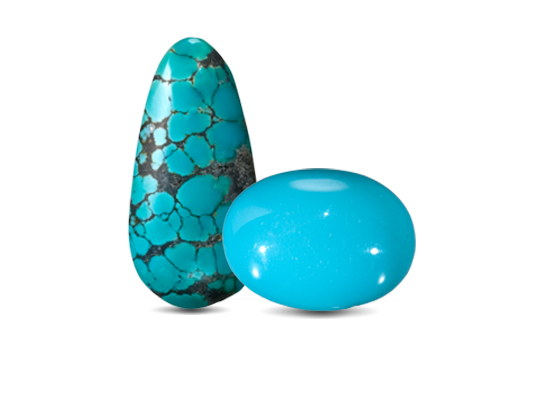
Azure sky, robin’s egg blue: Vivid shades of turquoise define the color that’s named after this gem.
OVERVIEW
ABOUT TURQUOISE

Turquoise is found in only a few places on earth: dry and barren regions where acidic, copper-rich groundwater seeps downward and reacts with minerals that contain phosphorus and aluminum. The result of this sedimentary process is a porous, semitranslucent to opaque compound of hydrated copper and aluminum phosphate.
BIRTHSTONES & ANNIVERSARIES
Turquoise is the traditional birthstone for the month of December and the gem of the 11th anniversary.
4,000 BC
Turquoise buried in Ancient Egyptian tombs is among the world’s oldest jewelry.
MEFKAT
Ancient Egyptians called turquoise “mefkat,” which also means “joy” and “delight.”
1519
Montezuma, thinking Cortes was Quetzalcoatl, gave him the god’s favorite gem: turquoise.
FACTS
Mineral: Turquoise
Chemistry: Cᵤₐₗ₆₍ₚₒ₄₎₄ ·₍ₒₕ₎₈ ·₅ₕ₂ₒ
Color: Blue to green
Refractive Index: 1.610 to 1.650
Birefringence: Not detectable
Specific Gravity: 2.76 (+0.14, -0.36)
Mohs Hardness: 5 to 6
TREATMENTS
There are a number of processes used to alter the color, apparent clarity, or improve the durability of gems.
SYNTHETICS
Some gemstones have synthetic counterparts that have essentially the same chemical, physical, and optical properties, but are grown by man in a laboratory.
IMITATIONS
Any gem can be imitated—sometimes by manmade materials or by natural materials chosen by man to impersonate a particular gem.
WHY WE LOVE THIS GEMSTONE

1
Spiderweb
The spiderweb of veins that appear in turquoise are matrix: evidence of the surrounding rock.
2
Legacy
A legacy of turquoise appreciation spans the globe, from ancient Egypt to Mesoamerica to China.
3
Copper
The spiderweb of veins that appear in turquoise are matrix: evidence of the surrounding rock.
QUALITY FACTORS
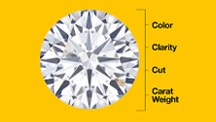
Turquoise is judged on its color, texture, and the absence of matrix.
COLOR

The even blue color of this cabochon would be called Persian blue in the trade.
CLARITY

These free-form turquoise cabochons show a typical matrix pattern.
CUT

Although turquoise is usually cut into beads and cabochons, it can also be carved.
CARAT WEIGHT

Cutters work around large areas of matrix to yield pieces of evenly colored turquoise.
TURQUOISE QUALITY FACTORS: THE COMPREHENSIVE GUIDE
RESEARCH
Explore sources, gemological research, and the role of gems in history.

An Evaluation of Turquoise from the Mona Lisa Mine in Arkansas
Alexander A. Goodsuhm , Feb 2, 2026

Mineralogy and Geochemistry of Turquoise from Tianhu East, Xinjiang, China
Ling Liu, Mingxing Yang, Qiaoqiao Li, Yi Tang, Huilin Wen, Ye Yuan, Yan Li, and Jia Liu , May 3, 2024