
As noted in the overview turquoise was one of the most prolific gems in Tucson this year, found in a variety of jewelry, cut stones, and rough throughout the shows. Richard Shull and Helen Constantine-Shull of Out of Our Mines (Dyer, Nevada) reported strong sales at the AGTA show, where they had an impressive variety of mainly American stones, particularly turquoise and variscite from Nevada. They also offered other popular materials, including Oregon chalcedony, California tourmaline, Oregon sunstone, Nevada golden opal, and Arizona amethyst.
Childhood visits to trading posts during trips to the Southwest sparked Richard’s fascination with turquoise and jewelry. His family’s gold mining activities in California and Nevada inspired his own interest in mining. Helen similarly traveled throughout the Southwest as a child, developing a strong appreciation for the local rocks and plants. Both Shulls have extensive lapidary and jewelry-making experience. They began mining their own material in the late 1980s and became mine owners in the 1990s. Currently, they own and operate several turquoise and variscite claims in Nevada.
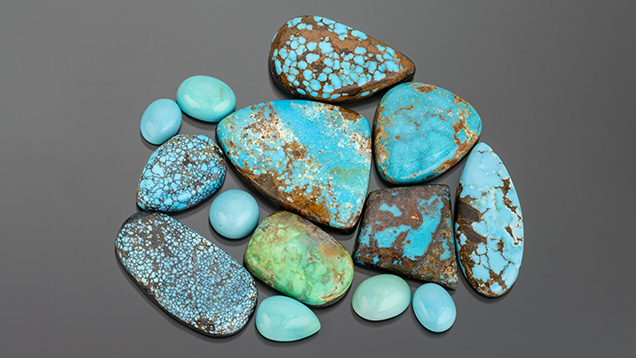
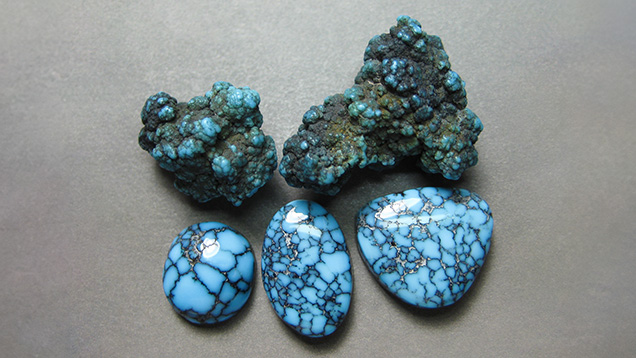
Helen attributed her passion for turquoise and variscite to their great variety of patterns and colors. Their highest-end turquoise is material with tight, distinct spiderweb patterning from their Black Widow and Black Web Gem mines. Only about two pounds of material has been recovered to date from the Black Web Gem mine, and it is some of the finest natural black web turquoise in the world (figure 1). Also popular are greens from the Northern Lights mine, bright greenish blue material with striking reddish brown matrix from the Double Eagle mine, blues with strongly contrasting matrix from the Nevada Blue mine, and pattern-free clear gem material from the Supernova and Aztec mines at Royston (figure 2).
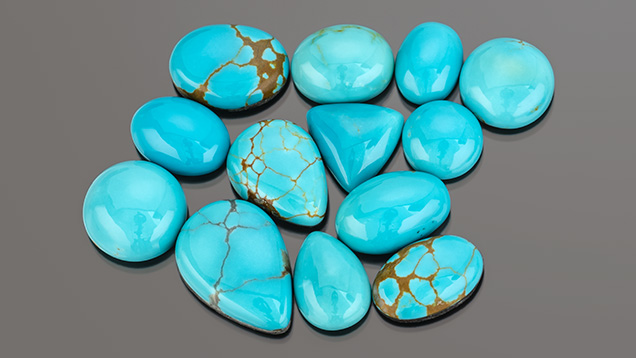
Turquoise with distinct matrix patterning is a strong draw for those seeking one-of-a-kind pieces, a very popular trend in jewelry today. However, there is still solid demand for clear gem material, which the Shulls sell from both vintage sources (1950s Persian) and from their own Dyer Blue and Supernova mines in Nevada, which both produce webbed and clear turquoise (figure 3).
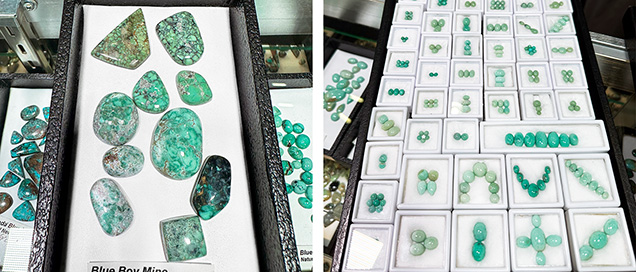
Variscite, a non-copper-containing aluminum phosphate mineral closely related to turquoise, is gaining popularity as consumers learn more about this mineral. Variscite comes in a range of greens and can exhibit the same fascinating matrix patterns found in turquoise (figure 4).
The Shulls described how some buyers form a personal connection with the material. For these customers, the stone they acquire is more than simply a piece of turquoise; it is a stone from a known location, uncovered by a known person, with a clear story of how it reached the final form in front of them.
Jennifer Stone-Sundberg is senior technical editor for Gems & Gemology at GIA in
Carlsbad, California.
As noted in the overview turquoise was one of the most prolific gems in Tucson this year, found in a variety of jewelry, cut stones, and rough throughout the shows. Richard Shull and Helen Constantine-Shull of Out of Our Mines (Dyer, Nevada) reported strong sales at the AGTA show, where they had an impressive variety of mainly American stones, particularly turquoise and variscite from Nevada. They also offered other popular materials, including Oregon chalcedony, California tourmaline, Oregon sunstone, Nevada golden opal, and Arizona amethyst.
Childhood visits to trading posts during trips to the Southwest sparked Richard’s fascination with turquoise and jewelry. His family’s gold mining activities in California and Nevada inspired his own interest in mining. Helen similarly traveled throughout the Southwest as a child, developing a strong appreciation for the local rocks and plants. Both Shulls have extensive lapidary and jewelry-making experience. They began mining their own material in the late 1980s and became mine owners in the 1990s. Currently, they own and operate several turquoise and variscite claims in Nevada.
Helen attributed her passion for turquoise and variscite to their great variety of patterns and colors. Their highest-end turquoise is material with tight, distinct spiderweb patterning from their Black Widow and Black Web Gem mines. Only about two pounds of material has been recovered to date from the Black Web Gem mine, and it is some of the finest natural black web turquoise in the world (figure 1). Also popular are greens from the Northern Lights mine, bright greenish blue material with striking reddish brown matrix from the Double Eagle mine, blues with strongly contrasting matrix from the Nevada Blue mine, and pattern-free clear gem material from the Supernova and Aztec mines at Royston (figure 2).
Turquoise with distinct matrix patterning is a strong draw for those seeking one-of-a-kind pieces, a very popular trend in jewelry today. However, there is still solid demand for clear gem material, which the Shulls sell from both vintage sources (1950s Persian) and from their own Dyer Blue and Supernova mines in Nevada, which both produce webbed and clear turquoise (figure 3).
Variscite, a non-copper-containing aluminum phosphate mineral closely related to turquoise, is gaining popularity as consumers learn more about this mineral. Variscite comes in a range of greens and can exhibit the same fascinating matrix patterns found in turquoise (figure 4).
The Shulls described how some buyers form a personal connection with the material. For these customers, the stone they acquire is more than simply a piece of turquoise; it is a stone from a known location, uncovered by a known person, with a clear story of how it reached the final form in front of them.
Jennifer Stone-Sundberg is senior technical editor for Gems & Gemology at GIA in
Carlsbad, California.