

Recently, three large baroque natural hollow pearls reportedly from the Pinctada radiata species were submitted for scientific examination at GIA’s Mumbai laboratory. According to the owner, the pearls were obtained from Bahraini divers more than a decade ago. Weighing 1.97, 3.92, and 6.13 ct, and measuring 10.09 × 8.40 × 6.32 mm, 12.78 × 11.12 × 9.45 mm, and 16.00 × 13.94 × 11.60 mm, respectively, these pearls had surprisingly low heft for their sizes (figure 1). Their purplish gray bodycolor, with varying tones of orient, displayed brown patches of different intensities.
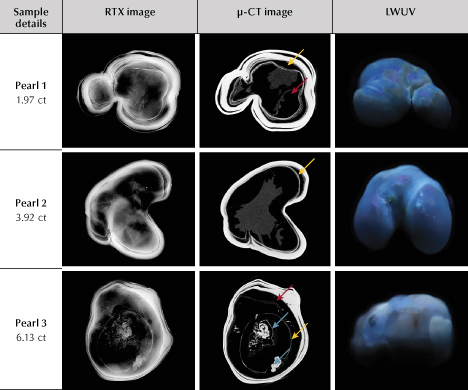
Under high magnification, the gray areas exhibited a fine striated nacre growth pattern of overlapping platelets typical of nacreous pearls from Pinctada species. Small areas on pearls 1 and 2 displayed a distinctive spiral platy structure, with the translucent outer nacre revealing layers of resinous organic-rich material. In addition, dull brownish patches with a crackled surface texture and a bumpy botryoidal appearance were observed in pearls 1 and 3, surrounded by minor surface blemishes. All three pearls exhibited an inert reaction when subjected to X-ray fluorescence. Energy-dispersive X-ray fluorescence spectrometry showed no traces of manganese and higher strontium levels of 853, 973, and 1013 ppm, respectively, indicative of a saltwater environment. When viewed under long-wave ultraviolet radiation, the pearls showed a moderate bluish green reaction (figure 2) and a similar weaker reaction under short-wave ultraviolet radiation.
Real-time X-ray microradiography (RTX) imaging of all the pearls revealed large voids and organic-rich material of varying opacities extending to the pearls’ edges. X-ray computed microtomography (μ-CT) imaging further emphasized the distinct features within these hollow pearls. The large voids consistently followed the outline of the pearls and were surrounded by fine growth arcs unlike the typical irregular voids found in non-bead cultured (NBC) pearls, which mostly lack natural growth arcs in the outer nacre (“The microradiographic structures of non‐bead cultured pearls,” GIA Research News, November 20, 2009). In addition, they contained organic-rich material enclosed by white walls that seamlessly followed each pearl’s shape. Interestingly, pearl 3 also displayed intriguing concentric aggregates within the void area.
Upon analysis and comparison with reference samples in GIA’s research database, it was evident that these specimens closely resembled natural hollow pearls observed in Pinctada species. The radiopacity and shape of the voids within them differed from voids typical of saltwater NBC pearls, which tend to be darker, irregular, and more elongated (“Non-bead-cultured pearls from Pinctada margaritifera,” GIA Research News, April 27, 2018). In contrast, the voids in natural hollow pearls exhibit varying degrees of radiopacity. Furthermore, hollow pearls are distinguished by their large, enclosed cavities (The Pearl Blue Book, CIBJO, 2023), which sets them apart from solid core pearls.
Notably, many antique pearl jewelry pieces dating before the twentieth century, prior to the start of pearl cultivation, feature large hollow natural pearls. These hollow natural pearls were often too fragile to set on jewelry and were frequently filled with metal fragments to increase both their durability and weight. Despite their significant size, hollow pearls are deceptively light. It is quite common for natural pearls to exhibit a hollow structure. The exploration of such pearls has consistently captivated gemologists, as their intricate and complex internal structures pose challenges in drawing definitive conclusions, with similar voids occasionally observed in NBC pearls. The study of such specimens provides valuable insights and significantly contributes to our understanding of the formation processes associated with natural hollow pearls.
Recently, three large baroque natural hollow pearls reportedly from the Pinctada radiata species were submitted for scientific examination at GIA’s Mumbai laboratory. According to the owner, the pearls were obtained from Bahraini divers more than a decade ago. Weighing 1.97, 3.92, and 6.13 ct, and measuring 10.09 × 8.40 × 6.32 mm, 12.78 × 11.12 × 9.45 mm, and 16.00 × 13.94 × 11.60 mm, respectively, these pearls had surprisingly low heft for their sizes (figure 1). Their purplish gray bodycolor, with varying tones of orient, displayed brown patches of different intensities.
Under high magnification, the gray areas exhibited a fine striated nacre growth pattern of overlapping platelets typical of nacreous pearls from Pinctada species. Small areas on pearls 1 and 2 displayed a distinctive spiral platy structure, with the translucent outer nacre revealing layers of resinous organic-rich material. In addition, dull brownish patches with a crackled surface texture and a bumpy botryoidal appearance were observed in pearls 1 and 3, surrounded by minor surface blemishes. All three pearls exhibited an inert reaction when subjected to X-ray fluorescence. Energy-dispersive X-ray fluorescence spectrometry showed no traces of manganese and higher strontium levels of 853, 973, and 1013 ppm, respectively, indicative of a saltwater environment. When viewed under long-wave ultraviolet radiation, the pearls showed a moderate bluish green reaction (figure 2) and a similar weaker reaction under short-wave ultraviolet radiation.
Real-time X-ray microradiography (RTX) imaging of all the pearls revealed large voids and organic-rich material of varying opacities extending to the pearls’ edges. X-ray computed microtomography (μ-CT) imaging further emphasized the distinct features within these hollow pearls. The large voids consistently followed the outline of the pearls and were surrounded by fine growth arcs unlike the typical irregular voids found in non-bead cultured (NBC) pearls, which mostly lack natural growth arcs in the outer nacre (“The microradiographic structures of non‐bead cultured pearls,” GIA Research News, November 20, 2009). In addition, they contained organic-rich material enclosed by white walls that seamlessly followed each pearl’s shape. Interestingly, pearl 3 also displayed intriguing concentric aggregates within the void area.
Upon analysis and comparison with reference samples in GIA’s research database, it was evident that these specimens closely resembled natural hollow pearls observed in Pinctada species. The radiopacity and shape of the voids within them differed from voids typical of saltwater NBC pearls, which tend to be darker, irregular, and more elongated (“Non-bead-cultured pearls from Pinctada margaritifera,” GIA Research News, April 27, 2018). In contrast, the voids in natural hollow pearls exhibit varying degrees of radiopacity. Furthermore, hollow pearls are distinguished by their large, enclosed cavities (The Pearl Blue Book, CIBJO, 2023), which sets them apart from solid core pearls.
Notably, many antique pearl jewelry pieces dating before the twentieth century, prior to the start of pearl cultivation, feature large hollow natural pearls. These hollow natural pearls were often too fragile to set on jewelry and were frequently filled with metal fragments to increase both their durability and weight. Despite their significant size, hollow pearls are deceptively light. It is quite common for natural pearls to exhibit a hollow structure. The exploration of such pearls has consistently captivated gemologists, as their intricate and complex internal structures pose challenges in drawing definitive conclusions, with similar voids occasionally observed in NBC pearls. The study of such specimens provides valuable insights and significantly contributes to our understanding of the formation processes associated with natural hollow pearls.