
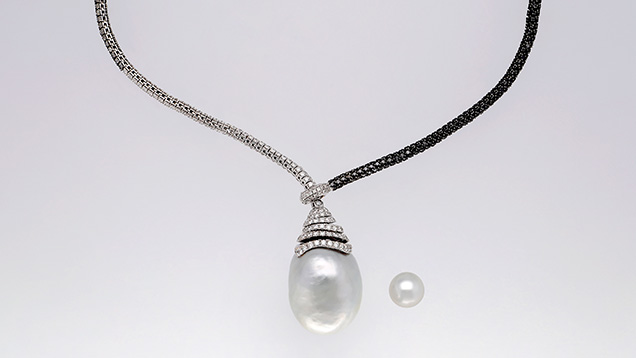
Many unusually large South Sea cultured pearls have been identified at GIA laboratories in the past (e.g., Fall 2013 Lab Notes, pp. 172–173; Summer 2023 Lab Notes, pp. 216–217). However, a recent submission to the New York laboratory particularly piqued the authors’ interest. This submission featured a gigantic South Sea bead cultured pearl incorporated into a distinctive lariat necklace (figure 1).
The semi-baroque pearl measured approximately 31.00 × 28.07 × 27.24 mm and exhibited a silvery bodycolor with creamy patches, a common characteristic of pearls harvested from the Pinctada maxima oyster. Additionally, energy-dispersive X-ray fluorescence chemical analysis showed low levels of manganese and high strontium content, confirming that the pearl originated from a saltwater environment.

This specimen represents one of the largest cultured pearls tested by GIA from the Pinctada maxima mollusk. Pinctada maxima is the largest species in the Pinctada genus, typically producing pearls ranging from 9 to 14 mm, though it sometimes produces exceptionally large pearls (L. Otter et al., “A look inside a remarkably large beaded South Sea cultured pearl,” Spring 2014 G&G, pp. 58–62). Due to the pearl’s size, it was fascinating to observe the internal growth structure. Real-time X-ray microradiography (RTX) imaging revealed a partially hollow structure containing a round bead nucleus approximately 10.5 mm in diameter, curiously filled with multiple metal wires approximately 0.40 mm in thickness (figure 2). The nacre thickness varied between approximately 0.50 mm to 1.00 mm.
Large pearls of either natural or cultured origin with hollow structures have occasionally been detected in laboratories, often filled with foreign materials such as resin, metals, shells, and even pearls (Fall 2013 Lab Notes, pp. 172–173; Spring 2014 Lab Notes, pp. 66–67; Summer 2019 Lab Notes, pp. 251–254). The observation of this large pearl filled with multiple metal wires was particularly interesting. Hollow pearls can be fragile due to their structural composition; the insertion of wires may serve to enhance durability, helping secure the bead in place, as well as retain weight.
This exquisite item was noteworthy for its size and intriguing internal structure. The lariat necklace featured a partially oxidized white metal set with numerous round brilliants gradually transitioning from near-colorless to gray and black, harmonizing with the beauty of the pearl.
Many unusually large South Sea cultured pearls have been identified at GIA laboratories in the past (e.g., Fall 2013 Lab Notes, pp. 172–173; Summer 2023 Lab Notes, pp. 216–217). However, a recent submission to the New York laboratory particularly piqued the authors’ interest. This submission featured a gigantic South Sea bead cultured pearl incorporated into a distinctive lariat necklace (figure 1).
The semi-baroque pearl measured approximately 31.00 × 28.07 × 27.24 mm and exhibited a silvery bodycolor with creamy patches, a common characteristic of pearls harvested from the Pinctada maxima oyster. Additionally, energy-dispersive X-ray fluorescence chemical analysis showed low levels of manganese and high strontium content, confirming that the pearl originated from a saltwater environment.
This specimen represents one of the largest cultured pearls tested by GIA from the Pinctada maxima mollusk. Pinctada maxima is the largest species in the Pinctada genus, typically producing pearls ranging from 9 to 14 mm, though it sometimes produces exceptionally large pearls (L. Otter et al., “A look inside a remarkably large beaded South Sea cultured pearl,” Spring 2014 G&G, pp. 58–62). Due to the pearl’s size, it was fascinating to observe the internal growth structure. Real-time X-ray microradiography (RTX) imaging revealed a partially hollow structure containing a round bead nucleus approximately 10.5 mm in diameter, curiously filled with multiple metal wires approximately 0.40 mm in thickness (figure 2). The nacre thickness varied between approximately 0.50 mm to 1.00 mm.
Large pearls of either natural or cultured origin with hollow structures have occasionally been detected in laboratories, often filled with foreign materials such as resin, metals, shells, and even pearls (Fall 2013 Lab Notes, pp. 172–173; Spring 2014 Lab Notes, pp. 66–67; Summer 2019 Lab Notes, pp. 251–254). The observation of this large pearl filled with multiple metal wires was particularly interesting. Hollow pearls can be fragile due to their structural composition; the insertion of wires may serve to enhance durability, helping secure the bead in place, as well as retain weight.
This exquisite item was noteworthy for its size and intriguing internal structure. The lariat necklace featured a partially oxidized white metal set with numerous round brilliants gradually transitioning from near-colorless to gray and black, harmonizing with the beauty of the pearl.