
“Wulanhua” turquoise is well known in the Taiwan and mainland China market. It has also been called “Ulan flower” turquoise in previous publications (L. Liu et al., “Unique raindrop pattern of turquoise from Hubei, China,” Fall 2020 G&G;, pp. 380–400). The term “Wulanhua” is a Chinese transliteration that means black orchid, and it usually refers to turquoise of medium dark to very dark blue color with a black spiderweb pattern found in Hubei Province.
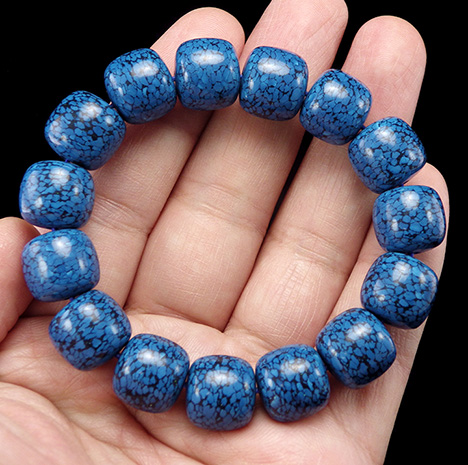
A bracelet recently submitted to Taiwan Union Lab of Gem Research (TULAB) as Wulanhua turquoise (figure 1) contained dark blue opaque beads with a black spiderweb pattern on the surface. The spot refractive index of these beads was about 1.62–1.63, close to that of turquoise. EDXRF analysis determined that the composition of the beads was inconsistent with that of turquoise (CuAl6(PO4)4(OH)8•4H2O). Instead, it was composed mainly of barium (Ba) and calcium (Ca).
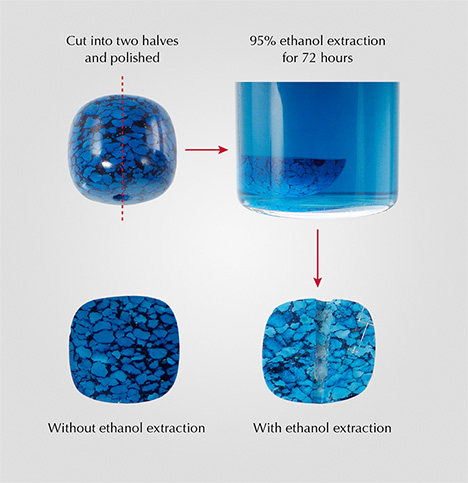
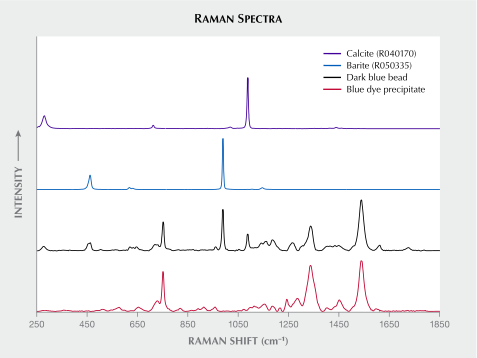
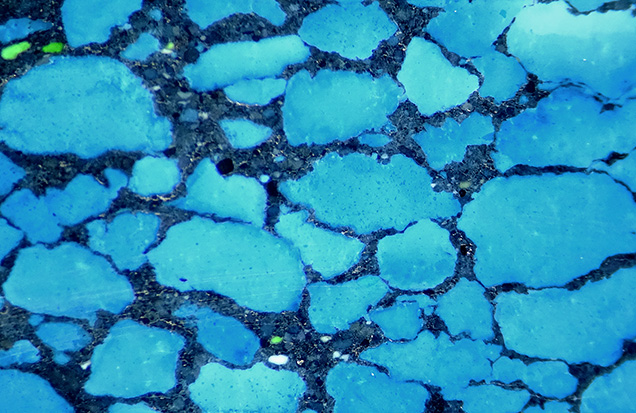
To further identify the composition, Raman spectra (785 nm laser) were analyzed and compared with those from the RRUFF database. The beads displayed mixed spectra of barite, calcite, and other unknown materials. With the consent of the client, a bead was cut into two halves and polished for more testing. One half was immersed in 95% ethanol for 72 hours to extract the dark blue dye (figure 2). After the ethanol volatilized, the blue precipitate was analyzed with Raman spectroscopy and the spectrum was compared with that of the bead and the spectra from the RRUFF database. Raman analysis and the extraction experiment revealed that this material was composed of barite and calcite with an unidentified blue dye (figure 3). Microscopic observation of the cross section suggested that the beads were made of irregularly shaped barite and barite with minor calcite particles with an unknown black filling as a bonding material (figure 4).
The beads could be defined as a composite material made of barite (BaSO4), calcite (CaCO3), and blue dye. While visual observation and refractive index might not be enough to distinguish these beads from true Wulanhua turquoise, Raman spectroscopy and EDXRF analysis were able to reveal their true identity.
“Wulanhua” turquoise is well known in the Taiwan and mainland China market. It has also been called “Ulan flower” turquoise in previous publications (L. Liu et al., “Unique raindrop pattern of turquoise from Hubei, China,” Fall 2020 G&G;, pp. 380–400). The term “Wulanhua” is a Chinese transliteration that means black orchid, and it usually refers to turquoise of medium dark to very dark blue color with a black spiderweb pattern found in Hubei Province.
A bracelet recently submitted to Taiwan Union Lab of Gem Research (TULAB) as Wulanhua turquoise (figure 1) contained dark blue opaque beads with a black spiderweb pattern on the surface. The spot refractive index of these beads was about 1.62–1.63, close to that of turquoise. EDXRF analysis determined that the composition of the beads was inconsistent with that of turquoise (CuAl6(PO4)4(OH)8•4H2O). Instead, it was composed mainly of barium (Ba) and calcium (Ca).
To further identify the composition, Raman spectra (785 nm laser) were analyzed and compared with those from the RRUFF database. The beads displayed mixed spectra of barite, calcite, and other unknown materials. With the consent of the client, a bead was cut into two halves and polished for more testing. One half was immersed in 95% ethanol for 72 hours to extract the dark blue dye (figure 2). After the ethanol volatilized, the blue precipitate was analyzed with Raman spectroscopy and the spectrum was compared with that of the bead and the spectra from the RRUFF database. Raman analysis and the extraction experiment revealed that this material was composed of barite and calcite with an unidentified blue dye (figure 3). Microscopic observation of the cross section suggested that the beads were made of irregularly shaped barite and barite with minor calcite particles with an unknown black filling as a bonding material (figure 4).
The beads could be defined as a composite material made of barite (BaSO4), calcite (CaCO3), and blue dye. While visual observation and refractive index might not be enough to distinguish these beads from true Wulanhua turquoise, Raman spectroscopy and EDXRF analysis were able to reveal their true identity.