
The author examined a 0.56 ct Fancy grayish bluish green diamond with prominent green radiation stains. Studies have shown that radiation can cause staining that expands the surface of a diamond (L. Nasdala et al., “Radio-colouration of diamond: A spectroscopic study,” Contributions to Mineralogy and Petrology, Vol. 165, 2013, pp. 843–861; S.C. Eaton-Magaña and K.S. Moe, “Temperature effects on radiation stains in natural diamonds,” Diamond and Related Materials, Vol. 64, 2016, pp. 130–142). This can create a noticeable bump that is visible in the microscope. The effect in this diamond is so pronounced that the radiation stains appear encased in a protective plastic bubble. This expansion effect is believed to be caused by the radiation damage creating an expansion in the diamond lattice (Nasdala et al., 2013).
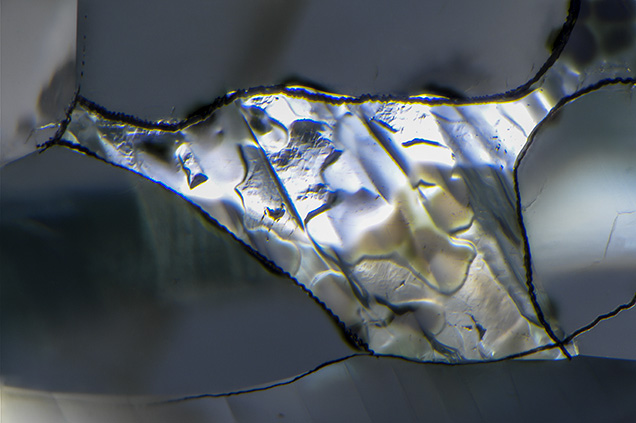
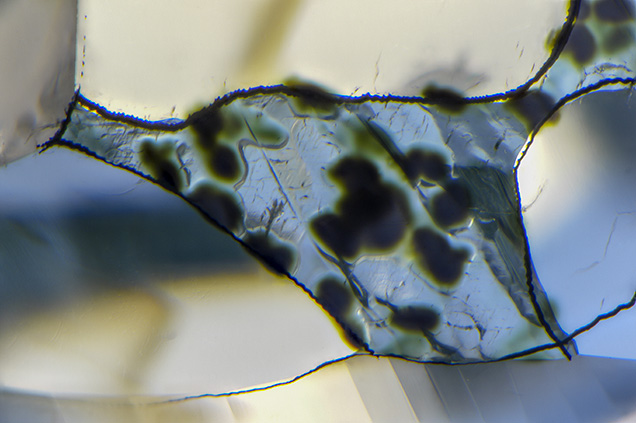
When viewed with transmitted light (figure 1), the raised lattice can be seen extending beyond the dimensions of the stain itself. The green-colored stains are very dark. Using reflected light (figure 2), the difference between surface textures is apparent. The surface that has been damaged and expanded by the radiation staining has a much smoother texture than the unaltered diamond surface. It is unknown why this diamond lattice was so distorted compared to typical radiation stains; they showed no unusual spectroscopic features that might provide a clue as to their formation.
Troy Ardon is a research associate at GIA in Carlsbad, California.
The author examined a 0.56 ct Fancy grayish bluish green diamond with prominent green radiation stains. Studies have shown that radiation can cause staining that expands the surface of a diamond (L. Nasdala et al., “Radio-colouration of diamond: A spectroscopic study,” Contributions to Mineralogy and Petrology, Vol. 165, 2013, pp. 843–861; S.C. Eaton-Magaña and K.S. Moe, “Temperature effects on radiation stains in natural diamonds,” Diamond and Related Materials, Vol. 64, 2016, pp. 130–142). This can create a noticeable bump that is visible in the microscope. The effect in this diamond is so pronounced that the radiation stains appear encased in a protective plastic bubble. This expansion effect is believed to be caused by the radiation damage creating an expansion in the diamond lattice (Nasdala et al., 2013).
When viewed with transmitted light (figure 1), the raised lattice can be seen extending beyond the dimensions of the stain itself. The green-colored stains are very dark. Using reflected light (figure 2), the difference between surface textures is apparent. The surface that has been damaged and expanded by the radiation staining has a much smoother texture than the unaltered diamond surface. It is unknown why this diamond lattice was so distorted compared to typical radiation stains; they showed no unusual spectroscopic features that might provide a clue as to their formation.
Troy Ardon is a research associate at GIA in Carlsbad, California.