
A rough diamond crystal weighing 4.05 ct was observed with radiation staining on its surface. Radiation staining is thought to occur when radioactive fluids or minerals are adjacent to a diamond crystal in the earth. The radiation imparts damage to the diamond lattice, leaving behind vacancies and interstitial carbon atoms. When initially formed, these stains are green or greenish in color. If they are subjected to heat, the stains will turn to a brownish color. This particular diamond had both green and brown radiation stains on the surface. Nearly all of the stains existed in pairs, one brown and one green, and were of the same shape. This has been reported previously (C.M. Breeding et al., “Natural-color green diamonds: A beautiful conundrum,” Spring 2018 G&G, pp. 2–27), and the proposed mechanism is that the diamond crystal is adjacent to a radioactive substance that imparts a green stain. When the diamond crystal is shifted slightly, the radioactive minerals create a new stain of the same shape but slightly displaced. The diamond was heated before the second set of stains had formed, which turned the initial set of stains brown.
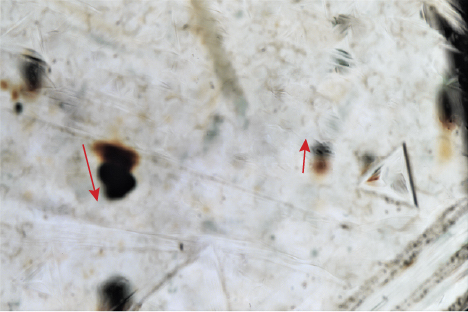
In this rough crystal, the stain pairs are on opposite sides and in opposite directions (figure 1). The shift must have occurred in the direction from brown to green, which means this crystal most likely rotated with respect to its environment. The other explanation is that the host material on either side shifted in opposite directions by roughly the same amount.
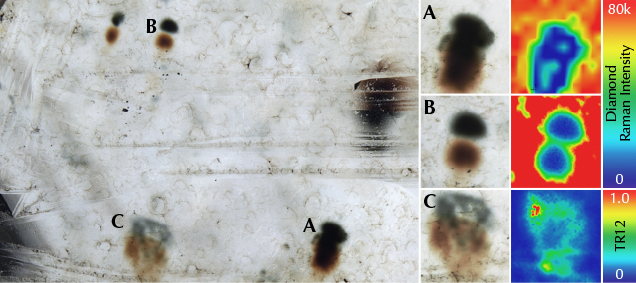
To examine the spectroscopic differences between the green and brown radiation stains, we collected photoluminescence (PL) maps using 532 and 455 nm excitation in confocal mode. We collected data on several of the radiation stains but will focus this discussion on three of them (figure 2). Figure 2A has dark, almost black coloration in the center with dark green and brown color around the periphery. Figure 2B shows green and brown radiation stains but with a colorless section between them, and figure 2C has very light radiation staining.
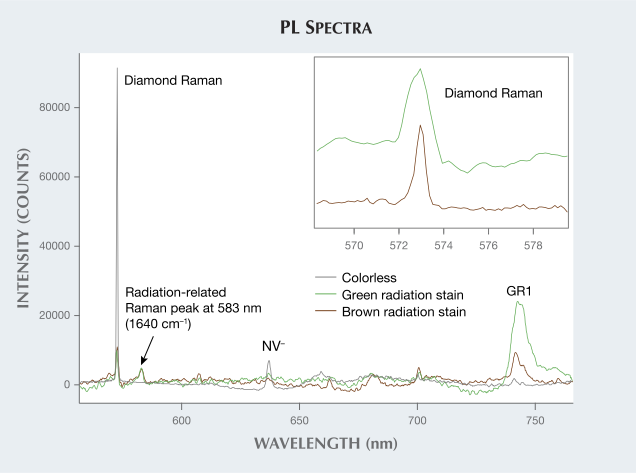
In the radiation stain imaged in figure 2A, the diamond Raman peak was quite broad and distorted within the radiation stain compared to the surrounding diamond (figure 3, inset). The broadened and distorted Raman peaks are indicators of the radiation damage brought upon these areas and are consistent with prior observations of other very dark radiation stains (e.g., S. Eaton-Magaña and K.S. Moe, “Temperature effects on radiation stains in natural diamonds,” Diamond and Related Materials, Vol. 64, 2016, pp. 130–142). The average Raman peak FWHM (full width at half maximum) within the green portion of the radiation stain was ~1.6 nm, while the average width within the brown portion of the radiation stain was ~1.1 nm. For comparison, the Raman width in the colorless sections was ~0.5 nm. The detected Raman intensity was also much lower than that of the surrounding colorless diamond (figures 2A and 3). Natural diamond and irradiation-related features such as TR12 (470 nm), H3 (503.2 nm), and NV– (637 nm) were not detected within this heavily damaged radiation stain. The GR1 peak was detected, though with higher intensity within the green radiation stain (figure 3).
In figure 2B, the PL map is consistent with the visual image and shows the area between the green and brown radiation stains approaching the features of the surrounding colorless diamond. Both figures 2B and 2C show indications of less radiation damage compared to figure 2A. The TR12, H3, and NV– features were detected in both the green and brown radiation stains, and the natural diamond features of H3 and NV– showed higher intensity in the brown. The GR1 and TR12 were slightly higher in the green radiation stains than in their brown counterparts and greater still than in the surrounding colorless diamond (figure 2C). For the radiation stains pictured in figures 2B and 2C, the diamond Raman widths were generally equivalent to those of the surrounding diamond. The PL maps also demonstrated that the boundary of the high GR1 intensity extended laterally ~30 μm beyond the colored radiation stain and into the surrounding colorless diamond; this is consistent with prior estimates of alpha radiation penetration (Eaton-Magaña and Moe, 2016).
In the radiation stains shown in figure 2, the brown portions of the radiation stains displayed features closer to the intrinsic diamond (lower diamond Raman width of the radiation stain shown in figure 2A and its corresponding spectra shown in figure 3, along with higher intensities of H3 and NV– of radiations stains shown in figures 2B and 2C; spectra not shown). These features suggest that the time and temperature that created the transition from green to brown as the diamond shifted to a new position also brought some “healing” from the localized radiation effects detected within the green radiation stains. This sample was interesting scientifically, as it allowed some direct comparison of radiation stain features created by the same point sources.
A rough diamond crystal weighing 4.05 ct was observed with radiation staining on its surface. Radiation staining is thought to occur when radioactive fluids or minerals are adjacent to a diamond crystal in the earth. The radiation imparts damage to the diamond lattice, leaving behind vacancies and interstitial carbon atoms. When initially formed, these stains are green or greenish in color. If they are subjected to heat, the stains will turn to a brownish color. This particular diamond had both green and brown radiation stains on the surface. Nearly all of the stains existed in pairs, one brown and one green, and were of the same shape. This has been reported previously (C.M. Breeding et al., “Natural-color green diamonds: A beautiful conundrum,” Spring 2018 G&G, pp. 2–27), and the proposed mechanism is that the diamond crystal is adjacent to a radioactive substance that imparts a green stain. When the diamond crystal is shifted slightly, the radioactive minerals create a new stain of the same shape but slightly displaced. The diamond was heated before the second set of stains had formed, which turned the initial set of stains brown.
In this rough crystal, the stain pairs are on opposite sides and in opposite directions (figure 1). The shift must have occurred in the direction from brown to green, which means this crystal most likely rotated with respect to its environment. The other explanation is that the host material on either side shifted in opposite directions by roughly the same amount.
To examine the spectroscopic differences between the green and brown radiation stains, we collected photoluminescence (PL) maps using 532 and 455 nm excitation in confocal mode. We collected data on several of the radiation stains but will focus this discussion on three of them (figure 2). Figure 2A has dark, almost black coloration in the center with dark green and brown color around the periphery. Figure 2B shows green and brown radiation stains but with a colorless section between them, and figure 2C has very light radiation staining.
In the radiation stain imaged in figure 2A, the diamond Raman peak was quite broad and distorted within the radiation stain compared to the surrounding diamond (figure 3, inset). The broadened and distorted Raman peaks are indicators of the radiation damage brought upon these areas and are consistent with prior observations of other very dark radiation stains (e.g., S. Eaton-Magaña and K.S. Moe, “Temperature effects on radiation stains in natural diamonds,” Diamond and Related Materials, Vol. 64, 2016, pp. 130–142). The average Raman peak FWHM (full width at half maximum) within the green portion of the radiation stain was ~1.6 nm, while the average width within the brown portion of the radiation stain was ~1.1 nm. For comparison, the Raman width in the colorless sections was ~0.5 nm. The detected Raman intensity was also much lower than that of the surrounding colorless diamond (figures 2A and 3). Natural diamond and irradiation-related features such as TR12 (470 nm), H3 (503.2 nm), and NV– (637 nm) were not detected within this heavily damaged radiation stain. The GR1 peak was detected, though with higher intensity within the green radiation stain (figure 3).
In figure 2B, the PL map is consistent with the visual image and shows the area between the green and brown radiation stains approaching the features of the surrounding colorless diamond. Both figures 2B and 2C show indications of less radiation damage compared to figure 2A. The TR12, H3, and NV– features were detected in both the green and brown radiation stains, and the natural diamond features of H3 and NV– showed higher intensity in the brown. The GR1 and TR12 were slightly higher in the green radiation stains than in their brown counterparts and greater still than in the surrounding colorless diamond (figure 2C). For the radiation stains pictured in figures 2B and 2C, the diamond Raman widths were generally equivalent to those of the surrounding diamond. The PL maps also demonstrated that the boundary of the high GR1 intensity extended laterally ~30 μm beyond the colored radiation stain and into the surrounding colorless diamond; this is consistent with prior estimates of alpha radiation penetration (Eaton-Magaña and Moe, 2016).
In the radiation stains shown in figure 2, the brown portions of the radiation stains displayed features closer to the intrinsic diamond (lower diamond Raman width of the radiation stain shown in figure 2A and its corresponding spectra shown in figure 3, along with higher intensities of H3 and NV– of radiations stains shown in figures 2B and 2C; spectra not shown). These features suggest that the time and temperature that created the transition from green to brown as the diamond shifted to a new position also brought some “healing” from the localized radiation effects detected within the green radiation stains. This sample was interesting scientifically, as it allowed some direct comparison of radiation stain features created by the same point sources.