

The Carlsbad laboratory recently examined a 1.03 ct natural Fancy Dark brown diamond with uneven color zoning and abundant black inclusions (figure 1). The diamond had infrared absorption features at 2370 and 659 cm–1, corresponding to the asymmetric stretching mode and bending mode of carbon dioxide, respectively (E. Barannik et al., “Shift of CO2-I absorption bands in diamond: A pressure or compositional effect? A FTIR mapping study,” Diamond and Related Materials, Vol. 113, 2021, article no. 108280). Diamonds containing carbon dioxide are rarely submitted for diamond grading reports, and this brown diamond is one of the few GIA has encountered. Carbon dioxide likely exists as submicroscopic solid inclusions in natural diamond (M. Schrauder and O. Navon, “Solid carbon dioxide in a natural diamond,” Nature, Vol. 365, 1993, pp. 42–44). The major infrared absorption peaks observed are shifted from the peak positions of atmospheric carbon dioxide (2350 and 667 cm–1), and the peak shift depends on pressure and the presence of impurities such as water and nitrogen in the trapped carbon dioxide inclusions (Barannik et al., 2021).
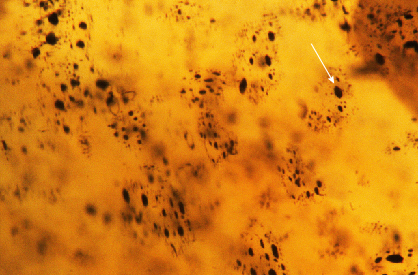
Carbonate-related absorptions at 1433 and 870 cm–1 were also detected. These absorptions have previously been reported in some natural diamonds containing solid carbon dioxide inclusions (e.g., Summer 2005 Lab Notes, pp. 165–167; Barannik et al., 2021). Clusters of black hexagonal inclusions were observed in the diamond (figure 2), and the individual inclusions ranged in size from <1 to ~50 μm. Similar inclusions have been documented in some carbon dioxide–bearing natural diamonds and identified as graphite platelets (A. Shiryaev et al., “Exsolution of oxygen impurity from diamond lattice and formation of pressurized CO2-I precipitates,” Carbon Trends, Vol. 11, 2023, article no. 100270).
This brown diamond containing carbon dioxide displayed yellow fluorescence when exposed to long-wave UV. When exposed to deep UV (<230 nm), the diamond exhibited irregular surface fluorescence zoning with yellowish green, bright green, and blue colors caused by distinct lattice defects. The yellow fluorescence to long-wave UV, heterogeneous distribution of lattice defects, and irregular surface fluorescence zoning under deep-UV excitation are commonly observed in diamonds colored by the 480 nm absorption band (known as “480 nm band diamonds” in the trade; C.M. Breeding et al., “Naturally colored yellow and orange gem diamonds: The nitrogen factor,” Summer 2020 G&G, pp. 194–219). In fact, the photoluminescence (PL) spectra of this brown diamond closely resembled those of 480 nm band diamonds. The most notable PL feature detected was the broad band centered at ~680 nm, which is attributed to the vibronic emission associated with the 480 nm absorption band (A. Collins and K. Mohammed, “Optical studies of vibronic bands in yellow luminescing natural diamonds,” Journal of Physics C: Solid State Physics, Vol. 15, 1982, pp. 147–158). The similarity in spectroscopic features between carbon dioxide–bearing brown diamonds and 480 nm band diamonds has been previously reported, and a genetic relationship between the two has been suggested (T. Hainschwang et al., “HPHT treatment of CO2 containing and CO2-related brown diamonds,” Diamond and Related Materials, Vol. 17, 2008, pp. 340–351).
Mei Yan Lai is a postdoctoral research associate, and Virginia Schwartz is supervisor of diamond identification, at GIA in Carlsbad, California.
The Carlsbad laboratory recently examined a 1.03 ct natural Fancy Dark brown diamond with uneven color zoning and abundant black inclusions (figure 1). The diamond had infrared absorption features at 2370 and 659 cm–1, corresponding to the asymmetric stretching mode and bending mode of carbon dioxide, respectively (E. Barannik et al., “Shift of CO2-I absorption bands in diamond: A pressure or compositional effect? A FTIR mapping study,” Diamond and Related Materials, Vol. 113, 2021, article no. 108280). Diamonds containing carbon dioxide are rarely submitted for diamond grading reports, and this brown diamond is one of the few GIA has encountered. Carbon dioxide likely exists as submicroscopic solid inclusions in natural diamond (M. Schrauder and O. Navon, “Solid carbon dioxide in a natural diamond,” Nature, Vol. 365, 1993, pp. 42–44). The major infrared absorption peaks observed are shifted from the peak positions of atmospheric carbon dioxide (2350 and 667 cm–1), and the peak shift depends on pressure and the presence of impurities such as water and nitrogen in the trapped carbon dioxide inclusions (Barannik et al., 2021).
Carbonate-related absorptions at 1433 and 870 cm–1 were also detected. These absorptions have previously been reported in some natural diamonds containing solid carbon dioxide inclusions (e.g., Summer 2005 Lab Notes, pp. 165–167; Barannik et al., 2021). Clusters of black hexagonal inclusions were observed in the diamond (figure 2), and the individual inclusions ranged in size from <1 to ~50 μm. Similar inclusions have been documented in some carbon dioxide–bearing natural diamonds and identified as graphite platelets (A. Shiryaev et al., “Exsolution of oxygen impurity from diamond lattice and formation of pressurized CO2-I precipitates,” Carbon Trends, Vol. 11, 2023, article no. 100270).
This brown diamond containing carbon dioxide displayed yellow fluorescence when exposed to long-wave UV. When exposed to deep UV (<230 nm), the diamond exhibited irregular surface fluorescence zoning with yellowish green, bright green, and blue colors caused by distinct lattice defects. The yellow fluorescence to long-wave UV, heterogeneous distribution of lattice defects, and irregular surface fluorescence zoning under deep-UV excitation are commonly observed in diamonds colored by the 480 nm absorption band (known as “480 nm band diamonds” in the trade; C.M. Breeding et al., “Naturally colored yellow and orange gem diamonds: The nitrogen factor,” Summer 2020 G&G, pp. 194–219). In fact, the photoluminescence (PL) spectra of this brown diamond closely resembled those of 480 nm band diamonds. The most notable PL feature detected was the broad band centered at ~680 nm, which is attributed to the vibronic emission associated with the 480 nm absorption band (A. Collins and K. Mohammed, “Optical studies of vibronic bands in yellow luminescing natural diamonds,” Journal of Physics C: Solid State Physics, Vol. 15, 1982, pp. 147–158). The similarity in spectroscopic features between carbon dioxide–bearing brown diamonds and 480 nm band diamonds has been previously reported, and a genetic relationship between the two has been suggested (T. Hainschwang et al., “HPHT treatment of CO2 containing and CO2-related brown diamonds,” Diamond and Related Materials, Vol. 17, 2008, pp. 340–351).
Mei Yan Lai is a postdoctoral research associate, and Virginia Schwartz is supervisor of diamond identification, at GIA in Carlsbad, California.