
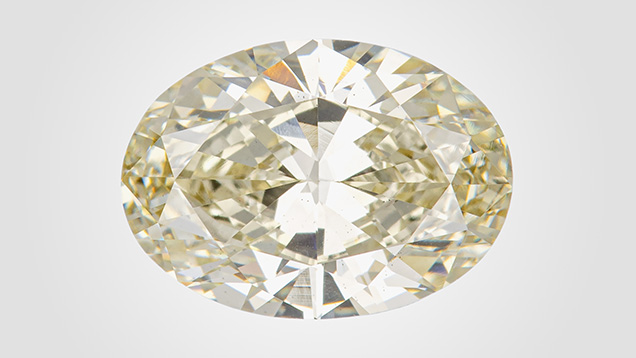
Recently, the Carlsbad laboratory received a fancy-color diamond grown by chemical vapor deposition (CVD) for a grading report. The 3.07 ct oval brilliant received a color grade of Fancy Light brownish greenish yellow (figure 1) and a clarity grade of VS1 due to the presence of some graphitic pinpoints. The photoluminescence (PL) spectra and DiamondView fluorescence imaging confirmed a CVD origin and post-growth high-pressure, high-temperature (HPHT) treatment.
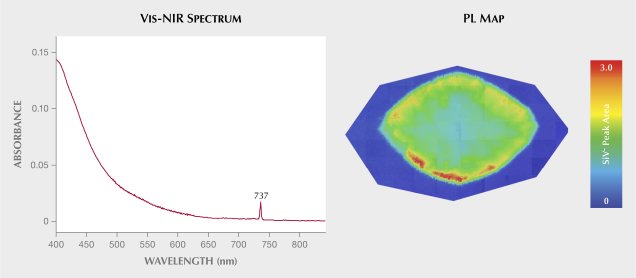
The CVD-grown diamond’s infrared absorption spectrum showed a weak 1344 cm–1 peak with an isolated nitrogen concentration of ~2 ppm. The visible/near-infrared (Vis-NIR) absorption spectrum shows a featureless absorption rise within the blue wavelengths due to the isolated nitrogen (figure 2, left). This is the primary cause of the yellow color. The CVD-grown diamond had been HPHT-treated, which is often used with the intention of removing brownish coloration; nevertheless, the color grade does include a brownish modifier. Although we do not know the color of the CVD diamond before HPHT processing, this treatment can enhance yellow coloration in natural diamonds by increasing the single substitutional nitrogen concentration (D. Fisher and R.A. Spits, “Spectroscopic evidence of GE POL HPHT-treated natural type IIa diamonds,” Spring 2000 G&G, pp. 42–49). Interestingly, this diamond also contains a greenish modifier which is ascribed as likely due to the absorption of SiV– centers at 737 nm. This absorption within the red portion of the visible spectrum and flanked by nitrogen-related absorption in the blue region created a transmission window within the green that, while subtle, was sufficient to create a detectable greenish color component. PL mapping using 633 nm excitation (figure 2, right) shows a very strong intensity of SiV– on the majority of the table facet area.
Previously, green color contributions in CVD-grown diamonds have been due to post-growth irradiation to form the GR1 center with its zero-phonon line at 741.2 nm (e.g., Summer 2018 Lab Notes, pp. 215–216). GIA has examined CVD-grown diamonds colored by much stronger absorption of SiV– centers, but those samples lacked isolated nitrogen absorption and often resulted in colors from pink to brown (S. Eaton-Magaña et al., “Laboratory-grown diamonds: An update on identification and products evaluated at GIA,” Summer 2024 G&G, pp. 146–167). An internal GIA database search indicated that this was likely the first submitted CVD-grown diamond in which a green color contribution could be attributed to SiV– at 737 nm instead of GR1 at 741.2 nm.
Recently, the Carlsbad laboratory received a fancy-color diamond grown by chemical vapor deposition (CVD) for a grading report. The 3.07 ct oval brilliant received a color grade of Fancy Light brownish greenish yellow (figure 1) and a clarity grade of VS1 due to the presence of some graphitic pinpoints. The photoluminescence (PL) spectra and DiamondView fluorescence imaging confirmed a CVD origin and post-growth high-pressure, high-temperature (HPHT) treatment.
The CVD-grown diamond’s infrared absorption spectrum showed a weak 1344 cm–1 peak with an isolated nitrogen concentration of ~2 ppm. The visible/near-infrared (Vis-NIR) absorption spectrum shows a featureless absorption rise within the blue wavelengths due to the isolated nitrogen (figure 2, left). This is the primary cause of the yellow color. The CVD-grown diamond had been HPHT-treated, which is often used with the intention of removing brownish coloration; nevertheless, the color grade does include a brownish modifier. Although we do not know the color of the CVD diamond before HPHT processing, this treatment can enhance yellow coloration in natural diamonds by increasing the single substitutional nitrogen concentration (D. Fisher and R.A. Spits, “Spectroscopic evidence of GE POL HPHT-treated natural type IIa diamonds,” Spring 2000 G&G, pp. 42–49). Interestingly, this diamond also contains a greenish modifier which is ascribed as likely due to the absorption of SiV– centers at 737 nm. This absorption within the red portion of the visible spectrum and flanked by nitrogen-related absorption in the blue region created a transmission window within the green that, while subtle, was sufficient to create a detectable greenish color component. PL mapping using 633 nm excitation (figure 2, right) shows a very strong intensity of SiV– on the majority of the table facet area.
Previously, green color contributions in CVD-grown diamonds have been due to post-growth irradiation to form the GR1 center with its zero-phonon line at 741.2 nm (e.g., Summer 2018 Lab Notes, pp. 215–216). GIA has examined CVD-grown diamonds colored by much stronger absorption of SiV– centers, but those samples lacked isolated nitrogen absorption and often resulted in colors from pink to brown (S. Eaton-Magaña et al., “Laboratory-grown diamonds: An update on identification and products evaluated at GIA,” Summer 2024 G&G, pp. 146–167). An internal GIA database search indicated that this was likely the first submitted CVD-grown diamond in which a green color contribution could be attributed to SiV– at 737 nm instead of GR1 at 741.2 nm.