
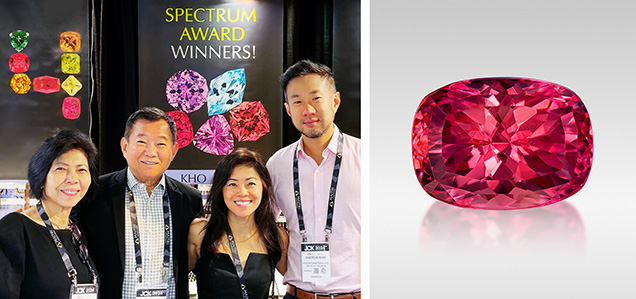
During the 2025 Tucson AGTA GemFair, a 12.88 ct Portuguese cushion-cut rhodochrosite from Colorado won the 2024 Cutting Edge Buyer’s Choice Award. This vibrant red gem is a testament to both the cutter’s skill and perseverance (figure 1). Rhodochrosite is notoriously difficult to cut because it is a soft material with perfect cleavage in three directions, heat sensitive, and rarely facet grade. Why cut such a difficult stone for a competition? The story of gem cutter Ben Kho (Ben Kho Gems, Decatur, Georgia), a man who has persevered throughout his life in the face of adversity, may help explain this choice.
Kho’s extraordinary story began in the 1960s. Growing up in Battambang, Cambodia, Kho demonstrated an entrepreneurial spirit at a young age. At 11 years old, he set up a stand and rented comic books and magazines to people waiting at theaters and outdoor markets. At 12, he took trains to the Cambodia-Thailand border to buy Thai goods to wholesale in Cambodia. At 14, he lived with a Burmese family in Pailin, where he packaged and transported heavy loads of rambutan fruit back to Battambang for his parents to wholesale to vendors.
In Pailin, Kho heard tales of large ruby and sapphire rough found in nearby mines and dreamed of mining them himself, with hopes of making a big discovery. When the rambutan harvest season was over, he and a friend bought a 6 × 3 m parcel of land. They would dig down about 2 meters and carry the dirt to the river for sifting using a shoulder pole and two rice bags. This difficult work was much harder when water entered their plot, making the dirt even heavier to dig out and carry. The process of sifting through the transported dirt at the river’s edge was extremely labor-intensive, as the few dense corundum pieces were inevitably at the bottoms of their baskets. After a year, they had found only very small crystals, worth less than what they had paid for the land.
Realizing that his mining efforts were not yielding significant discoveries, Kho decided to pursue gem cutting. The family he was staying with had a friend who ran a small lapidary operation behind his house with six employees. At 15, Kho spent three months as an apprentice and learned to facet gems by hand. After becoming proficient, he was paid by the carat. He aspired to be a gem cutter as well as a wholesaler of the cut gems. After a year, he had made enough money to start purchasing rough from the miners. He invested in a moped and drove to the mines near the end of each workday to buy the rough found that day. During this time, he honed his skills of rough selection and orientation to maximize face-up color. He would then preform the rough to properly position the color at the bottoms of the stones.
Knowing how to cut gems meant that Kho knew the desirable qualities of rough and its value. He became a confident buyer of stones and a keen negotiator. He would cut and polish groups of 10–20 gems and visit the opulent homes of the gem wholesaler “big bosses” to see how much riel (the Cambodian currency) they would offer for his collection. His stones then went to Bangkok’s gem market for purchase by international buyers.
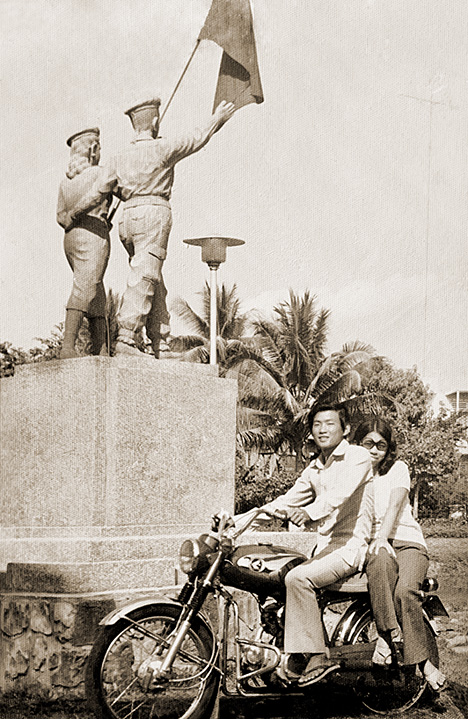
Kho spent four years building his business, until the devastation of the Khmer Rouge regime takeover displaced him and his wife, Molly, (figure 2) and their families and friends to the jungle in 1975, during the mass genocide of Cambodians known as “the Killing Fields.”
Kho and his family and friends were forced to work in the rice fields under the supervision of armed Communists. The goal was to survive without being noticed. Each worker was allowed only a small bowl of rice a day. The drinking water was dirty, and many people became sick or starved to death. There was no medicine. People caught and ate frogs, snakes, and insects in the fields to get enough protein to stay alive. For Kho, the worst feeling of all was trying to go to sleep while extraordinarily hungry. For shelter, they built huts, and for sleeping, they made hammocks from rice bags and sticks.
Kho recalled gazing up at the moon after an exhausting day of hard labor. Somewhere in the world, someone living in freedom is looking up at this same moon, he thought. This gave him some small hope that he would survive this nightmare and one day provide a better life for his family.
In 1979, Kho and his family heard bombing. Instead of fear, they felt hope that finally this oppressive regime would be defeated, and their torture would be over. Indeed, Vietnam had invaded and taken over Cambodia. He and his family went back to Battambang, but they were not allowed to return to their home and were once again forced to build their shelter, a hut of leaves and sticks. Many Cambodians escaped to Thailand during this time, and Kho and his parents, wife, baby girl, six brothers, and two sisters decided to do the same. They walked for three days and nights to the border and encountered many dangers, including land mines and aggressive thieves.
At the border, the Thai government blocked them and thousands of other refugees. Soldiers rounded them up, drove them a couple of hours away, and left them in the jungle. There was no food or shelter, and again they had to build their own huts, forage for food, drink dirty water, and fend off mosquitoes carrying malaria.
After several months, the United Nations offered to take refugees to countries such as Australia, Germany, and the United States. Kho’s family was taken to a refugee camp, where they were each given a can of rice per day. They chose to relocate to the United States without speaking any English. Kho was willing to work any job as long as he and his family could get three meals a day. On October 2, 1979, sponsored by the Covenant Presbyterian Church, they left Thailand for Atlanta, Georgia. Kho’s family lived in a house on the church property for a couple of years.
Based on Kho’s background as a gem cutter, he was introduced to Tim Roark of Tim Roark Imports, who needed a cutter for his wholesale gemstone business. Roark introduced Kho to another cutter, Mark Songer, who spent a month training Kho to use a Facetron. In December 1979, Kho went to work for Roark. Between Roark’s business and the government, he made US$3 per hour. Over the next six years, he worked for Roark for 14–16 hours a day, helping him build the business. During this time, he learned how to cut a large variety of gem materials and honed his craft. His passion was growing, and he appreciated the great beauty of the gems he was creating. In 1987, he wanted to start his own business and gave three months’ notice, with a promise to train anyone before leaving.
Kho launched his business in the basement of the home he had purchased with his brother. His reputation as an exceptional cutter had begun to spread, and dealers started asking him to cut their stones. Soon he was cutting for many large companies as well. By 1990, Kho was buying rough and going to several gem shows, with vendors from different countries—Nigeria, Brazil, Sri Lanka, and Thailand. He had a keen eye for quality material. He purchased large parcels so he could cut the stones and sell them wholesale to big companies. Kho also learned how to make jewelry and set stones, eventually selling both jewelry and gemstones on consignment to Atlanta’s many jewelry stores.
In 1990, Kho started selling gems at the Holidome show in Tucson, Arizona. Around that time, he met award-winning gem cutter and dealer Bill Day, who introduced him to the AGTA Spectrum and Cutting Edge Award competitions. After receiving his first award for an 8.68 ct fantasy cushion-cut sphalerite in 1995, he applied for AGTA membership and in 1996 obtained a small booth at the show. Today, the business is still family-owned and operated. Kho and Molly run the gem shows with their daughter, Angela, who designs jewelry; their son, Andrew, who manages the website and social media; and other family members, who run the Decatur office.
Kho’s prowess as one of the world’s best cutters of difficult stones has given him unique access to rare material. He began cutting rhodochrosite in 1992, after being introduced to the owner of Colorado’s Sweet Home mine. He loved the challenge of cutting such a difficult material and has been dubbed the “Rhodochrosite King.” In 2005, he was sought out by the owner of the benitoite mine in California to cut a newly discovered large benitoite rough. The result was a magnificent 8.05 ct oval, the third-largest faceted benitoite in the world.
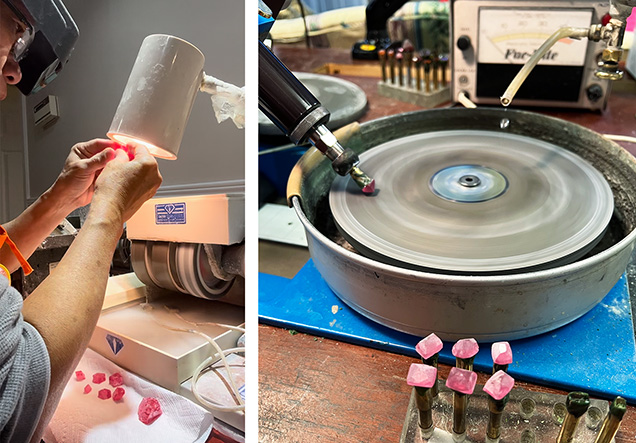
Kho described his process for cutting a stone for a competition: he takes several days to study the rough for inspiration for a cutting design, designs the cut, and then practices on a lower-quality piece of rough (figure 3).
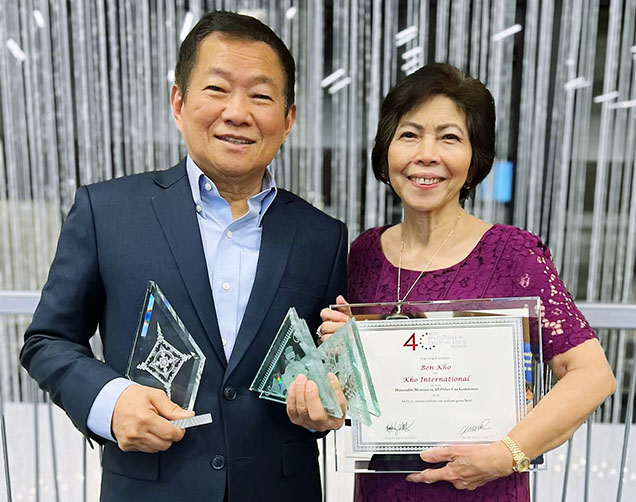
Since 1995, Kho has won more than 30 AGTA Cutting Edge Awards (figure 4). Kho achieved a clean sweep in the 2022 AGTA Cutting Edge All Other Cut Gemstones category—an honor recognizing exceptional lapidary artistry and mastery featuring traditional gemstone cutting techniques. In Tucson this year, his three winning entries from the 2024 competition were on display: the rhodochrosite, which won both the Buyer’s Choice Award and second place in the North American Mined Gemstones category; a 109.92 ct trilliant-cut bright bluish green fluorite from New Hampshire, the third-place winner in the same category; and a 50.52 ct custom cushion-cut seafoam green beryl, an honorable mention in the All Other Cut Gemstones category (see photo gallery).
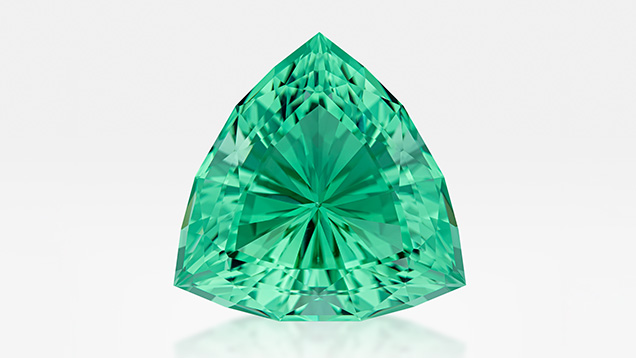
Ben Kho, an unassuming man with a kindly smile, has all the ingredients for success: great talent, a strong work ethic, an entrepreneurial spirit, and the ability to overcome seemingly insurmountable challenges. He is deeply grateful to live in the U.S. and for the opportunities it has brought him. With the freedom to pursue his passion, he has built a thriving business and created a brighter future for his family.
At the AGTA shows, one can find exquisite examples of his masterfully cut fine gems, both loose and set in jewelry. His booth is filled with a constant flow of repeat customers and old friends coming by to say hello and make their annual purchases, and newcomers attracted by the array of color fortunate enough to meet this one-of-a-kind gem cutter.
During the 2025 Tucson AGTA GemFair, a 12.88 ct Portuguese cushion-cut rhodochrosite from Colorado won the 2024 Cutting Edge Buyer’s Choice Award. This vibrant red gem is a testament to both the cutter’s skill and perseverance (figure 1). Rhodochrosite is notoriously difficult to cut because it is a soft material with perfect cleavage in three directions, heat sensitive, and rarely facet grade. Why cut such a difficult stone for a competition? The story of gem cutter Ben Kho (Ben Kho Gems, Decatur, Georgia), a man who has persevered throughout his life in the face of adversity, may help explain this choice.
Kho’s extraordinary story began in the 1960s. Growing up in Battambang, Cambodia, Kho demonstrated an entrepreneurial spirit at a young age. At 11 years old, he set up a stand and rented comic books and magazines to people waiting at theaters and outdoor markets. At 12, he took trains to the Cambodia-Thailand border to buy Thai goods to wholesale in Cambodia. At 14, he lived with a Burmese family in Pailin, where he packaged and transported heavy loads of rambutan fruit back to Battambang for his parents to wholesale to vendors.
In Pailin, Kho heard tales of large ruby and sapphire rough found in nearby mines and dreamed of mining them himself, with hopes of making a big discovery. When the rambutan harvest season was over, he and a friend bought a 6 × 3 m parcel of land. They would dig down about 2 meters and carry the dirt to the river for sifting using a shoulder pole and two rice bags. This difficult work was much harder when water entered their plot, making the dirt even heavier to dig out and carry. The process of sifting through the transported dirt at the river’s edge was extremely labor-intensive, as the few dense corundum pieces were inevitably at the bottoms of their baskets. After a year, they had found only very small crystals, worth less than what they had paid for the land.
Realizing that his mining efforts were not yielding significant discoveries, Kho decided to pursue gem cutting. The family he was staying with had a friend who ran a small lapidary operation behind his house with six employees. At 15, Kho spent three months as an apprentice and learned to facet gems by hand. After becoming proficient, he was paid by the carat. He aspired to be a gem cutter as well as a wholesaler of the cut gems. After a year, he had made enough money to start purchasing rough from the miners. He invested in a moped and drove to the mines near the end of each workday to buy the rough found that day. During this time, he honed his skills of rough selection and orientation to maximize face-up color. He would then preform the rough to properly position the color at the bottoms of the stones.
Knowing how to cut gems meant that Kho knew the desirable qualities of rough and its value. He became a confident buyer of stones and a keen negotiator. He would cut and polish groups of 10–20 gems and visit the opulent homes of the gem wholesaler “big bosses” to see how much riel (the Cambodian currency) they would offer for his collection. His stones then went to Bangkok’s gem market for purchase by international buyers.
Kho spent four years building his business, until the devastation of the Khmer Rouge regime takeover displaced him and his wife, Molly, (figure 2) and their families and friends to the jungle in 1975, during the mass genocide of Cambodians known as “the Killing Fields.”
Kho and his family and friends were forced to work in the rice fields under the supervision of armed Communists. The goal was to survive without being noticed. Each worker was allowed only a small bowl of rice a day. The drinking water was dirty, and many people became sick or starved to death. There was no medicine. People caught and ate frogs, snakes, and insects in the fields to get enough protein to stay alive. For Kho, the worst feeling of all was trying to go to sleep while extraordinarily hungry. For shelter, they built huts, and for sleeping, they made hammocks from rice bags and sticks.
Kho recalled gazing up at the moon after an exhausting day of hard labor. Somewhere in the world, someone living in freedom is looking up at this same moon, he thought. This gave him some small hope that he would survive this nightmare and one day provide a better life for his family.
In 1979, Kho and his family heard bombing. Instead of fear, they felt hope that finally this oppressive regime would be defeated, and their torture would be over. Indeed, Vietnam had invaded and taken over Cambodia. He and his family went back to Battambang, but they were not allowed to return to their home and were once again forced to build their shelter, a hut of leaves and sticks. Many Cambodians escaped to Thailand during this time, and Kho and his parents, wife, baby girl, six brothers, and two sisters decided to do the same. They walked for three days and nights to the border and encountered many dangers, including land mines and aggressive thieves.
At the border, the Thai government blocked them and thousands of other refugees. Soldiers rounded them up, drove them a couple of hours away, and left them in the jungle. There was no food or shelter, and again they had to build their own huts, forage for food, drink dirty water, and fend off mosquitoes carrying malaria.
After several months, the United Nations offered to take refugees to countries such as Australia, Germany, and the United States. Kho’s family was taken to a refugee camp, where they were each given a can of rice per day. They chose to relocate to the United States without speaking any English. Kho was willing to work any job as long as he and his family could get three meals a day. On October 2, 1979, sponsored by the Covenant Presbyterian Church, they left Thailand for Atlanta, Georgia. Kho’s family lived in a house on the church property for a couple of years.
Based on Kho’s background as a gem cutter, he was introduced to Tim Roark of Tim Roark Imports, who needed a cutter for his wholesale gemstone business. Roark introduced Kho to another cutter, Mark Songer, who spent a month training Kho to use a Facetron. In December 1979, Kho went to work for Roark. Between Roark’s business and the government, he made US$3 per hour. Over the next six years, he worked for Roark for 14–16 hours a day, helping him build the business. During this time, he learned how to cut a large variety of gem materials and honed his craft. His passion was growing, and he appreciated the great beauty of the gems he was creating. In 1987, he wanted to start his own business and gave three months’ notice, with a promise to train anyone before leaving.
Kho launched his business in the basement of the home he had purchased with his brother. His reputation as an exceptional cutter had begun to spread, and dealers started asking him to cut their stones. Soon he was cutting for many large companies as well. By 1990, Kho was buying rough and going to several gem shows, with vendors from different countries—Nigeria, Brazil, Sri Lanka, and Thailand. He had a keen eye for quality material. He purchased large parcels so he could cut the stones and sell them wholesale to big companies. Kho also learned how to make jewelry and set stones, eventually selling both jewelry and gemstones on consignment to Atlanta’s many jewelry stores.
In 1990, Kho started selling gems at the Holidome show in Tucson, Arizona. Around that time, he met award-winning gem cutter and dealer Bill Day, who introduced him to the AGTA Spectrum and Cutting Edge Award competitions. After receiving his first award for an 8.68 ct fantasy cushion-cut sphalerite in 1995, he applied for AGTA membership and in 1996 obtained a small booth at the show. Today, the business is still family-owned and operated. Kho and Molly run the gem shows with their daughter, Angela, who designs jewelry; their son, Andrew, who manages the website and social media; and other family members, who run the Decatur office.
Kho’s prowess as one of the world’s best cutters of difficult stones has given him unique access to rare material. He began cutting rhodochrosite in 1992, after being introduced to the owner of Colorado’s Sweet Home mine. He loved the challenge of cutting such a difficult material and has been dubbed the “Rhodochrosite King.” In 2005, he was sought out by the owner of the benitoite mine in California to cut a newly discovered large benitoite rough. The result was a magnificent 8.05 ct oval, the third-largest faceted benitoite in the world.
Kho described his process for cutting a stone for a competition: he takes several days to study the rough for inspiration for a cutting design, designs the cut, and then practices on a lower-quality piece of rough (figure 3).
Since 1995, Kho has won more than 30 AGTA Cutting Edge Awards (figure 4). Kho achieved a clean sweep in the 2022 AGTA Cutting Edge All Other Cut Gemstones category—an honor recognizing exceptional lapidary artistry and mastery featuring traditional gemstone cutting techniques. In Tucson this year, his three winning entries from the 2024 competition were on display: the rhodochrosite, which won both the Buyer’s Choice Award and second place in the North American Mined Gemstones category; a 109.92 ct trilliant-cut bright bluish green fluorite from New Hampshire, the third-place winner in the same category; and a 50.52 ct custom cushion-cut seafoam green beryl, an honorable mention in the All Other Cut Gemstones category (see photo gallery).
Ben Kho, an unassuming man with a kindly smile, has all the ingredients for success: great talent, a strong work ethic, an entrepreneurial spirit, and the ability to overcome seemingly insurmountable challenges. He is deeply grateful to live in the U.S. and for the opportunities it has brought him. With the freedom to pursue his passion, he has built a thriving business and created a brighter future for his family.
At the AGTA shows, one can find exquisite examples of his masterfully cut fine gems, both loose and set in jewelry. His booth is filled with a constant flow of repeat customers and old friends coming by to say hello and make their annual purchases, and newcomers attracted by the array of color fortunate enough to meet this one-of-a-kind gem cutter.