
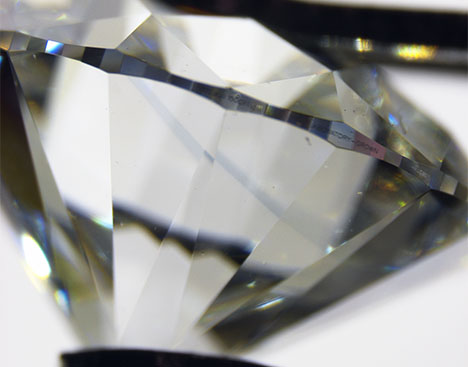
A 1.09 ct D-color diamond grown by chemical vapor deposition (CVD) was recently submitted to the Mumbai laboratory. This submission displayed an interesting blue band, seen through the pavilion facets (figure 1). The blue band could not be observed through the table facet. Infrared spectroscopy showed that it was type IIb with a bulk uncompensated boron concentration of ~10 ppb; the observed color was likely due to boron and a higher concentration of uncompensated boron within this blue growth layer.
Boron is present in only about 5% of CVD-grown diamonds, with the 2800 cm–1 infrared absorption band indicating the presence of uncompensated boron (S. Eaton-Magaña et al., “Laboratory-grown diamonds: An update on identification and products evaluated at GIA,” Summer 2024 G&G, pp. 146–167). However, the detected boron concentration is generally <20 ppb, too low to impart blue color. Additionally, thin layers of boron-doped CVD overgrowth on natural diamond have had a high enough concentration to impart a blue color appearance to the combined CVD/natural hybrid stone (e.g., Summer 2017 Lab Notes, pp. 237–239). Nevertheless, boron has not been a common cause of blue color in CVD-grown diamonds, unlike their HPHT-grown counterparts produced through high pressure and high temperature.
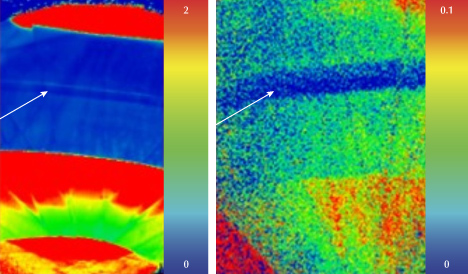
Besides boron impurities, the SiV0 center at 946 nm has been shown to create blue color in CVD diamonds (U.F.S. D’Haenens-Johansson et al., “CVD synthetic gem diamonds with high silicon-vacancy concentrations,” Conference on New Diamond and Nano Carbons, May 2015, Shizuoka, Japan). However, photoluminescence (PL) mapping indicated this region showed lower silicon (as SiV– at 737 nm), eliminating silicon as the likely cause of the blue color (figure 2, left).
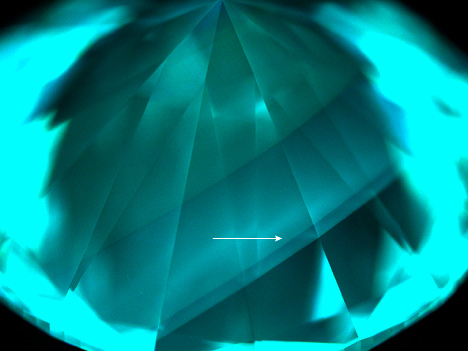
PL spectroscopy and DiamondView imaging (figure 3) established that this CVD-grown diamond had been subjected to post-growth HPHT annealing. Spectroscopic features supporting this conclusion include several sharp peaks in the 520–580 nm wavelength range (using 514 nm excitation) that develop in CVD-grown diamonds following HPHT treatment (W. Wang et al., “CVD synthetic diamonds from Gemesis Corp.,” Summer 2012 G&G, pp. 80–97). Pronounced greenish blue phosphorescence was also detected with DiamondView imaging.
No known boron-related features, such as the 648.2 nm peak (attributed to a boron interstitial), were detected by PL mapping using 455 and 532 nm laser excitation within the region corresponding to the blue band (figure 2, left). However, this lack of boron-related PL features is not surprising, as the 648.2 nm peak often does not develop unless the laboratory-grown diamond has been subjected to irradiation and subsequent annealing treatment (B.L. Green, “Optical and magnetic resonance studies of point defects in single crystal diamond,” PhD thesis, University of Warwick, 2013). PL mapping with 455 nm excitation (figure 2, right) did indicate that the region with the blue band showed a pronounced decrease in the H3 defect (NVN0). The thickness of this region with low nitrogen impurities was ~300 μm and corresponded with the blue-colored area.
When boron impurities are present but electrically compensated by other defects such as nitrogen, the 2800 cm–1 peak would be undetected or detected at lower concentrations. It is unclear whether this blue layer with a sufficiently high concentration of uncompensated boron to show color was intentionally created by the manufacturer or resulted from an accidental disruption of the standard growth recipe.
A 1.09 ct D-color diamond grown by chemical vapor deposition (CVD) was recently submitted to the Mumbai laboratory. This submission displayed an interesting blue band, seen through the pavilion facets (figure 1). The blue band could not be observed through the table facet. Infrared spectroscopy showed that it was type IIb with a bulk uncompensated boron concentration of ~10 ppb; the observed color was likely due to boron and a higher concentration of uncompensated boron within this blue growth layer.
Boron is present in only about 5% of CVD-grown diamonds, with the 2800 cm–1 infrared absorption band indicating the presence of uncompensated boron (S. Eaton-Magaña et al., “Laboratory-grown diamonds: An update on identification and products evaluated at GIA,” Summer 2024 G&G, pp. 146–167). However, the detected boron concentration is generally <20 ppb, too low to impart blue color. Additionally, thin layers of boron-doped CVD overgrowth on natural diamond have had a high enough concentration to impart a blue color appearance to the combined CVD/natural hybrid stone (e.g., Summer 2017 Lab Notes, pp. 237–239). Nevertheless, boron has not been a common cause of blue color in CVD-grown diamonds, unlike their HPHT-grown counterparts produced through high pressure and high temperature.
Besides boron impurities, the SiV0 center at 946 nm has been shown to create blue color in CVD diamonds (U.F.S. D’Haenens-Johansson et al., “CVD synthetic gem diamonds with high silicon-vacancy concentrations,” Conference on New Diamond and Nano Carbons, May 2015, Shizuoka, Japan). However, photoluminescence (PL) mapping indicated this region showed lower silicon (as SiV– at 737 nm), eliminating silicon as the likely cause of the blue color (figure 2, left).
PL spectroscopy and DiamondView imaging (figure 3) established that this CVD-grown diamond had been subjected to post-growth HPHT annealing. Spectroscopic features supporting this conclusion include several sharp peaks in the 520–580 nm wavelength range (using 514 nm excitation) that develop in CVD-grown diamonds following HPHT treatment (W. Wang et al., “CVD synthetic diamonds from Gemesis Corp.,” Summer 2012 G&G, pp. 80–97). Pronounced greenish blue phosphorescence was also detected with DiamondView imaging.
No known boron-related features, such as the 648.2 nm peak (attributed to a boron interstitial), were detected by PL mapping using 455 and 532 nm laser excitation within the region corresponding to the blue band (figure 2, left). However, this lack of boron-related PL features is not surprising, as the 648.2 nm peak often does not develop unless the laboratory-grown diamond has been subjected to irradiation and subsequent annealing treatment (B.L. Green, “Optical and magnetic resonance studies of point defects in single crystal diamond,” PhD thesis, University of Warwick, 2013). PL mapping with 455 nm excitation (figure 2, right) did indicate that the region with the blue band showed a pronounced decrease in the H3 defect (NVN0). The thickness of this region with low nitrogen impurities was ~300 μm and corresponded with the blue-colored area.
When boron impurities are present but electrically compensated by other defects such as nitrogen, the 2800 cm–1 peak would be undetected or detected at lower concentrations. It is unclear whether this blue layer with a sufficiently high concentration of uncompensated boron to show color was intentionally created by the manufacturer or resulted from an accidental disruption of the standard growth recipe.