

This year, phenomenal gems were very popular and selling well throughout the Tucson shows, illustrating the growing desire for one-of-a-kind stones. Phenomena such as asterism, schiller, play-of-color, and iridescence were on full display at all of the major shows. Vendors reported strong sales of fine asteriated gems such as star ruby and sapphire from Sri Lanka, Vietnam, and Myanmar; moonstone of all varieties, but particularly “rainbow moonstone” with orange flash and blue adularescence from Madagascar; sunstone with reddish gold schiller from Oregon and India; precious opal from all over the world; and a wide variety of labradorite.
These fascinating optical phenomena arise from many different sources, with the common theme being how light interacts with inclusions and/or the host material itself. Parallel needle inclusions aligned with crystallographic directions in crystals can yield attractive cat’s-eyes (figure 1) or stars when these stones are properly cut. Precious opal can show a rainbow of colors (play-of-color) when incoming light interacts with the host by being diffracted as it passes through the oriented silica spheres comprising the material. Many gems belonging to the feldspar group of minerals—including moonstone, sunstone, and labradorite—can exhibit iridescence related to light interacting with thin film structures or with platy particulate inclusions (R.J. Strutt, “Studies of iridescent colour, and the structure producing it. III.—The colours of labrador felspar,” Proceedings of the Royal Society London A, Vol. 103, No. 720, 1923, pp. 34–45).
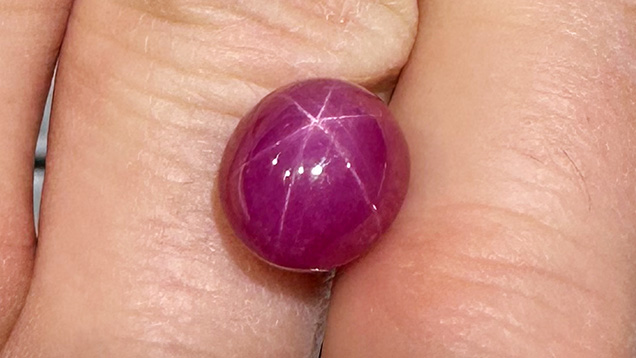
At the AGTA show, Eric Braunwart of Columbia Gem House (Vancouver, Washington) showed us a remarkable 13.2 ct star ruby from Vietnam in a brilliant purplish red (figure 2). His regard for the stone due to its exceptionally sharp star, rarity, and beauty was apparent. Reports from other vendors such as Dudley Blauwet with booths at multiple shows, indicated that star sapphire and star ruby were selling very well this year.
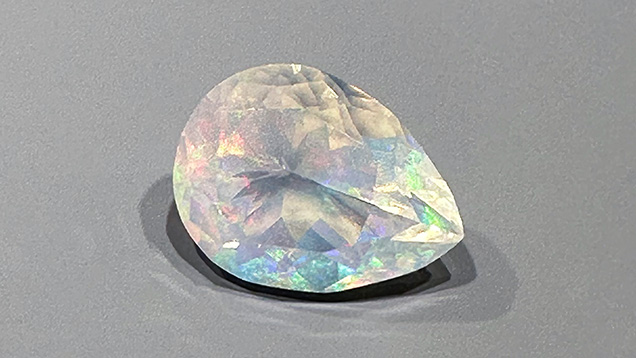
Opal has traditionally been one of the most popular phenomenal gems, and this year its presence was exceptionally strong. Remarkable examples with striking play-of-color from Australia, North America, and particularly Ethiopia were in high demand. This material ranges from opaque to transparent; its matrix color is generally white, gray, or black; and its play-of-color can assume many forms including pinprick-sized spots all the way up to large brush strokes (Spring 2025 Lab Notes, p. 64). Braunwart shared an exceptional faceted Mexican fire opal with high transparency and brilliant flashes of color spanning the entire rainbow (figure 3).
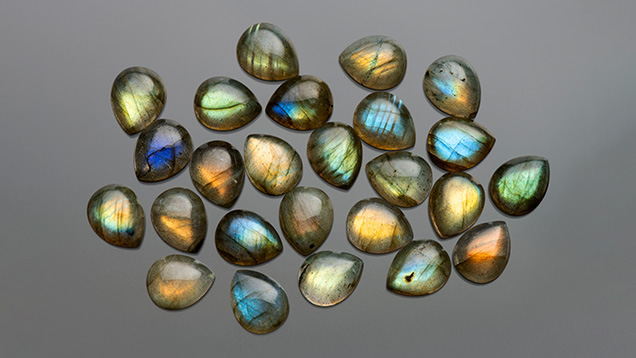
Labradorite, a relatively inexpensive plagioclase feldspar that has been used extensively as a high-end countertop material, was first recognized in Labrador, Canada, in 1770. It has since been identified in locations all over the world. Its iridescent effect, known as labradorescence, can display a wide range of iridescent colors including blue, green, yellow, orange, and violet (figure 4). Labradorite was offered in a wide range of qualities and price points at the shows this year. Several Idar-Oberstein cutters at GJX exhibited high-end labradorite carvings along with their tourmaline, beryl, peridot, amethyst, and agate carvings.
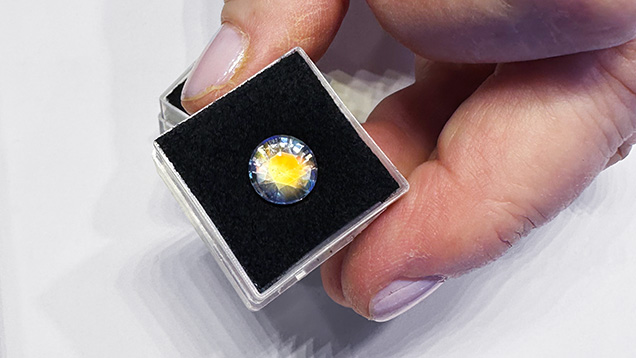
Highly transparent “rainbow moonstone” from Madagascar—a plagioclase feldspar confirmed to be of the labradorite variety, so therefore not a true moonstone—was one of this year’s hottest materials after making its debut last year (Spring 2024 GNI, p. 102). Several vendors at AGTA and GJX carried this material both faceted and en cabochon, with the faceted stones being slightly more popular. Many layouts and matched sets were on display in shapes ranging from rounds to hearts to hexagons. At AGTA, Mayer & Watt (Maysville, Kentucky) offered a wide selection of various cuts and sizes with strong yellow to orange flash and blue adularescence (figure 5).
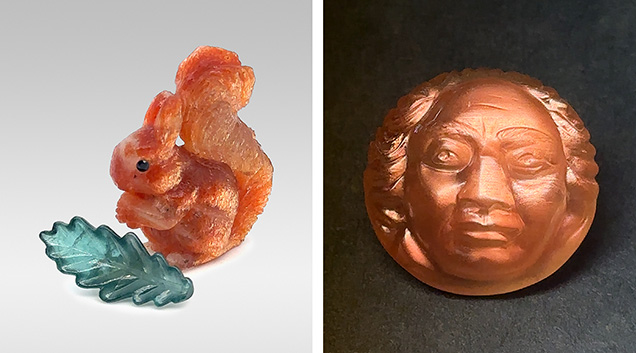
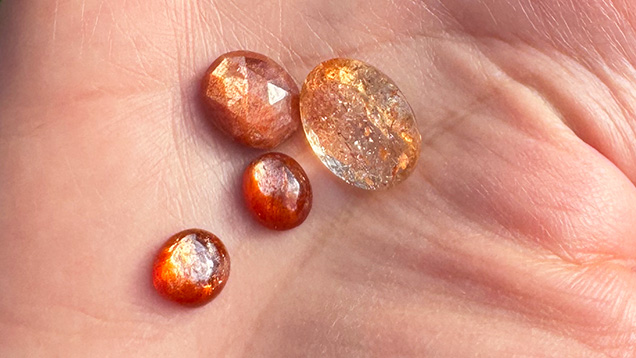
Sunstone, a gem known for its reddish golden metallic schiller, was available through more vendors and shows than in years past. Oregon sunstone, once a curiosity, is now a highly sought gem by many around the world. Oregon sunstone is a plagioclase feldspar colored by copper (S. Jin et al., “Special colors and optical effects of Oregon sunstone: Absorption, scattering, pleochroism, and color zoning,” Fall 2023 G&G, pp. 298–322). This unique gem has fine copper schiller that can take on many different appearances depending upon copper particle size. Other sunstones exhibit thin plates of reddish hematite schiller, such as those from India. Idar-Oberstein carver Hans-Ulrich “Uli” Pauly carves both Oregon sunstone and Indian sunstone into exquisite objets d’art, which were on display at the GJX show in the Idar-Oberstein Pavillion (figure 6). At the Holidome show, Sami Gems & Jewellers (Jaipur, India) offered sunstone from India. This material varied from densely included with high metallic luster and a rich reddish gold color to transparent (figure 7). The faceted transparent stone in figure 7 (top right) showed a faint bluish cast on two ends and a reddish golden cast on the other two, with a light scattering of metallic inclusions throughout. Suwalin Shamsi (“Sami”) indicated that the material comes from Madras (Chennai) in Tamil Nadu, a region in southern India known for farming.
Phenomenal gems always carry appeal, as they delight the observer and can inspire a desire to learn more about the science behind them. The availability of so many varieties provides the opportunity to appreciate the complex and diverse optical phenomena responsible for their captivating special effects.
This year, phenomenal gems were very popular and selling well throughout the Tucson shows, illustrating the growing desire for one-of-a-kind stones. Phenomena such as asterism, schiller, play-of-color, and iridescence were on full display at all of the major shows. Vendors reported strong sales of fine asteriated gems such as star ruby and sapphire from Sri Lanka, Vietnam, and Myanmar; moonstone of all varieties, but particularly “rainbow moonstone” with orange flash and blue adularescence from Madagascar; sunstone with reddish gold schiller from Oregon and India; precious opal from all over the world; and a wide variety of labradorite.
These fascinating optical phenomena arise from many different sources, with the common theme being how light interacts with inclusions and/or the host material itself. Parallel needle inclusions aligned with crystallographic directions in crystals can yield attractive cat’s-eyes (figure 1) or stars when these stones are properly cut. Precious opal can show a rainbow of colors (play-of-color) when incoming light interacts with the host by being diffracted as it passes through the oriented silica spheres comprising the material. Many gems belonging to the feldspar group of minerals—including moonstone, sunstone, and labradorite—can exhibit iridescence related to light interacting with thin film structures or with platy particulate inclusions (R.J. Strutt, “Studies of iridescent colour, and the structure producing it. III.—The colours of labrador felspar,” Proceedings of the Royal Society London A, Vol. 103, No. 720, 1923, pp. 34–45).
At the AGTA show, Eric Braunwart of Columbia Gem House (Vancouver, Washington) showed us a remarkable 13.2 ct star ruby from Vietnam in a brilliant purplish red (figure 2). His regard for the stone due to its exceptionally sharp star, rarity, and beauty was apparent. Reports from other vendors such as Dudley Blauwet with booths at multiple shows, indicated that star sapphire and star ruby were selling very well this year.
Opal has traditionally been one of the most popular phenomenal gems, and this year its presence was exceptionally strong. Remarkable examples with striking play-of-color from Australia, North America, and particularly Ethiopia were in high demand. This material ranges from opaque to transparent; its matrix color is generally white, gray, or black; and its play-of-color can assume many forms including pinprick-sized spots all the way up to large brush strokes (Spring 2025 Lab Notes, p. 64). Braunwart shared an exceptional faceted Mexican fire opal with high transparency and brilliant flashes of color spanning the entire rainbow (figure 3).
Labradorite, a relatively inexpensive plagioclase feldspar that has been used extensively as a high-end countertop material, was first recognized in Labrador, Canada, in 1770. It has since been identified in locations all over the world. Its iridescent effect, known as labradorescence, can display a wide range of iridescent colors including blue, green, yellow, orange, and violet (figure 4). Labradorite was offered in a wide range of qualities and price points at the shows this year. Several Idar-Oberstein cutters at GJX exhibited high-end labradorite carvings along with their tourmaline, beryl, peridot, amethyst, and agate carvings.
Highly transparent “rainbow moonstone” from Madagascar—a plagioclase feldspar confirmed to be of the labradorite variety, so therefore not a true moonstone—was one of this year’s hottest materials after making its debut last year (Spring 2024 GNI, p. 102). Several vendors at AGTA and GJX carried this material both faceted and en cabochon, with the faceted stones being slightly more popular. Many layouts and matched sets were on display in shapes ranging from rounds to hearts to hexagons. At AGTA, Mayer & Watt (Maysville, Kentucky) offered a wide selection of various cuts and sizes with strong yellow to orange flash and blue adularescence (figure 5).
Sunstone, a gem known for its reddish golden metallic schiller, was available through more vendors and shows than in years past. Oregon sunstone, once a curiosity, is now a highly sought gem by many around the world. Oregon sunstone is a plagioclase feldspar colored by copper (S. Jin et al., “Special colors and optical effects of Oregon sunstone: Absorption, scattering, pleochroism, and color zoning,” Fall 2023 G&G, pp. 298–322). This unique gem has fine copper schiller that can take on many different appearances depending upon copper particle size. Other sunstones exhibit thin plates of reddish hematite schiller, such as those from India. Idar-Oberstein carver Hans-Ulrich “Uli” Pauly carves both Oregon sunstone and Indian sunstone into exquisite objets d’art, which were on display at the GJX show in the Idar-Oberstein Pavillion (figure 6). At the Holidome show, Sami Gems & Jewellers (Jaipur, India) offered sunstone from India. This material varied from densely included with high metallic luster and a rich reddish gold color to transparent (figure 7). The faceted transparent stone in figure 7 (top right) showed a faint bluish cast on two ends and a reddish golden cast on the other two, with a light scattering of metallic inclusions throughout. Suwalin Shamsi (“Sami”) indicated that the material comes from Madras (Chennai) in Tamil Nadu, a region in southern India known for farming.
Phenomenal gems always carry appeal, as they delight the observer and can inspire a desire to learn more about the science behind them. The availability of so many varieties provides the opportunity to appreciate the complex and diverse optical phenomena responsible for their captivating special effects.