
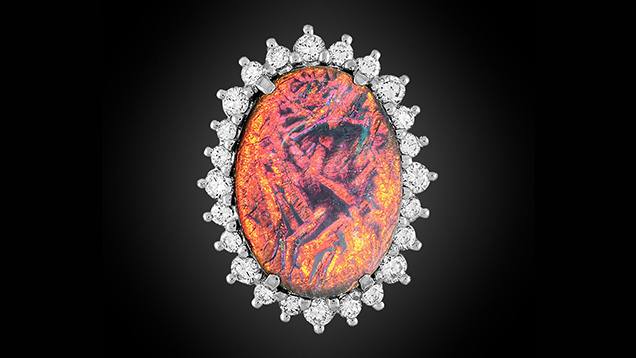
The Carlsbad laboratory recently examined a black oval cabochon displaying play-of-color, set in a white metal ring with 24 near-colorless round brilliants (figure 1). The stone measured approximately 19.56 × 14.28 × 3.00 mm. Standard gemological testing revealed a spot refractive index of 1.44, as well as weak blue long-wave fluorescence, very weak blue short-wave fluorescence, and weak green phosphorescence. These gemological properties were consistent with Australian black opal.
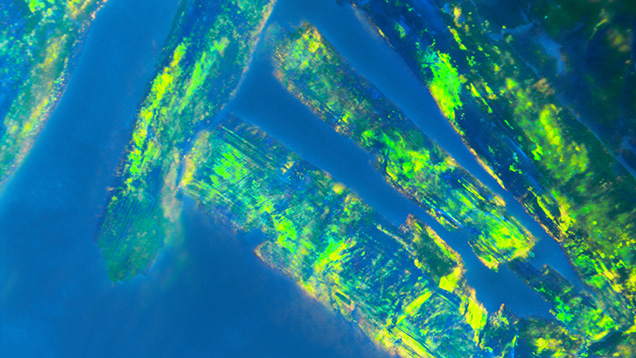
The visual impact of this opal was particularly striking, displaying vivid orange play-of-color when viewed face-up and brilliant flashes of green, blue, red, and yellow when gently rocked. The unique play-of-color pattern resembled broad, blocky brush strokes separated by areas of gray potch (figure 2). This array of iridescent colors was caused by light interacting with the silica spheres within the opal. However, the exact process behind the formation of such a distinct pattern is unknown, making this stone one of the more fascinating opals the author has encountered.
The Carlsbad laboratory recently examined a black oval cabochon displaying play-of-color, set in a white metal ring with 24 near-colorless round brilliants (figure 1). The stone measured approximately 19.56 × 14.28 × 3.00 mm. Standard gemological testing revealed a spot refractive index of 1.44, as well as weak blue long-wave fluorescence, very weak blue short-wave fluorescence, and weak green phosphorescence. These gemological properties were consistent with Australian black opal.
The visual impact of this opal was particularly striking, displaying vivid orange play-of-color when viewed face-up and brilliant flashes of green, blue, red, and yellow when gently rocked. The unique play-of-color pattern resembled broad, blocky brush strokes separated by areas of gray potch (figure 2). This array of iridescent colors was caused by light interacting with the silica spheres within the opal. However, the exact process behind the formation of such a distinct pattern is unknown, making this stone one of the more fascinating opals the author has encountered.