
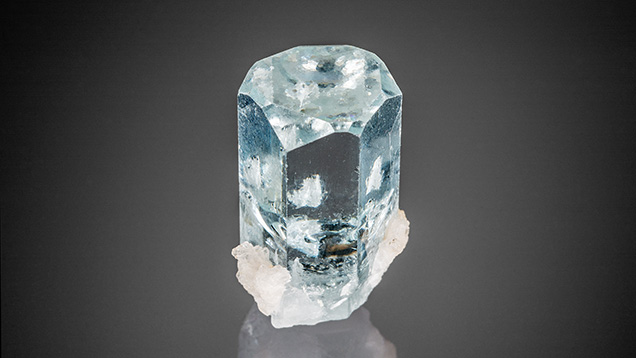
Whenever we study natural uncut gem minerals, we carefully examine all outer surfaces for any photogenic etch figures or growth hillocks that might yield interesting and educational photographs. For this issue’s Quarterly Crystal, we recently had the opportunity to study a very well-formed, gem-quality aquamarine crystal supplied by Ali Shad of Shad Fine Minerals in Gilgit-Baltistan, Pakistan. The aquamarine, pictured in figure 1, was reportedly from the Qandahar mine, located in the Braldu Valley, Shigar District, Gilgit-Baltistan, Pakistan.
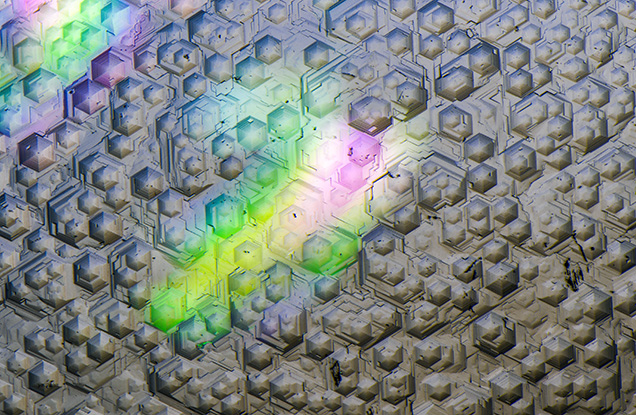
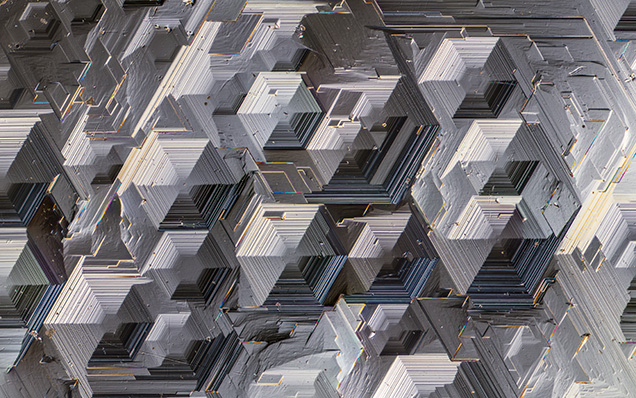
At 31.06 ct with corresponding measurements of 22.28 × 14.50 × 11.24 mm, this aquamarine did not show etch figures on any of its crystal faces, proving that the beryl had not gone through post-growth dissolution. However, examination showed that the pinacoid was completely covered with small hexagonal growth hillocks (figure 2) of the type discussed by John Sinkankas in Emerald and Other Beryls (1981) and illustrated on page 273. The hillocks on the terminal pinacoid, which were all generally of the same small size, blanketed the termination completely. Under high magnification, the hexagonal hillocks appeared very complex in form (figure 3). Their sharp, pristine, geometric habit once again illustrated that post-growth dissolution of this crystal had not taken place.
Whenever we study natural uncut gem minerals, we carefully examine all outer surfaces for any photogenic etch figures or growth hillocks that might yield interesting and educational photographs. For this issue’s Quarterly Crystal, we recently had the opportunity to study a very well-formed, gem-quality aquamarine crystal supplied by Ali Shad of Shad Fine Minerals in Gilgit-Baltistan, Pakistan. The aquamarine, pictured in figure 1, was reportedly from the Qandahar mine, located in the Braldu Valley, Shigar District, Gilgit-Baltistan, Pakistan.
At 31.06 ct with corresponding measurements of 22.28 × 14.50 × 11.24 mm, this aquamarine did not show etch figures on any of its crystal faces, proving that the beryl had not gone through post-growth dissolution. However, examination showed that the pinacoid was completely covered with small hexagonal growth hillocks (figure 2) of the type discussed by John Sinkankas in Emerald and Other Beryls (1981) and illustrated on page 273. The hillocks on the terminal pinacoid, which were all generally of the same small size, blanketed the termination completely. Under high magnification, the hexagonal hillocks appeared very complex in form (figure 3). Their sharp, pristine, geometric habit once again illustrated that post-growth dissolution of this crystal had not taken place.