
Barker & Co. (Scottsdale, Arizona) exhibited remarkable stones at this year’s AGTA show, including some extremely fine, rare gemstones for collectors. Two of their collector stones, colemanite and phosphophyllite, stood out for their record-breaking size.
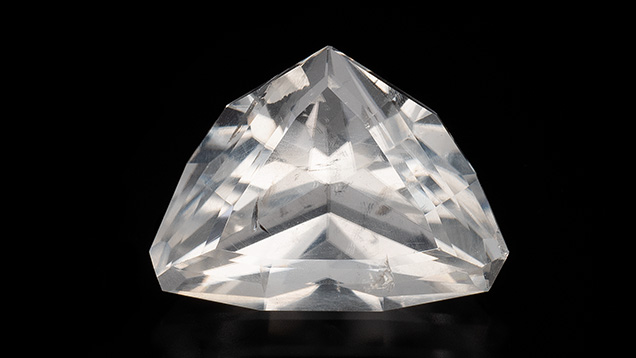
The colorless colemanite in figure 1, a modified triangular brilliant weighing 7.36 ct, is believed to be one of the largest faceted examples of its kind. Colemanite is known to fluoresce a strong yellow under ultraviolet light and phosphoresce green.
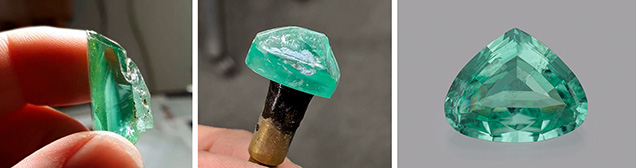
The strongly saturated bluish green hue of a 17.52 ct phosphophyllite echoed that of some of the finest hues of Paraíba tourmalines, though the stone is very different both structurally and chemically. Phosphophyllite was named in 1920 as a homage to its phosphate composition and perfect leaf-like cleavage (from the Greek phyllon, meaning “leaf”). Ann Barker of Barker & Co. explained that this particular phosphophyllite has a significant provenance. Once owned by author and renowned mineral collector Dr. Peter Bancroft, it was mined in the famed Potosí mine of Bolivia in 1958. Many years later, prize-winning gem cutter Stacy Whetstone took the striking 45.42 ct rough and expertly faceted the material into the finished 17.52 ct rounded trillion (figure 2). Given phosphophyllite’s considerable heat sensitivity, the gem took four weeks to cut and finish.
Colemanite and phosphophyllite, like other collector stones, are seldom faceted due to their low hardness (4.5 and 3–3.5, respectively) and durability issues. As collector stones, they hold a unique position in the gem and jewelry industry, valued for expanding private collections. In recent years, with the help of a little luck and a lot of talent, collector stones are being seen more in jewelry.
Barker & Co. (Scottsdale, Arizona) exhibited remarkable stones at this year’s AGTA show, including some extremely fine, rare gemstones for collectors. Two of their collector stones, colemanite and phosphophyllite, stood out for their record-breaking size.
The colorless colemanite in figure 1, a modified triangular brilliant weighing 7.36 ct, is believed to be one of the largest faceted examples of its kind. Colemanite is known to fluoresce a strong yellow under ultraviolet light and phosphoresce green.
The strongly saturated bluish green hue of a 17.52 ct phosphophyllite echoed that of some of the finest hues of Paraíba tourmalines, though the stone is very different both structurally and chemically. Phosphophyllite was named in 1920 as a homage to its phosphate composition and perfect leaf-like cleavage (from the Greek phyllon, meaning “leaf”). Ann Barker of Barker & Co. explained that this particular phosphophyllite has a significant provenance. Once owned by author and renowned mineral collector Dr. Peter Bancroft, it was mined in the famed Potosí mine of Bolivia in 1958. Many years later, prize-winning gem cutter Stacy Whetstone took the striking 45.42 ct rough and expertly faceted the material into the finished 17.52 ct rounded trillion (figure 2). Given phosphophyllite’s considerable heat sensitivity, the gem took four weeks to cut and finish.
Colemanite and phosphophyllite, like other collector stones, are seldom faceted due to their low hardness (4.5 and 3–3.5, respectively) and durability issues. As collector stones, they hold a unique position in the gem and jewelry industry, valued for expanding private collections. In recent years, with the help of a little luck and a lot of talent, collector stones are being seen more in jewelry.