
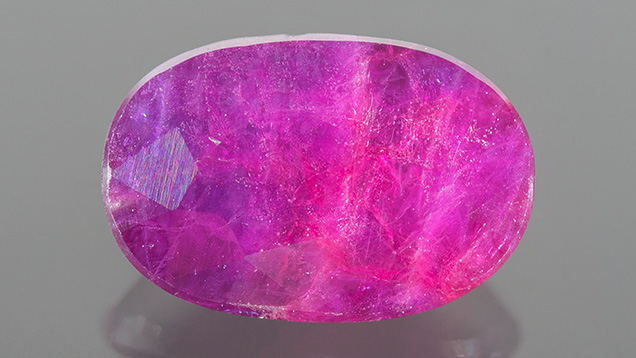
Recently the Carlsbad laboratory received a 4.12 ct purple-red stone measuring approximately 11.50 × 7.70 × 4.72 mm (figure 1) for identification services. It featured unusual veil-like reddish color zoning wafting throughout a purple bodycolor. The refractive index measured 1.760–1.770, identifying the stone as a ruby.
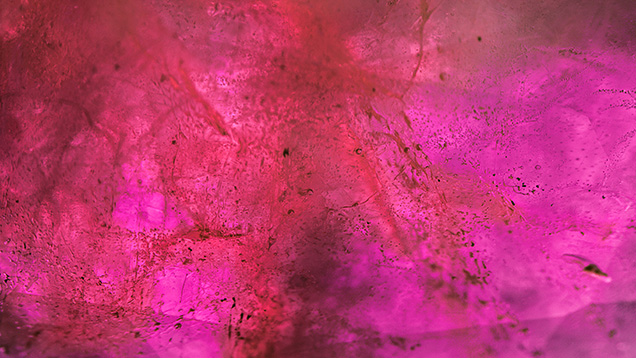
Microscopic examination indicated that the reddish color zoning was associated with altered fingerprints that resembled a cosmic nebula due to a flux-rich residue (figure 2). These fingerprints appeared to be consistent with fractures that had been healed using a flux-assisted heating process in a high-heat environment.
Due to the indications of high heat, laser ablation–inductively coupled plasma–mass spectrometry (LA-ICP-MS) chemical analysis was performed to check for the presence of beryllium diffusion. Initially, LA-ICP-MS conducted on two spots revealed beryllium concentrations of <0.019 ppma and 60.87 ppma. This significant discrepancy prompted additional LA-ICP-MS testing in three spots, revealing beryllium concentrations of <0.19 ppma, 1780 ppma, and <0.19 ppma. Microscopic observation of the testing spots showed areas of high beryllium on or near the reddish color zones, while areas of very low beryllium were associated with testing areas on the purple areas of the stone.
Therefore, it was concluded that a beryllium-rich flux was used to heal the fractures naturally present in the stone. The ruby was likely heated in this flux at temperatures high enough to allow the beryllium to seep from the flux into the stone, but not long enough for the beryllium to infiltrate its entirety.
Recently the Carlsbad laboratory received a 4.12 ct purple-red stone measuring approximately 11.50 × 7.70 × 4.72 mm (figure 1) for identification services. It featured unusual veil-like reddish color zoning wafting throughout a purple bodycolor. The refractive index measured 1.760–1.770, identifying the stone as a ruby.
Microscopic examination indicated that the reddish color zoning was associated with altered fingerprints that resembled a cosmic nebula due to a flux-rich residue (figure 2). These fingerprints appeared to be consistent with fractures that had been healed using a flux-assisted heating process in a high-heat environment.
Due to the indications of high heat, laser ablation–inductively coupled plasma–mass spectrometry (LA-ICP-MS) chemical analysis was performed to check for the presence of beryllium diffusion. Initially, LA-ICP-MS conducted on two spots revealed beryllium concentrations of <0.019 ppma and 60.87 ppma. This significant discrepancy prompted additional LA-ICP-MS testing in three spots, revealing beryllium concentrations of <0.19 ppma, 1780 ppma, and <0.19 ppma. Microscopic observation of the testing spots showed areas of high beryllium on or near the reddish color zones, while areas of very low beryllium were associated with testing areas on the purple areas of the stone.
Therefore, it was concluded that a beryllium-rich flux was used to heal the fractures naturally present in the stone. The ruby was likely heated in this flux at temperatures high enough to allow the beryllium to seep from the flux into the stone, but not long enough for the beryllium to infiltrate its entirety.