
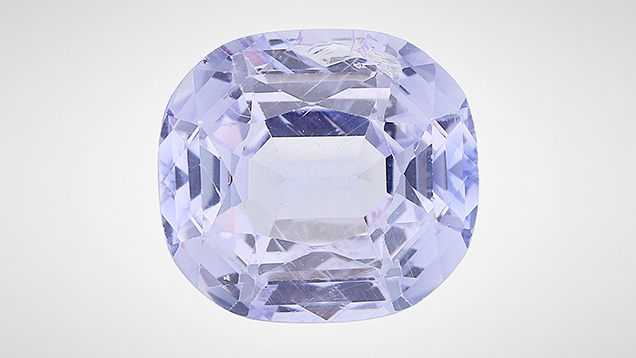
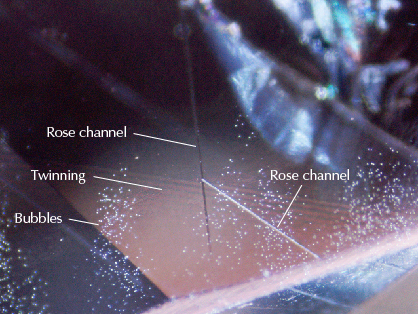
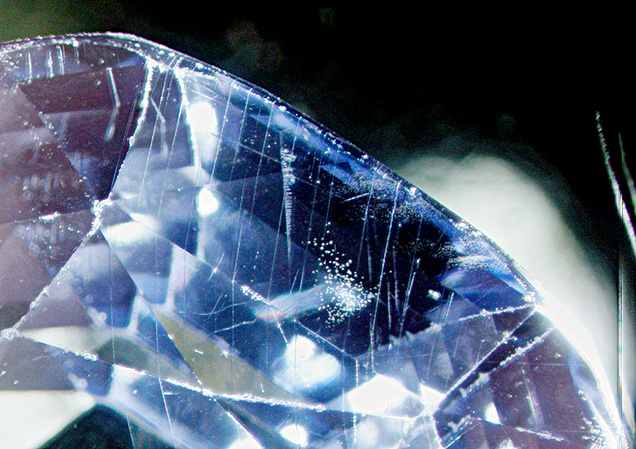
The Laboratoire Français de Gemmologie (LFG) received a 15.84 ct light purplish blue corundum for identification (figure 1). Under the microscope, clouds of bubbles similar to those seen in synthetic corundum were observed (figure 2), along with twinning planes and hollow channels known as Rose channels (figures 2 and 3). The Rose channels, which are always found at the intersection of twin lamellae, were crystallographically oriented along the edges of the rhombohedral faces and formed angles of about 90° (again, see figure 2); these features are normally seen in natural corundum (F. Notari et al., “‘Boehmite needles’ in corundum are Rose channels,” Fall 2018 G&G, p. 257).
Rose channels and twinning lamellae are common in natural corundum but seldom reported in synthetic corundum, including one instance in a Ramaura flux synthetic ruby (E. Fritsch et al., “Are boehmite needles in corundum Rose channels?” Geophysical Research Abstracts, Vol. 20, EGU2018-19493, 2018). This is because the twinning lamellae is most often formed via deformation twinning and results from post-growth events; thus, it is frequently observed in natural samples.
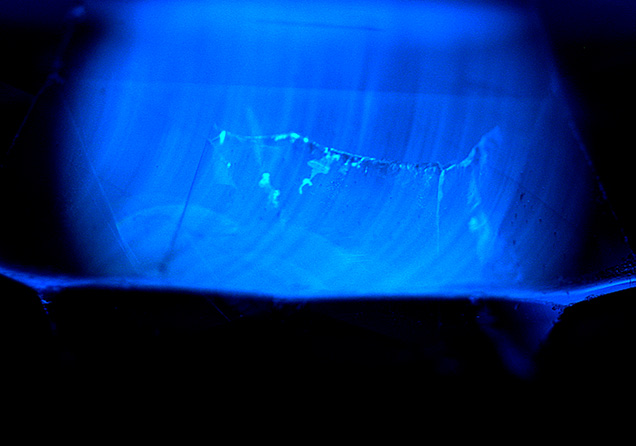
The sample was inert under long-wave UV and presented strong blue luminescence under short-wave UV. No gallium was detected with energy dispersive X-ray fluorescence, which further confirms that this corundum was synthetic (S. Muhlmeister et al., “Separating natural and synthetic rubies on the basis of trace-element chemistry,” Summer 1998 G&G, pp. 80–101). DiamondView imaging showed curved growth lines, characteristic of Verneuil flame-fusion synthetic corundum (figure 4). Rose channels in corundum were linked in the past with boehmite needles and the characteristic absorptions in the 1500–4000 cm–1 region (Notari et al., 2018); however, no absorptions were observed in this region of the FTIR spectrum.
Although by far most common in natural corundum, the presence of Rose channels and twinning planes in synthetic corundum serves as evidence that these features alone cannot be used to confirm natural origin.
Ugo Hennebois and Annabell Herreweghe are gemologists, Stefanos Karampelas (s.karampelas@lfg.paris) is chief gemologist, and Aurélien Delaunay is director, at the Laboratoire Français de Gemmologie in Paris. Emmanuel Fritsch is professor of physics at University of Nantes in France.
The Laboratoire Français de Gemmologie (LFG) received a 15.84 ct light purplish blue corundum for identification (figure 1). Under the microscope, clouds of bubbles similar to those seen in synthetic corundum were observed (figure 2), along with twinning planes and hollow channels known as Rose channels (figures 2 and 3). The Rose channels, which are always found at the intersection of twin lamellae, were crystallographically oriented along the edges of the rhombohedral faces and formed angles of about 90° (again, see figure 2); these features are normally seen in natural corundum (F. Notari et al., “‘Boehmite needles’ in corundum are Rose channels,” Fall 2018 G&G, p. 257).
Rose channels and twinning lamellae are common in natural corundum but seldom reported in synthetic corundum, including one instance in a Ramaura flux synthetic ruby (E. Fritsch et al., “Are boehmite needles in corundum Rose channels?” Geophysical Research Abstracts, Vol. 20, EGU2018-19493, 2018). This is because the twinning lamellae is most often formed via deformation twinning and results from post-growth events; thus, it is frequently observed in natural samples.
The sample was inert under long-wave UV and presented strong blue luminescence under short-wave UV. No gallium was detected with energy dispersive X-ray fluorescence, which further confirms that this corundum was synthetic (S. Muhlmeister et al., “Separating natural and synthetic rubies on the basis of trace-element chemistry,” Summer 1998 G&G, pp. 80–101). DiamondView imaging showed curved growth lines, characteristic of Verneuil flame-fusion synthetic corundum (figure 4). Rose channels in corundum were linked in the past with boehmite needles and the characteristic absorptions in the 1500–4000 cm–1 region (Notari et al., 2018); however, no absorptions were observed in this region of the FTIR spectrum.
Although by far most common in natural corundum, the presence of Rose channels and twinning planes in synthetic corundum serves as evidence that these features alone cannot be used to confirm natural origin.
Ugo Hennebois and Annabell Herreweghe are gemologists, Stefanos Karampelas (s.karampelas@lfg.paris) is chief gemologist, and Aurélien Delaunay is director, at the Laboratoire Français de Gemmologie in Paris. Emmanuel Fritsch is professor of physics at University of Nantes in France.