
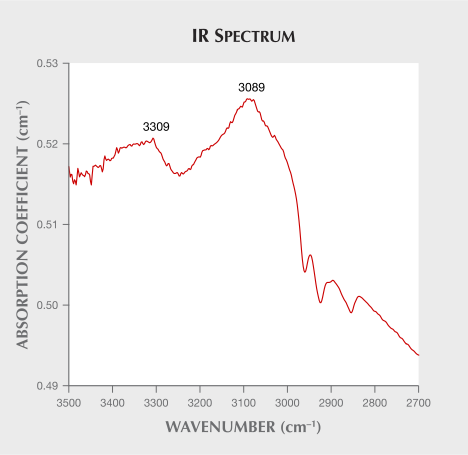
Gemologists at Bangkok’s Lotus Gemology laboratory recently examined a large lot of rubies believed to originate from the Montepuez area of Mozambique. Microscopic examination confirmed that assessment. Many of these stones displayed features in their infrared spectra that are typical for böhmite, with a characteristic “twin peak” spectrum at ~3309 and 3089 cm–1 (figure 1).
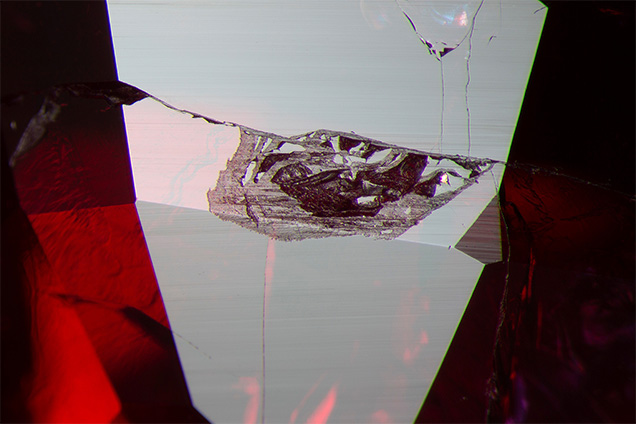
One of the stones showed a large area cut through on a pavilion facet that appeared to be a foreign substance. A similar substance was seen in many of the fissures in the stone (top of page). Judicious use of the hot point under the microscope produced no reaction. We then moved to analyze the substance via micro-Raman. The result was böhmite, which neatly confirmed the results from the infrared spectrum.
Böhmite, AlO(OH), is a polymorph of diaspore. In corundum it is generally a secondary mineral, infilling surface-reaching openings after the host corundum has grown.
Gemologists at Bangkok’s Lotus Gemology laboratory recently examined a large lot of rubies believed to originate from the Montepuez area of Mozambique. Microscopic examination confirmed that assessment. Many of these stones displayed features in their infrared spectra that are typical for böhmite, with a characteristic “twin peak” spectrum at ~3309 and 3089 cm–1 (figure 1).
One of the stones showed a large area cut through on a pavilion facet that appeared to be a foreign substance. A similar substance was seen in many of the fissures in the stone (top of page). Judicious use of the hot point under the microscope produced no reaction. We then moved to analyze the substance via micro-Raman. The result was böhmite, which neatly confirmed the results from the infrared spectrum.
Böhmite, AlO(OH), is a polymorph of diaspore. In corundum it is generally a secondary mineral, infilling surface-reaching openings after the host corundum has grown.