
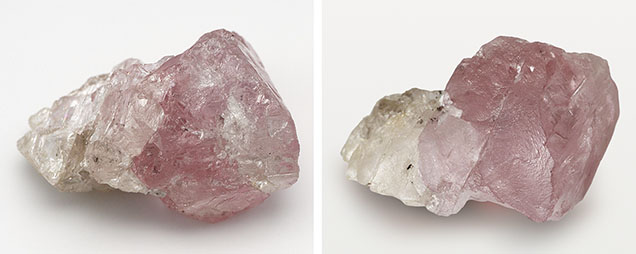
Rough pink diamonds are rarely found, and although the cause of color has been correlated with plastic deformation, the precise mechanism and atomic configuration for the resulting color are topics of continuous research. Therefore, when GIA receives a diamond with distinct pink and colorless sections (figure 1), it is of scientific interest, particularly at an astounding weight of 37.41 ct. GIA has previously examined comparable type Ia pink and colorless bicolor rough, both reportedly from Australia, in much smaller specimens weighing less than 2 ct each (Spring 2021 Lab Notes, pp. 53–55).
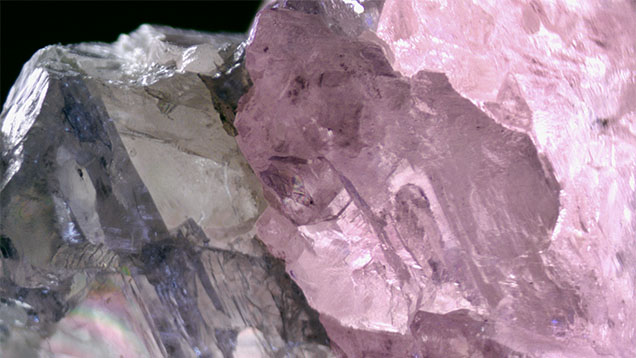
Sourced from the Karowe mine in Botswana, this rare find was submitted to GIA’s Botswana laboratory for the GIA Diamond Origin Report service. The stone measured 24.3 × 16.0 × 14.5 mm and examination showed mostly a sharp boundary between the pink and colorless zones (figure 2).
The Karowe mine recently has been a frequent source of noteworthy diamonds, including the second-largest rough diamond ever recovered at 2,488 ct (“GIA tests the world’s second largest diamond,” GIA Research News, August 15, 2025), nine diamonds weighing more than 1,000 ct each, and several other pink diamonds, such as the 62 ct type IIa “Boitumelo” (“Lucara recovers 62 carat fancy pink diamond ‘Boitumelo’ from the Karowe mine in Botswana,” July 13, 2021, https://lucaradiamond.com/newsroom/news-releases/lucara-recovers-62-carat-fancy-pink-diamond-boitum-122825/).

Fourier-transform infrared absorption, visible/near-infrared (Vis-NIR) absorption, and photoluminescence (PL) spectroscopy along with deep-UV imaging were collected from both the pink and the colorless portions of the submitted diamond in order to better characterize its properties. The diamond was identified as type IIa with no observable differences in the IR spectra in the two sections. Vis-NIR absorption showed the 550 nm absorption band in the spectrum collected from the pink section; unsurprisingly, it was absent from the colorless section (figure 3). There were minor differences in features detected within the PL spectra collected with 457, 633, and 830 nm lasers, along with deep-UV fluorescence imaging when comparing data collected between the pink and colorless portions. However, the full peak width at half-maximum of the H3 center (NVN0; 503.2 nm) was significantly narrower in the pink section (0.61 nm) than in the colorless section (1.12 nm).

The 514 nm PL spectra did show some differences (figure 4). The pink zone displayed an undulating broad photoluminescence band centered at ~670 nm, commonly seen in the PL spectra of pink diamonds, that was not apparent in the colorless spectrum (S. Eaton-Magaña et al., “Comparison of gemological and spectroscopic features in type IIa and Ia natural pink diamonds,” Diamond and Related Materials, Vol. 105, 2020, article no. 107784). Additionally, the 514 nm PL spectrum from the colorless zone showed a series of features from 790–840 nm; although this series of features is uncharacterized, it is often observed in the 514 nm PL spectra of rough IIa diamonds and occasionally faceted diamonds.
Nearly all natural pink diamonds derive their color from the 550 nm absorption band, which is generally accepted as a byproduct in the diamond when stress, such as mountain-building events, results in plastic deformation of the stone. From what is understood about pink diamond formation, the pink section likely was initially colorless and then plastically deformed resulting in its pink color; it is assumed that the colorless section formed at a later time after the stress-causing event. The distinctive appearance of this bicolor rough diamond displaying two attractive colors, its large size, and its potential to yield more information about pink diamond formation make this diamond quite noteworthy.
Loading video player...
37.41 ct Bicolor Natural Rough Diamond
Sally Eaton-Magaña is senior manager of diamond identification at GIA in Carlsbad, California. Kgotlaetsho Baatshwana is a senior analytics technician, and Norma-Jean Osi is an analytics technician, at GIA in Gaborone, Botswana.
Rough pink diamonds are rarely found, and although the cause of color has been correlated with plastic deformation, the precise mechanism and atomic configuration for the resulting color are topics of continuous research. Therefore, when GIA receives a diamond with distinct pink and colorless sections (figure 1), it is of scientific interest, particularly at an astounding weight of 37.41 ct. GIA has previously examined comparable type Ia pink and colorless bicolor rough, both reportedly from Australia, in much smaller specimens weighing less than 2 ct each (Spring 2021 Lab Notes, pp. 53–55).
Sourced from the Karowe mine in Botswana, this rare find was submitted to GIA’s Botswana laboratory for the GIA Diamond Origin Report service. The stone measured 24.3 × 16.0 × 14.5 mm and examination showed mostly a sharp boundary between the pink and colorless zones (figure 2).
The Karowe mine recently has been a frequent source of noteworthy diamonds, including the second-largest rough diamond ever recovered at 2,488 ct (“GIA tests the world’s second largest diamond,” GIA Research News, August 15, 2025), nine diamonds weighing more than 1,000 ct each, and several other pink diamonds, such as the 62 ct type IIa “Boitumelo” (“Lucara recovers 62 carat fancy pink diamond ‘Boitumelo’ from the Karowe mine in Botswana,” July 13, 2021, https://lucaradiamond.com/newsroom/news-releases/lucara-recovers-62-carat-fancy-pink-diamond-boitum-122825/).
Fourier-transform infrared absorption, visible/near-infrared (Vis-NIR) absorption, and photoluminescence (PL) spectroscopy along with deep-UV imaging were collected from both the pink and the colorless portions of the submitted diamond in order to better characterize its properties. The diamond was identified as type IIa with no observable differences in the IR spectra in the two sections. Vis-NIR absorption showed the 550 nm absorption band in the spectrum collected from the pink section; unsurprisingly, it was absent from the colorless section (figure 3). There were minor differences in features detected within the PL spectra collected with 457, 633, and 830 nm lasers, along with deep-UV fluorescence imaging when comparing data collected between the pink and colorless portions. However, the full peak width at half-maximum of the H3 center (NVN0; 503.2 nm) was significantly narrower in the pink section (0.61 nm) than in the colorless section (1.12 nm).
The 514 nm PL spectra did show some differences (figure 4). The pink zone displayed an undulating broad photoluminescence band centered at ~670 nm, commonly seen in the PL spectra of pink diamonds, that was not apparent in the colorless spectrum (S. Eaton-Magaña et al., “Comparison of gemological and spectroscopic features in type IIa and Ia natural pink diamonds,” Diamond and Related Materials, Vol. 105, 2020, article no. 107784). Additionally, the 514 nm PL spectrum from the colorless zone showed a series of features from 790–840 nm; although this series of features is uncharacterized, it is often observed in the 514 nm PL spectra of rough IIa diamonds and occasionally faceted diamonds.
Nearly all natural pink diamonds derive their color from the 550 nm absorption band, which is generally accepted as a byproduct in the diamond when stress, such as mountain-building events, results in plastic deformation of the stone. From what is understood about pink diamond formation, the pink section likely was initially colorless and then plastically deformed resulting in its pink color; it is assumed that the colorless section formed at a later time after the stress-causing event. The distinctive appearance of this bicolor rough diamond displaying two attractive colors, its large size, and its potential to yield more information about pink diamond formation make this diamond quite noteworthy.
Loading video player...
37.41 ct Bicolor Natural Rough Diamond
Sally Eaton-Magaña is senior manager of diamond identification at GIA in Carlsbad, California. Kgotlaetsho Baatshwana is a senior analytics technician, and Norma-Jean Osi is an analytics technician, at GIA in Gaborone, Botswana.