
Loading video player...
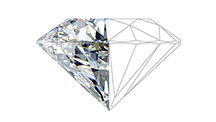
360-degree video of the Motswedi diamond.
The Karowe Diamond Mine in Botswana, owned and operated by Lucara Diamond Corp., has gained international recognition for producing large, high-quality type IaB or coexistence of IaB with IIa diamonds since its operations began in 2012. Among the notable finds are the 1,109-carat Lesedi La Rona and the 813-carat Constellation. In August 2024, Lucara announced the recovery of a remarkable 2,492-carat diamond from the same mine. This exceptional stone was later named the Motswedi through a public competition in Botswana, with "Motswedi" meaning "water spring" or "source" in Setswana. It now holds the distinction of being the second-largest diamond ever discovered, surpassed only by the legendary 3,106-carat Cullinan Diamond, which was recovered from the Premier Mine (now the Cullinan Mine) in South Africa in 1905—more than a century ago.
GIA recently examined the Motswedi diamond at its laboratory in Botswana, and this report summarizes the key gemological and spectroscopic findings.
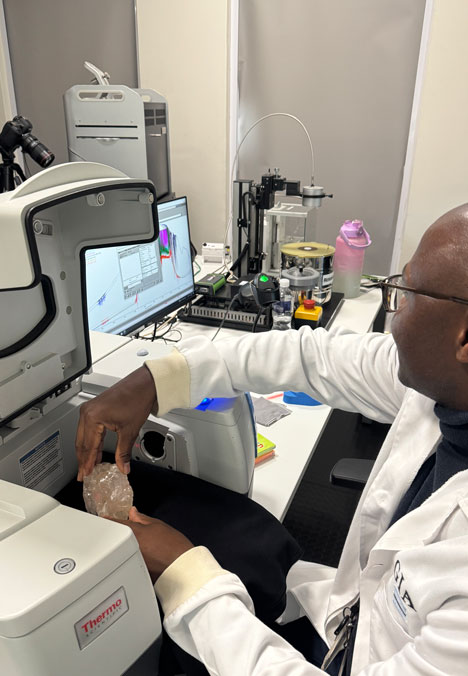
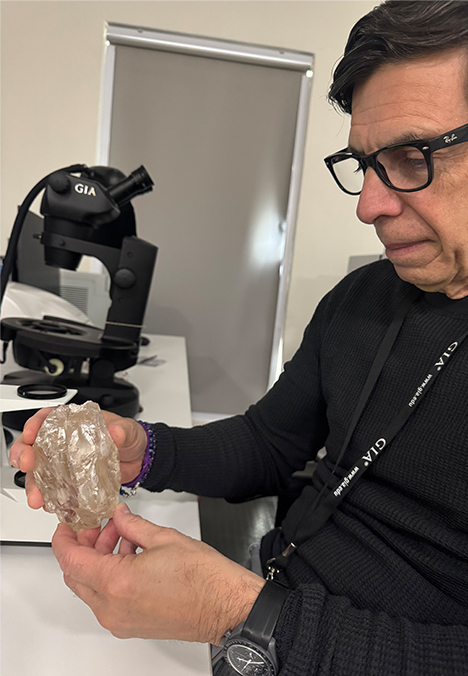
The Motswedi diamond weighed 2,488.32 carats (approximately 1.10 pounds!) upon arrival at GIA, along with 11 smaller fragments that had broken off, weighing a total of 1.50 carats. Two larger pieces weighed 0.75 and 0.47 carat, respectively. The Motswedi diamond is transparent, gem-quality, and displays a light brown color, while the fragments are essentially colorless. The immense size of the diamond along with foreign materials in fractures likely accentuates its brown color, which is basically evenly distributed.
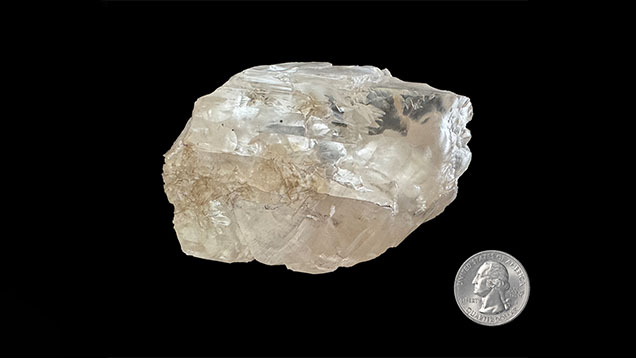
The crystal displays an irregular morphology with an elongated oval shape, measuring 106.3 × 71.6 × 53.8 mm (see Figure 1). No intact crystal faces are visible. The surface is mainly covered with resorption pits and linear etching. Prominent trigons are observed on the lower left portion, while multiple dislocation networks are evident on the right side, as seen in Figure 1. A large, irregular break is visible at the top of the stone. Microscopic examination reveals weak resorption features around the break, suggesting it formed naturally rather than during recovery. Due to its large size and likely multiple growth stages the breaks are not unexpected. The left end of the diamond shows several shallow fractures, and small fragments could break off under significant stress.
Along the length of the stone, about five large fractures run nearly perpendicular to the surface, dividing the crystal into several large blocks. These blocks are of high gem quality, with minimal internal fractures or mineral inclusions. These features confirm that the Motswedi is a single crystal rather than a polycrystalline aggregate. A few small, flake-like black inclusions were observed near the surface, but overall, mineral inclusions are sparse. While metallic inclusions are often found in large type IIa CLIPPIR diamonds of super-deep origin (E.M. Smith et al., 2017, The Very Deep Origin of the World’s Biggest Diamonds, Gems & Gemology, Vol. 53, No. 4, pp. 388-403), their presence in the Motswedi appears limited—consisting of only small black flake-like inclusions—or entirely absent. Consequently, no detectable magnetic response was observed when the stone was exposed to a strong magnet.
Infrared absorption spectroscopy confirmed that the Motswedi is a type IIa diamond, with no detectable nitrogen-related absorption. Multiple measurements at different locations yielded consistent results. Due to the stone’s massive size and irregular morphology, the spectra were somewhat noisy. Additionally, it is not possible to analyze every part of this stone. In contrast, the spectra from the 0.75 ct and 0.47 ct fragments were clearer, confirmed the type IIa conclusion, and revealed a weak absorption feature at 3107 cm⁻¹, attributed to the N3VH defect. This spectral feature is drastically different from many other large diamonds from this mine, which were type IaB with varying concentrations of the B form nitrogen (N4V).
UV-Visible absorption spectroscopy at room temperature showed a gradual increase in absorption toward the higher-energy region (i.e., lower wavelengths), consistent with the observed light brown color. Photoluminescence spectroscopy was conducted on the two fragments using multiple laser excitations (457 nm, 514 nm, 633 nm, and 830 nm) at liquid nitrogen temperatures. A weak and broad GR1 emission band (1.35–1.38 nm, full width at half maximum) was detected, along with weak emissions at 579.0 nm, 575.9 nm, a broad band around 566 nm, 558.2 nm, 503.1 nm (H3), 496.0 nm (H4), and 490.7 nm. No NV center emissions were observed. Photoluminescence spectra of the main Motswedi diamond, collected at room temperature only, yielded comparable results.
In summary, the Motswedi diamond from Lucara’s Karowe Diamond Mine in Botswana—second largest ever discovered and the largest known single crystal in existence—boasts not only remarkable size but exceptional gemological properties and purity, as confirmed by spectroscopic analysis. It is undoubtedly a diamond of historical significance.
Tom Moses is Executive Vice President and Chief Laboratory and Research Officer at GIA.
Wuyi Wang is Vice President of Research & Development at GIA.
Loading video player...
360-degree video of the Motswedi diamond.
The Karowe Diamond Mine in Botswana, owned and operated by Lucara Diamond Corp., has gained international recognition for producing large, high-quality type IaB or coexistence of IaB with IIa diamonds since its operations began in 2012. Among the notable finds are the 1,109-carat Lesedi La Rona and the 813-carat Constellation. In August 2024, Lucara announced the recovery of a remarkable 2,492-carat diamond from the same mine. This exceptional stone was later named the Motswedi through a public competition in Botswana, with "Motswedi" meaning "water spring" or "source" in Setswana. It now holds the distinction of being the second-largest diamond ever discovered, surpassed only by the legendary 3,106-carat Cullinan Diamond, which was recovered from the Premier Mine (now the Cullinan Mine) in South Africa in 1905—more than a century ago.
GIA recently examined the Motswedi diamond at its laboratory in Botswana, and this report summarizes the key gemological and spectroscopic findings.
The Motswedi diamond weighed 2,488.32 carats (approximately 1.10 pounds!) upon arrival at GIA, along with 11 smaller fragments that had broken off, weighing a total of 1.50 carats. Two larger pieces weighed 0.75 and 0.47 carat, respectively. The Motswedi diamond is transparent, gem-quality, and displays a light brown color, while the fragments are essentially colorless. The immense size of the diamond along with foreign materials in fractures likely accentuates its brown color, which is basically evenly distributed.
The crystal displays an irregular morphology with an elongated oval shape, measuring 106.3 × 71.6 × 53.8 mm (see Figure 1). No intact crystal faces are visible. The surface is mainly covered with resorption pits and linear etching. Prominent trigons are observed on the lower left portion, while multiple dislocation networks are evident on the right side, as seen in Figure 1. A large, irregular break is visible at the top of the stone. Microscopic examination reveals weak resorption features around the break, suggesting it formed naturally rather than during recovery. Due to its large size and likely multiple growth stages the breaks are not unexpected. The left end of the diamond shows several shallow fractures, and small fragments could break off under significant stress.
Along the length of the stone, about five large fractures run nearly perpendicular to the surface, dividing the crystal into several large blocks. These blocks are of high gem quality, with minimal internal fractures or mineral inclusions. These features confirm that the Motswedi is a single crystal rather than a polycrystalline aggregate. A few small, flake-like black inclusions were observed near the surface, but overall, mineral inclusions are sparse. While metallic inclusions are often found in large type IIa CLIPPIR diamonds of super-deep origin (E.M. Smith et al., 2017, The Very Deep Origin of the World’s Biggest Diamonds, Gems & Gemology, Vol. 53, No. 4, pp. 388-403), their presence in the Motswedi appears limited—consisting of only small black flake-like inclusions—or entirely absent. Consequently, no detectable magnetic response was observed when the stone was exposed to a strong magnet.
Infrared absorption spectroscopy confirmed that the Motswedi is a type IIa diamond, with no detectable nitrogen-related absorption. Multiple measurements at different locations yielded consistent results. Due to the stone’s massive size and irregular morphology, the spectra were somewhat noisy. Additionally, it is not possible to analyze every part of this stone. In contrast, the spectra from the 0.75 ct and 0.47 ct fragments were clearer, confirmed the type IIa conclusion, and revealed a weak absorption feature at 3107 cm⁻¹, attributed to the N3VH defect. This spectral feature is drastically different from many other large diamonds from this mine, which were type IaB with varying concentrations of the B form nitrogen (N4V).
UV-Visible absorption spectroscopy at room temperature showed a gradual increase in absorption toward the higher-energy region (i.e., lower wavelengths), consistent with the observed light brown color. Photoluminescence spectroscopy was conducted on the two fragments using multiple laser excitations (457 nm, 514 nm, 633 nm, and 830 nm) at liquid nitrogen temperatures. A weak and broad GR1 emission band (1.35–1.38 nm, full width at half maximum) was detected, along with weak emissions at 579.0 nm, 575.9 nm, a broad band around 566 nm, 558.2 nm, 503.1 nm (H3), 496.0 nm (H4), and 490.7 nm. No NV center emissions were observed. Photoluminescence spectra of the main Motswedi diamond, collected at room temperature only, yielded comparable results.
In summary, the Motswedi diamond from Lucara’s Karowe Diamond Mine in Botswana—second largest ever discovered and the largest known single crystal in existence—boasts not only remarkable size but exceptional gemological properties and purity, as confirmed by spectroscopic analysis. It is undoubtedly a diamond of historical significance.
Tom Moses is Executive Vice President and Chief Laboratory and Research Officer at GIA.
Wuyi Wang is Vice President of Research & Development at GIA.