

GIA’s Mumbai laboratory recently received an undrilled white semi-baroque saltwater nacreous pearl for identification, weighing 8.98 ct and measuring 11.31 × 10.75 × 10.30 mm (figure 1). Externally, the pearl exhibited dents and wrinkles on its surface, similar to those observed in cultured pearls.
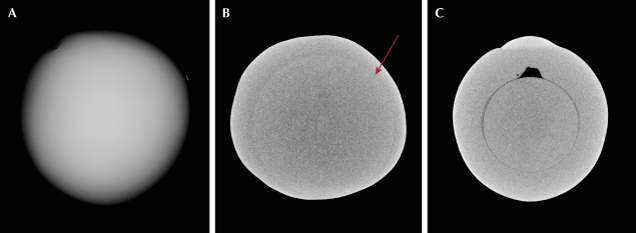
Real-time X-ray microradiography (RTX) revealed a tight structure with uniform opacity throughout the pearl and the absence of growth features typical of natural or cultured origin in pearls of this size (figure 2A). The internal structure was challenging to interpret, requiring further analysis using X-ray computed microtomography (μ-CT) imaging, which also revealed a tight structure. However, a fine round demarcation of a possible bead nucleus was present, exhibiting a subtle variation in its radiopacity with an outer nacre area (figure 2B). This evidence indicated that the pearl was likely bead cultured, though it appeared atypical.
Typically, bead cultured pearls are easily identifiable as they show a characteristic distinct dark gray demarcation of the round bead nucleus used during the cultivation process (figure 2C), and sometimes are accompanied by small organic gaps. The examined pearl exhibited a more blended and uniform opacity throughout, with the bead nucleus appearing more radiopaque than traditional freshwater shell nuclei. The pearl displayed an inert reaction when subjected to X-ray fluorescence (XRF), indicating its saltwater origin. Moreover, this reaction suggests that the bead is of a non-standard material, as typical white saltwater bead cultured pearls with this nacre thickness (again, see figure 2B) usually exhibit weak yellowish green fluorescence under XRF due to trace amounts of manganese from the freshwater shell material of the bead. These observations suggest the potential use of an unconventional bead nucleus for culturing, such as a saltwater shell bead or other organic material (L.E. Cartier and M.S. Krzemnicki, “New developments in cultured pearl production: Use of organic and baroque shell nuclei,” Australian Gemmologist, Vol. 25, No. 1, 2013, pp. 6–13).
Identifying the material used as the bead nucleus in this pearl remains inconclusive due to the lack of fluorescence and shell banding, coupled with the subtle variations in the radiopacity of the bead nucleus. Significant advancements in techniques and materials used for culturing pearls have resulted in an increased number of challenging pearls submitted for identification to laboratories. In a few cases similar to the pearl examined here, results based entirely on RTX imaging can lead to misidentification. The use of μ-CT imaging has proven to be a pivotal tool in the identification of such challenging pearls (M.S. Krzemnicki et al., “X-ray computed microtomography: Distinguishing natural pearls from beaded and non-beaded cultured pearls,” Summer 2010 G&G, pp. 128–134).
Pfokreni Nipuni is a gemologist at GIA in Mumbai. Abeer Al-Alawi is a consultant to GIA. Chunhui Zhou is senior manager of pearl identification at GIA in New York.
GIA’s Mumbai laboratory recently received an undrilled white semi-baroque saltwater nacreous pearl for identification, weighing 8.98 ct and measuring 11.31 × 10.75 × 10.30 mm (figure 1). Externally, the pearl exhibited dents and wrinkles on its surface, similar to those observed in cultured pearls.
Real-time X-ray microradiography (RTX) revealed a tight structure with uniform opacity throughout the pearl and the absence of growth features typical of natural or cultured origin in pearls of this size (figure 2A). The internal structure was challenging to interpret, requiring further analysis using X-ray computed microtomography (μ-CT) imaging, which also revealed a tight structure. However, a fine round demarcation of a possible bead nucleus was present, exhibiting a subtle variation in its radiopacity with an outer nacre area (figure 2B). This evidence indicated that the pearl was likely bead cultured, though it appeared atypical.
Typically, bead cultured pearls are easily identifiable as they show a characteristic distinct dark gray demarcation of the round bead nucleus used during the cultivation process (figure 2C), and sometimes are accompanied by small organic gaps. The examined pearl exhibited a more blended and uniform opacity throughout, with the bead nucleus appearing more radiopaque than traditional freshwater shell nuclei. The pearl displayed an inert reaction when subjected to X-ray fluorescence (XRF), indicating its saltwater origin. Moreover, this reaction suggests that the bead is of a non-standard material, as typical white saltwater bead cultured pearls with this nacre thickness (again, see figure 2B) usually exhibit weak yellowish green fluorescence under XRF due to trace amounts of manganese from the freshwater shell material of the bead. These observations suggest the potential use of an unconventional bead nucleus for culturing, such as a saltwater shell bead or other organic material (L.E. Cartier and M.S. Krzemnicki, “New developments in cultured pearl production: Use of organic and baroque shell nuclei,” Australian Gemmologist, Vol. 25, No. 1, 2013, pp. 6–13).
Identifying the material used as the bead nucleus in this pearl remains inconclusive due to the lack of fluorescence and shell banding, coupled with the subtle variations in the radiopacity of the bead nucleus. Significant advancements in techniques and materials used for culturing pearls have resulted in an increased number of challenging pearls submitted for identification to laboratories. In a few cases similar to the pearl examined here, results based entirely on RTX imaging can lead to misidentification. The use of μ-CT imaging has proven to be a pivotal tool in the identification of such challenging pearls (M.S. Krzemnicki et al., “X-ray computed microtomography: Distinguishing natural pearls from beaded and non-beaded cultured pearls,” Summer 2010 G&G, pp. 128–134).
Pfokreni Nipuni is a gemologist at GIA in Mumbai. Abeer Al-Alawi is a consultant to GIA. Chunhui Zhou is senior manager of pearl identification at GIA in New York.