
Recently, at the Carlsbad laboratory, the authors studied two diamonds, submitted separately for scientific examination, with interesting appearances due to the presence of dark micro-inclusions.
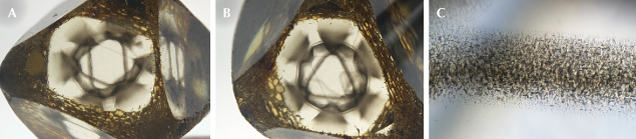
The first stone, a 3.45 ct diamond reportedly from Zimbabwe, was partially faceted with rough surfaces preserved along the edges (figure 1A). The stone had six-lobed asteriated inclusion sectors, with a six-sided star pattern visible in the center. When tilted to view through a different facet, some of the star’s points were fainter, making the pattern appear as a triangle (figure 1B). These patterns were formed by dark micro-inclusions (figure 1C), concluded as graphite from visual examination.
The visible/near-infrared (Vis-NIR) absorption spectra showed the nitrogen-related features N3 and H3, the radiation-related feature GR1, and a hydrogen-related band at 835 nm. Pronounced brown radiation staining was observed on the unpolished surfaces. The infrared (IR) absorption spectrum confirmed the diamond as type Ia with high amounts of nitrogen and hydrogen, consistent with other diamonds exhibiting similar inclusion scenes (Fall 2019 Lab Notes, p. 417; Fall 2021 G&G Micro-World, pp. 269–270; Summer 2024 Lab Notes, pp. 212–214). The inclusion patterns formed in such natural diamonds are often symmetrical and can appear as various configurations of lobed “stars” or triangles when viewed through the polished windows. This diamond was unusual as it showed the graphitic clouds radiating outward starting from the central figure—a pattern not previously seen by the authors.
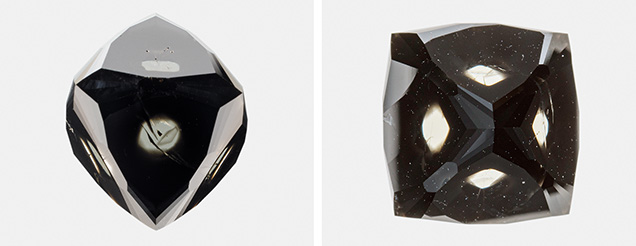
The second natural diamond was faceted and displayed dark clouds of micro-inclusions with clear openings in the center of the main facets (figure 2). IR absorption spectroscopy indicated that the 13.89 ct stone was also type Ia with hydrogen-related defects. Photoluminescence (PL) mapping using 455 nm laser excitation revealed that the dark cloud inclusion sectors correlated with high concentrations of the S3 defect (figure 3A). This nickel-related peak (A.M. Zaitsev, Optical Properties of Diamond: A Data Handbook, Springer-Verlag, Berlin, 2001) caused the clouds to fluoresce green when exposed to long-wave UV, such as in the cloud-inclusion sectors observed in asteriated diamonds (e.g., Fall 2019 Lab Notes, p. 417; Summer 2024 Lab Notes, pp. 212–214). PL spectra within the cloud sector using 532 nm excitation also showed another potentially nickel-related feature at ~694.3 nm.
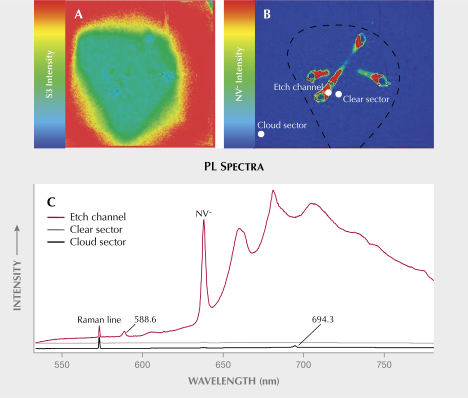
The stone also contained etch channels passing through clear openings of the clouds. Within the etch channels, brown radiation stains and a high concentration of PL features were detected, such as NV–; (figure 3, B and C), GR1, and a peak at 588.6 nm. These defects may have been produced by radioactive fluids entering the etch channel while in the earth, creating the resulting stains; subsequent annealing could then create higher concentrations of several vacancy-related centers such as NV–.
Although both of these diamonds have similar infrared spectra, radiation staining, and the presence of dark micro-inclusions, the diamonds manifest these characteristics in different ways. They provide another example that all natural diamonds have their own journey and origin story.
Loading video player...
Unusual Patterns in Diamonds
Taryn Linzmeyer is an analytics technician, and Sally Eaton-Magaña is senior manager of diamond identification, at GIA in Carlsbad, California.
Recently, at the Carlsbad laboratory, the authors studied two diamonds, submitted separately for scientific examination, with interesting appearances due to the presence of dark micro-inclusions.
The first stone, a 3.45 ct diamond reportedly from Zimbabwe, was partially faceted with rough surfaces preserved along the edges (figure 1A). The stone had six-lobed asteriated inclusion sectors, with a six-sided star pattern visible in the center. When tilted to view through a different facet, some of the star’s points were fainter, making the pattern appear as a triangle (figure 1B). These patterns were formed by dark micro-inclusions (figure 1C), concluded as graphite from visual examination.
The visible/near-infrared (Vis-NIR) absorption spectra showed the nitrogen-related features N3 and H3, the radiation-related feature GR1, and a hydrogen-related band at 835 nm. Pronounced brown radiation staining was observed on the unpolished surfaces. The infrared (IR) absorption spectrum confirmed the diamond as type Ia with high amounts of nitrogen and hydrogen, consistent with other diamonds exhibiting similar inclusion scenes (Fall 2019 Lab Notes, p. 417; Fall 2021 G&G Micro-World, pp. 269–270; Summer 2024 Lab Notes, pp. 212–214). The inclusion patterns formed in such natural diamonds are often symmetrical and can appear as various configurations of lobed “stars” or triangles when viewed through the polished windows. This diamond was unusual as it showed the graphitic clouds radiating outward starting from the central figure—a pattern not previously seen by the authors.
The second natural diamond was faceted and displayed dark clouds of micro-inclusions with clear openings in the center of the main facets (figure 2). IR absorption spectroscopy indicated that the 13.89 ct stone was also type Ia with hydrogen-related defects. Photoluminescence (PL) mapping using 455 nm laser excitation revealed that the dark cloud inclusion sectors correlated with high concentrations of the S3 defect (figure 3A). This nickel-related peak (A.M. Zaitsev, Optical Properties of Diamond: A Data Handbook, Springer-Verlag, Berlin, 2001) caused the clouds to fluoresce green when exposed to long-wave UV, such as in the cloud-inclusion sectors observed in asteriated diamonds (e.g., Fall 2019 Lab Notes, p. 417; Summer 2024 Lab Notes, pp. 212–214). PL spectra within the cloud sector using 532 nm excitation also showed another potentially nickel-related feature at ~694.3 nm.
The stone also contained etch channels passing through clear openings of the clouds. Within the etch channels, brown radiation stains and a high concentration of PL features were detected, such as NV–; (figure 3, B and C), GR1, and a peak at 588.6 nm. These defects may have been produced by radioactive fluids entering the etch channel while in the earth, creating the resulting stains; subsequent annealing could then create higher concentrations of several vacancy-related centers such as NV–.
Although both of these diamonds have similar infrared spectra, radiation staining, and the presence of dark micro-inclusions, the diamonds manifest these characteristics in different ways. They provide another example that all natural diamonds have their own journey and origin story.
Loading video player...
Unusual Patterns in Diamonds
Taryn Linzmeyer is an analytics technician, and Sally Eaton-Magaña is senior manager of diamond identification, at GIA in Carlsbad, California.