
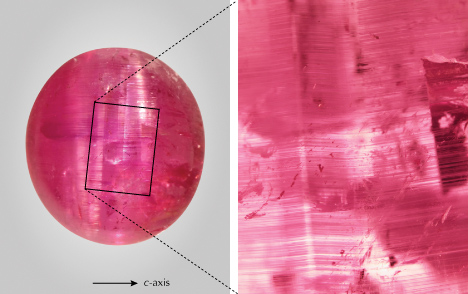
An 11.23 ct purplish pink cabochon exhibiting multiple cat’s-eye phenomena was recently submitted to the Tokyo laboratory for identification (see above, left). Standard gemological testing results included a spot refractive index of 1.59, a specific gravity of 3.11, dichroism, and an inert reaction under both long-wave (365 nm) and short-wave (254 nm) UV radiation. Microscopic observation revealed several inclusions: iridescent parallel growth tubes or elongated thin films, trichite-like iridescent fingerprints, and transparent colorless crystals. The Raman spectrum was consistent with pezzottaite (CsLiBe2Al2Si6O18).
Pezzottaite was discovered in Madagascar in 2002 and approved as a new mineral by the International Mineralogical Association in 2004. While it belongs to the beryl mineral group, pezzottaite has a trigonal crystal system, differing from beryl’s hexagonal crystal system, and can be described as having imperfect cleavage parallel to the basal {001} planes, which are perpendicular to the c-axis (i.e., the optical axis; F.C. Hawthone et al., “Pezzottaite Cs(Be2Li)Al2Si6O18: A spectacular new beryl-group mineral from the Sakavalana pegmatite, Fianarantsoa province, Madagascar,” Mineralogical Record, Vol. 35, No. 5, 2004, pp. 369–378).
In the submitted stone, the growth tubes or elongated thin films were oriented nearly parallel to the c-axis and displayed multiple bends possibly resulting from imperfect {001} cleavage planes, producing multiple cat’s-eyes perpendicular to them, or almost perpendicular to the c-axis (see above, right). Though it is unknown how the bending of these inclusions happened, they work together to produce the highly exceptional and impressive phenomenon of multiple cat’s-eyes.
An 11.23 ct purplish pink cabochon exhibiting multiple cat’s-eye phenomena was recently submitted to the Tokyo laboratory for identification (see above, left). Standard gemological testing results included a spot refractive index of 1.59, a specific gravity of 3.11, dichroism, and an inert reaction under both long-wave (365 nm) and short-wave (254 nm) UV radiation. Microscopic observation revealed several inclusions: iridescent parallel growth tubes or elongated thin films, trichite-like iridescent fingerprints, and transparent colorless crystals. The Raman spectrum was consistent with pezzottaite (CsLiBe2Al2Si6O18).
Pezzottaite was discovered in Madagascar in 2002 and approved as a new mineral by the International Mineralogical Association in 2004. While it belongs to the beryl mineral group, pezzottaite has a trigonal crystal system, differing from beryl’s hexagonal crystal system, and can be described as having imperfect cleavage parallel to the basal {001} planes, which are perpendicular to the c-axis (i.e., the optical axis; F.C. Hawthone et al., “Pezzottaite Cs(Be2Li)Al2Si6O18: A spectacular new beryl-group mineral from the Sakavalana pegmatite, Fianarantsoa province, Madagascar,” Mineralogical Record, Vol. 35, No. 5, 2004, pp. 369–378).
In the submitted stone, the growth tubes or elongated thin films were oriented nearly parallel to the c-axis and displayed multiple bends possibly resulting from imperfect {001} cleavage planes, producing multiple cat’s-eyes perpendicular to them, or almost perpendicular to the c-axis (see above, right). Though it is unknown how the bending of these inclusions happened, they work together to produce the highly exceptional and impressive phenomenon of multiple cat’s-eyes.