Unique Moiré-Pattern Metallic Inclusion in Paraíba Tourmaline
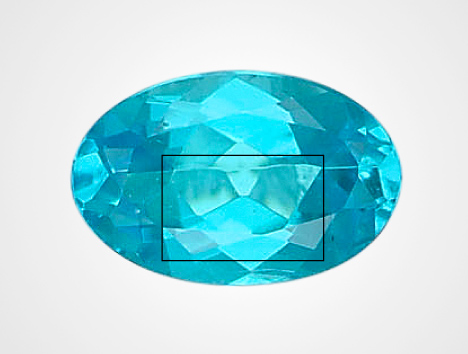
The Tokyo laboratory received a 0.33 ct greenish blue oval modified brilliant measuring 5.48 × 3.60 × 2.37 mm (figure 1). Gemological properties, as well as trace element analysis collected with laser ablation–inductively coupled plasma–mass spectrometry (LA-ICP-MS), identified this gem as a Paraíba tourmaline from Brazil.
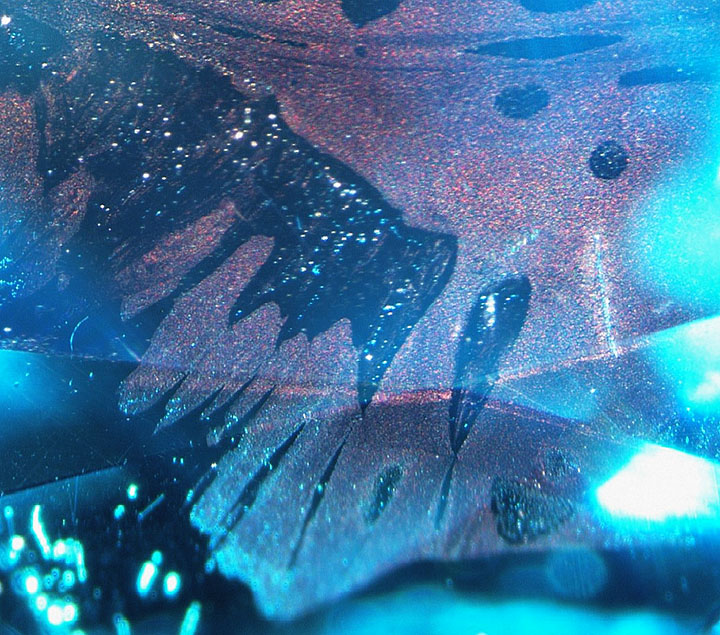
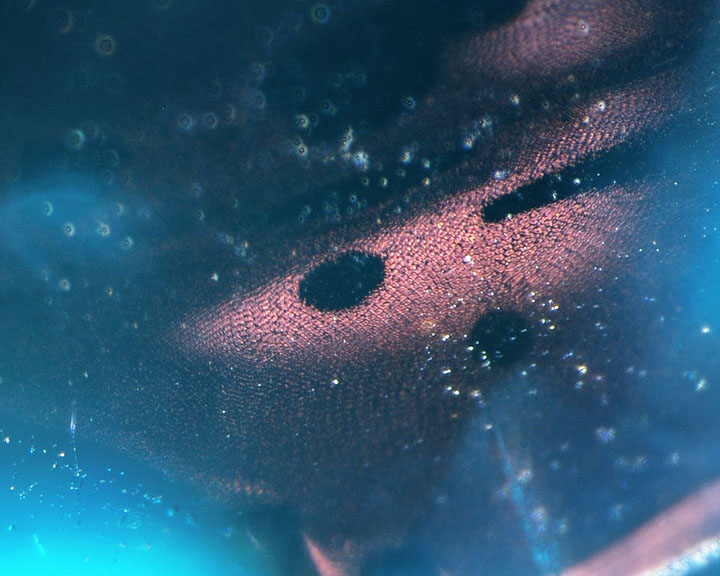
Microscopic observation revealed planar inclusions consisting of minute particles in the area marked in figure 1. Under fiber-optic illumination, these minute particles had a pink metallic luster. The particles were clustered together, but circular to teardrop-shaped voids in these clusters contained no observable particles (figure 2). Further magnification showed that the particles were arranged in a moiré pattern (figure 3). A moiré pattern occurs when two sets of parallel lines are superimposed, which is sometimes observed in gemstone inclusions (e.g., Fall 2023 G&G Micro-World, pp. 375–376). These planar inclusions did not reach the surface of the stone. No fissure was observed along the inclusion. Based on the particles’ pinkish color and metallic luster, as well as the stone’s high copper content (17095–22700 ppmw), we assume they were native copper. This data was not collected directly from the inclusions but from the girdle of the stone by LA-ICP-MS. Considering the high range of copper concentration compared to the reported copper level of Brazilian Paraíba tourmaline from 119 to 38800 ppmw (Y. Katsurada et al., “Geographic origin determination of Paraíba tourmaline,” Winter 2019 G&G, pp. 648–659), it is possible they are native copper just like the metallic platelets sometimes found in high-copper Paraíba tourmalines (e.g., F. Brandstätter and G. Niedermayr, “Copper and tenorite inclusions in cuprian-elbaite tourmaline from Paraíba, Brazil,” Fall 1994 G&G, pp. 178–183; Fall 2022 Lab Notes, pp. 362–363; H.A.O. Wang et al., “Further characterisation of native copper inclusions in Cu-bearing tourmaline,” Journal of Gemmology, Vol. 38, No. 5, 2023, pp. 427–429).
Some studies have discussed formation scenarios of dendritic copper inclusions. Brandstätter and Niedermayr (1994) suggested epigenetic exsolution formation because the concentration of CuO decreased toward the native copper inclusions, which were located along the planes corresponding to the trigonal symmetry of tourmaline. On the other hand, Wang et al. (2023) suggested syngenetic formation rather than epigenetic formation, based on the distribution of valence states of copper (metallic copper/Cu2+) and the presence of liquid inclusions similar in shape to dendritic native copper.
The inclusions we observed were different from the dendritic inclusions discussed in previous studies in terms of pattern and orientation in the host tourmaline. Consequently, there could be other mechanisms or scenarios at play with these inclusions, including the possibility of a material other than native copper.