

Most of the synthetic beryl currently on the market has been created by a hydrothermal process. Hydrothermally grown crystals have obviously different crystal forms compared to their natural counterparts. Hydrothermal synthetics are often easily identified by their typical zigzag- or chevron-patterned graining and color zoning. Flux-grown synthetics, though less common, are able to form more natural-looking crystals. However, despite having natural forms, flux synthetics contain many unusual inclusions that clearly distinguish them from their natural counterparts. Copper platelets that form within the crystal either from contamination or intentionally introducing metal in the growth material are obvious indications of synthetic origin. Flux fingerprints are another easily observed type of inclusion unique to flux synthetic crystals.
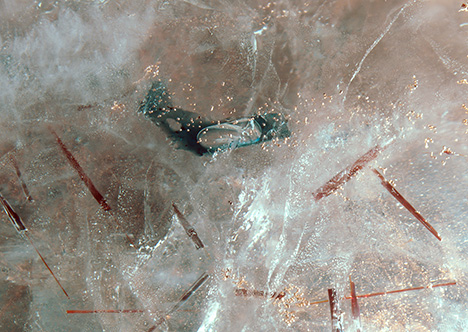
Weighing 211.78 ct, the hexagonal doubly terminated crystal in figure 1 looks like a natural beryl crystal at first glance. Eye-visible well-formed copper platelets and wispy flux fingerprints indicate that the stone did not form naturally. A closer look revealed reddish clouds of well-formed minute copper platelets and copper crystals. Euhedral red rod-like crystals of columbite were scattered throughout, similar to those in a natural sample. Partially healed tension cracks with white secondary flux particles were also present. A few areas throughout the crystal had unique thin angular and jagged films containing blue flux liquid and gas bubbles (figure 2). Areas with higher clarity reveal the boundary between the natural aquamarine seed crystal and the flux overgrowth. This stone is a product of synthetic flux beryl overgrowth on a natural aquamarine seed crystal produced in a Russian synthetic gem facility.
Most of the synthetic beryl currently on the market has been created by a hydrothermal process. Hydrothermally grown crystals have obviously different crystal forms compared to their natural counterparts. Hydrothermal synthetics are often easily identified by their typical zigzag- or chevron-patterned graining and color zoning. Flux-grown synthetics, though less common, are able to form more natural-looking crystals. However, despite having natural forms, flux synthetics contain many unusual inclusions that clearly distinguish them from their natural counterparts. Copper platelets that form within the crystal either from contamination or intentionally introducing metal in the growth material are obvious indications of synthetic origin. Flux fingerprints are another easily observed type of inclusion unique to flux synthetic crystals.
Weighing 211.78 ct, the hexagonal doubly terminated crystal in figure 1 looks like a natural beryl crystal at first glance. Eye-visible well-formed copper platelets and wispy flux fingerprints indicate that the stone did not form naturally. A closer look revealed reddish clouds of well-formed minute copper platelets and copper crystals. Euhedral red rod-like crystals of columbite were scattered throughout, similar to those in a natural sample. Partially healed tension cracks with white secondary flux particles were also present. A few areas throughout the crystal had unique thin angular and jagged films containing blue flux liquid and gas bubbles (figure 2). Areas with higher clarity reveal the boundary between the natural aquamarine seed crystal and the flux overgrowth. This stone is a product of synthetic flux beryl overgrowth on a natural aquamarine seed crystal produced in a Russian synthetic gem facility.