

Jeremejevite is a rare aluminum borate mineral with an ideal chemical formula of Al6B5O15[F,OH]3 (K. Scarratt et al., “Jeremejevite: A gemological update,” Fall 2001 G&G, pp. 206–211). Its crystal system is hexagonal, and this mineral tends to occur in pegmatitic or volcanic deposits as a prismatic crystal. The authors recently examined a violetish blue jeremejevite measuring 10.48 × 4.98 × 4.04 mm and weighing 1.78 ct.
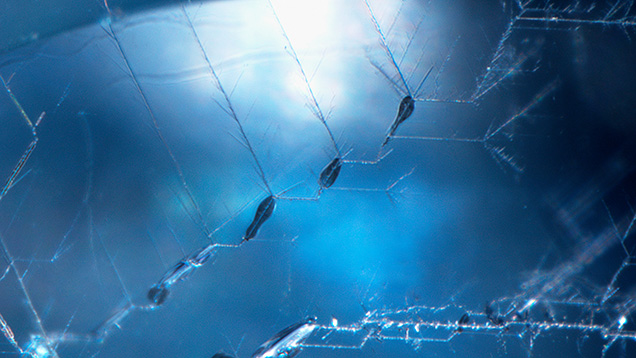
The stone contained unique dendritic inclusions resembling the encasing of a tree in ice, known as rime ice, along the c-axis (figure 1). The “trunk” was parallel to the direction of the c-axis, and the “branches” extended from the trunk at approximately a 60° angle. On the other side, a lightning-strike pattern was observed (figure 2). Specific Raman spectra were not detected from these inclusions, suggesting they may be a kind of hollow channel within the crystal. Similar internal features have been observed in Namibian materials and were likely formed by the “step” growth of jeremejevite crystals (Scarratt et al., 2001; “Jeremejevite: A description of a 400 crystal collection from Namibia and a preliminary study of five color types,” GIA Research News, 2009). Crystal growth can create attractive patterns such as these unique inclusions in jeremejevite.
Makoto Miura is supervisor of colored stone identification, and Yusuke Katsurada is a senior staff gemologist, at GIA in Tokyo.
Jeremejevite is a rare aluminum borate mineral with an ideal chemical formula of Al6B5O15[F,OH]3 (K. Scarratt et al., “Jeremejevite: A gemological update,” Fall 2001 G&G, pp. 206–211). Its crystal system is hexagonal, and this mineral tends to occur in pegmatitic or volcanic deposits as a prismatic crystal. The authors recently examined a violetish blue jeremejevite measuring 10.48 × 4.98 × 4.04 mm and weighing 1.78 ct.
The stone contained unique dendritic inclusions resembling the encasing of a tree in ice, known as rime ice, along the c-axis (figure 1). The “trunk” was parallel to the direction of the c-axis, and the “branches” extended from the trunk at approximately a 60° angle. On the other side, a lightning-strike pattern was observed (figure 2). Specific Raman spectra were not detected from these inclusions, suggesting they may be a kind of hollow channel within the crystal. Similar internal features have been observed in Namibian materials and were likely formed by the “step” growth of jeremejevite crystals (Scarratt et al., 2001; “Jeremejevite: A description of a 400 crystal collection from Namibia and a preliminary study of five color types,” GIA Research News, 2009). Crystal growth can create attractive patterns such as these unique inclusions in jeremejevite.
Makoto Miura is supervisor of colored stone identification, and Yusuke Katsurada is a senior staff gemologist, at GIA in Tokyo.