

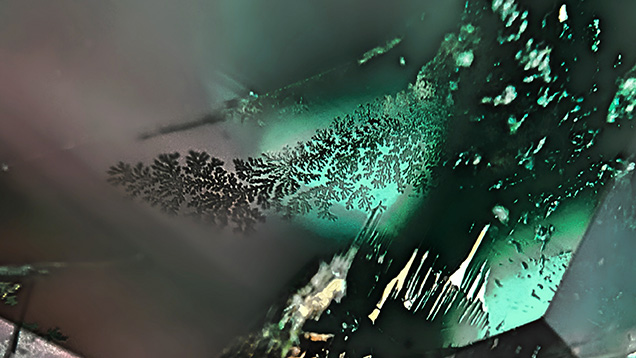
Dendritic, or tree-like, patterned inclusions are captivating features found in emeralds that significantly enhance their beauty and uniqueness. Typically composed of iron, manganese, or other trace elements, these minerals crystallize into intricate patterns that resemble natural foliage or tree branches. Dendritic patterns form under specific geological conditions, where variations in temperature, pressure, and the presence of different minerals can create such striking formations.
Alternatively, dendritic inclusions can result from clarity-enhancing treatments, where oils or resins are introduced to improve the visual quality of the emerald (see above). When these substances dry, they can leave behind patterns that closely resemble some natural inclusions.
This inclusion suite in emerald is commonly referred to as a jardin, which translates to “garden” in French. Each jardin tells a unique story, showcasing the complex interplay of geological processes and human intervention that contribute to its allure. As no two gardens are alike, each piece is truly one-of-a-kind.
Dendritic, or tree-like, patterned inclusions are captivating features found in emeralds that significantly enhance their beauty and uniqueness. Typically composed of iron, manganese, or other trace elements, these minerals crystallize into intricate patterns that resemble natural foliage or tree branches. Dendritic patterns form under specific geological conditions, where variations in temperature, pressure, and the presence of different minerals can create such striking formations.
Alternatively, dendritic inclusions can result from clarity-enhancing treatments, where oils or resins are introduced to improve the visual quality of the emerald (see above). When these substances dry, they can leave behind patterns that closely resemble some natural inclusions.
This inclusion suite in emerald is commonly referred to as a jardin, which translates to “garden” in French. Each jardin tells a unique story, showcasing the complex interplay of geological processes and human intervention that contribute to its allure. As no two gardens are alike, each piece is truly one-of-a-kind.