
A 0.66 ct piece of blue sapphire rough from the Bo Tang Su mining area of Cambodia’s Pailin region displayed dendritic inclusions, commonly found in quartz and chalcedony but rarely seen in corundum.
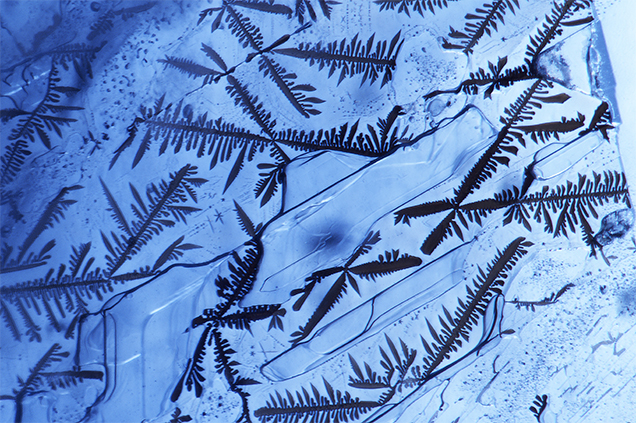
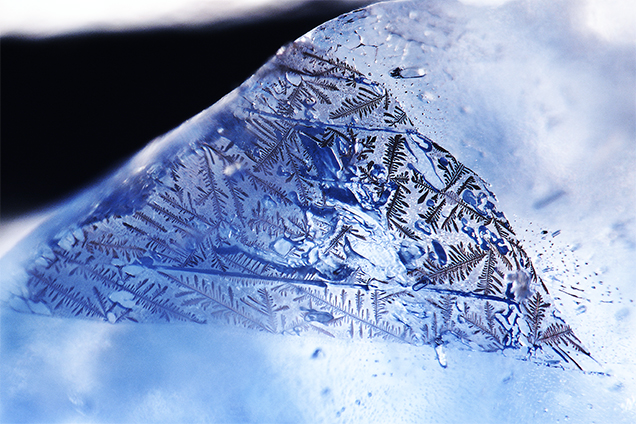
These epigenetic inclusions occur as a dendritic pattern trapped along surface-reaching fractures and show higher luster than the host under reflected light. Viewed in fiber-optic light, they appear black along the fracture and the trapped unknown fluid phases (figure 1). Raman spectroscopy identified the inclusions as a compound of manganese oxide-hydroxides. The presence of these dendritic inclusions, seen trapped in a triangular fracture in figure 2, is quite unusual in sapphire from Cambodia.
Charuwan Khowpong is an analyst at GIA in Bangkok.
A 0.66 ct piece of blue sapphire rough from the Bo Tang Su mining area of Cambodia’s Pailin region displayed dendritic inclusions, commonly found in quartz and chalcedony but rarely seen in corundum.
These epigenetic inclusions occur as a dendritic pattern trapped along surface-reaching fractures and show higher luster than the host under reflected light. Viewed in fiber-optic light, they appear black along the fracture and the trapped unknown fluid phases (figure 1). Raman spectroscopy identified the inclusions as a compound of manganese oxide-hydroxides. The presence of these dendritic inclusions, seen trapped in a triangular fracture in figure 2, is quite unusual in sapphire from Cambodia.
Charuwan Khowpong is an analyst at GIA in Bangkok.