
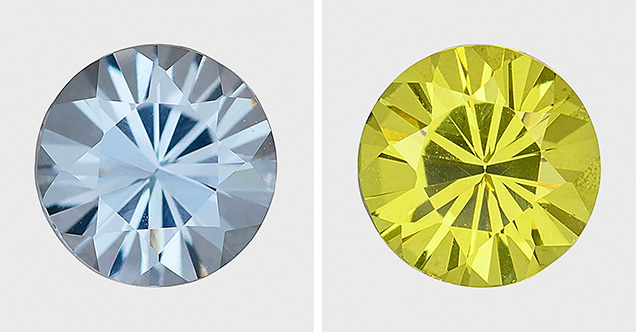
Recently, a 1.70 ct light blue stone was submitted as an alexandrite to the New York laboratory for identification (see above, left). Standard gemological testing yielded a refractive index of 1.760–1.768 and a specific gravity of 3.99, values consistent with corundum. Microscopic examination revealed an internally clean stone. It did not display curved color banding under diffused light, and Plato lines were not observed under cross-polarized light. Due to the lack of diagnostic inclusions and growth structures, the authors examined the stone’s short-wave ultraviolet fluorescence under a mercury mineral lamp (S. Elen and E. Fritsch, “The separation of natural from synthetic colorless sapphire,” Spring 1999 G&G, pp. 30–41). The stone displayed a moderately strong yellow “chalky” fluorescence with a banded pattern that is not known to be observed in natural stones. During the exposure time, which was only a few seconds, a photochromic effect occurred in which the bodycolor changed from light blue to yellow (see above, right). Photochromism can be defined as the reversible change of color from exposure to electromagnetic radiation, typically due to wavelengths of light from the visible to ultraviolet range.
Laser ablation–inductively coupled plasma–mass spectrometry returned very low concentrations of gallium (0.022–0.025 ppma), supporting a synthetic origin. The unnaturally high levels of nickel (28.3–31.2 ppma) may explain the sudden and drastic color change exhibited by this stone. In the late 1990s, researchers from the joint venture Tairus experimented with varying concentrations of Ni2+, Ni3+, and Cr3+ to grow blue gem-quality hydrothermal sapphires with an even color distribution. Interestingly, some of their light greenish blue nickel-doped sapphires displayed a stable color change to yellow when artificially irradiated with gamma radiation (V.G. Thomas et al., “Tairus hydrothermal synthetic sapphires doped with nickel and chromium,” Fall 1997 G&G, pp. 188–202). However, the sapphire studied here did not share the swirl-like growth observed in Tairus laboratory-grown sapphires.
Yellow and orange photochromism has been a known phenomenon in sapphires for some time (R. Crowningshield, “Developments and highlights at the Gem Trade Lab in New York: X-ray bombarded sapphires,” Summer 1969 G&G, p. 57; K. Nassau and G.K. Valente, “The seven types of yellow sapphire and their stability to light,” Winter 1987 G&G, pp. 222–231). Until now, however, changes in color with exposure to UV light have always been found to be reversible with exposure to white light.
The authors tried to revert the stone back to its original color, starting with the standard color stability test performed on all padparadscha sapphires submitted to GIA. This involves exposing the stone to a high-strength incandescent light source. When no change was observed, additional attempts were made, including gentle heating similar to that performed on “chameleon” diamonds, as well as X-ray exposure and long-term illumination under an LED light source containing no UV component. Images were collected before and after each stability test, and the bodycolor remained unchanged after every attempt to revert the stone to its original color. Despite these efforts, the sapphire was returned to the client as yellow.
This stone serves as a cautionary tale. Synthetic sapphire is often observed under short-wave UV or placed in a DiamondView to look for curved banding. Caution should be used when using these tests, at least on some colors of possible synthetic sapphire. To the authors’ knowledge, this is the first documented case of corundum with irreversible photochromism encountered in a gemological laboratory. One should avoid exposing these pale blue laboratory-grown sapphires to UV radiation until this phenomenon is better understood.
Recently, a 1.70 ct light blue stone was submitted as an alexandrite to the New York laboratory for identification (see above, left). Standard gemological testing yielded a refractive index of 1.760–1.768 and a specific gravity of 3.99, values consistent with corundum. Microscopic examination revealed an internally clean stone. It did not display curved color banding under diffused light, and Plato lines were not observed under cross-polarized light. Due to the lack of diagnostic inclusions and growth structures, the authors examined the stone’s short-wave ultraviolet fluorescence under a mercury mineral lamp (S. Elen and E. Fritsch, “The separation of natural from synthetic colorless sapphire,” Spring 1999 G&G, pp. 30–41). The stone displayed a moderately strong yellow “chalky” fluorescence with a banded pattern that is not known to be observed in natural stones. During the exposure time, which was only a few seconds, a photochromic effect occurred in which the bodycolor changed from light blue to yellow (see above, right). Photochromism can be defined as the reversible change of color from exposure to electromagnetic radiation, typically due to wavelengths of light from the visible to ultraviolet range.
Laser ablation–inductively coupled plasma–mass spectrometry returned very low concentrations of gallium (0.022–0.025 ppma), supporting a synthetic origin. The unnaturally high levels of nickel (28.3–31.2 ppma) may explain the sudden and drastic color change exhibited by this stone. In the late 1990s, researchers from the joint venture Tairus experimented with varying concentrations of Ni2+, Ni3+, and Cr3+ to grow blue gem-quality hydrothermal sapphires with an even color distribution. Interestingly, some of their light greenish blue nickel-doped sapphires displayed a stable color change to yellow when artificially irradiated with gamma radiation (V.G. Thomas et al., “Tairus hydrothermal synthetic sapphires doped with nickel and chromium,” Fall 1997 G&G, pp. 188–202). However, the sapphire studied here did not share the swirl-like growth observed in Tairus laboratory-grown sapphires.
Yellow and orange photochromism has been a known phenomenon in sapphires for some time (R. Crowningshield, “Developments and highlights at the Gem Trade Lab in New York: X-ray bombarded sapphires,” Summer 1969 G&G, p. 57; K. Nassau and G.K. Valente, “The seven types of yellow sapphire and their stability to light,” Winter 1987 G&G, pp. 222–231). Until now, however, changes in color with exposure to UV light have always been found to be reversible with exposure to white light.
The authors tried to revert the stone back to its original color, starting with the standard color stability test performed on all padparadscha sapphires submitted to GIA. This involves exposing the stone to a high-strength incandescent light source. When no change was observed, additional attempts were made, including gentle heating similar to that performed on “chameleon” diamonds, as well as X-ray exposure and long-term illumination under an LED light source containing no UV component. Images were collected before and after each stability test, and the bodycolor remained unchanged after every attempt to revert the stone to its original color. Despite these efforts, the sapphire was returned to the client as yellow.
This stone serves as a cautionary tale. Synthetic sapphire is often observed under short-wave UV or placed in a DiamondView to look for curved banding. Caution should be used when using these tests, at least on some colors of possible synthetic sapphire. To the authors’ knowledge, this is the first documented case of corundum with irreversible photochromism encountered in a gemological laboratory. One should avoid exposing these pale blue laboratory-grown sapphires to UV radiation until this phenomenon is better understood.