
On February 5 at the Pima County Historic Courthouse in Tucson, Hayley Henning, chairperson of Gems Keep Giving, introduced us to the nonprofit focused on improving the lives of small scale–mining and gem-cutting communities around the world. This 501c3 organization, started by the International Colored Gemstone Association, is now autonomous. Gems Keep Giving works to develop better living conditions, provide safety protections, ensure sustainability of resources, and protect the environment with projects funded via ethical and transparent partnerships.
Henning presented on the progress made in Kamtonga, Kenya, with Gems Keep Giving’s first project. This tsavorite mining community has benefited from the contributions of solar energy and clean drinking water. The organization aims to apply this model in other mining regions to provide community members with needed resources, while ensuring that mining profits are shared fairly. A second presentation by Brian Cook summarized his project in Brazil to provide safety equipment and sustainable farming in a community that produces rutilated quartz.
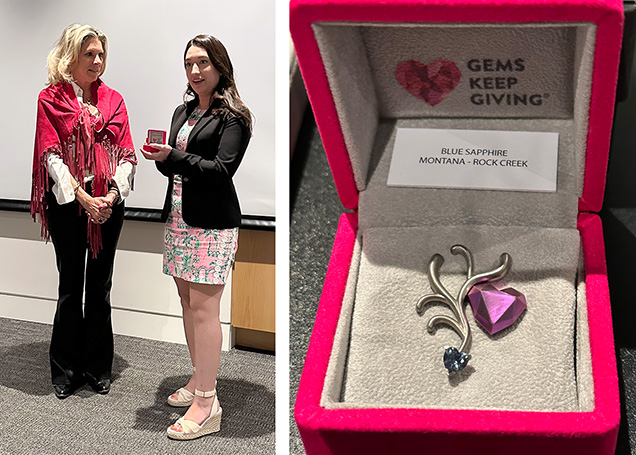
A collaboration between Gems Keep Giving and Italian brands Margherita Burgener and Petramundi has produced a limited-edition set of 10 pins. These titanium and gemstone pins, designed by Emanuela Burgener and handcrafted in Valenza, Italy, symbolize the foundation’s mission. Each pin contains a unique gemstone, and all 10 include a central pink titanium heart representing the Gems Keep Giving logo, with five extending branches for the five major gem-sourcing continents. The gemstones were carefully chosen to represent the location of each project, whether a specific community or country. The original prototype pin, which contains a Montana sapphire and represents North America, was donated to the Smithsonian National Museum of Natural History’s gem and mineral collection and presented to curator Gabriela Farfan during the event (see above). Over the next three months, Gems Keep Giving will raise money for future projects similar to their first in Kenya, awarding the remaining pins to the top donors.
On February 5 at the Pima County Historic Courthouse in Tucson, Hayley Henning, chairperson of Gems Keep Giving, introduced us to the nonprofit focused on improving the lives of small scale–mining and gem-cutting communities around the world. This 501c3 organization, started by the International Colored Gemstone Association, is now autonomous. Gems Keep Giving works to develop better living conditions, provide safety protections, ensure sustainability of resources, and protect the environment with projects funded via ethical and transparent partnerships.
Henning presented on the progress made in Kamtonga, Kenya, with Gems Keep Giving’s first project. This tsavorite mining community has benefited from the contributions of solar energy and clean drinking water. The organization aims to apply this model in other mining regions to provide community members with needed resources, while ensuring that mining profits are shared fairly. A second presentation by Brian Cook summarized his project in Brazil to provide safety equipment and sustainable farming in a community that produces rutilated quartz.
A collaboration between Gems Keep Giving and Italian brands Margherita Burgener and Petramundi has produced a limited-edition set of 10 pins. These titanium and gemstone pins, designed by Emanuela Burgener and handcrafted in Valenza, Italy, symbolize the foundation’s mission. Each pin contains a unique gemstone, and all 10 include a central pink titanium heart representing the Gems Keep Giving logo, with five extending branches for the five major gem-sourcing continents. The gemstones were carefully chosen to represent the location of each project, whether a specific community or country. The original prototype pin, which contains a Montana sapphire and represents North America, was donated to the Smithsonian National Museum of Natural History’s gem and mineral collection and presented to curator Gabriela Farfan during the event (see above). Over the next three months, Gems Keep Giving will raise money for future projects similar to their first in Kenya, awarding the remaining pins to the top donors.