
The seventh annual Chicago Responsible Jewelry Conference (CRJC) was held August 11–13, 2023, in Rosemont, Illinois. Susan Wheeler, Responsible Jewelry Transformative (RJT) founder and Virtu Gem cofounder, opened by highlighting efforts to further the United Nations Sustainable Development Goals (SDGs) and the UN Women’s Generation Equality campaign. The first of the 17 SDGs is to end poverty, which disproportionately affects the roughly 40 million artisanal and small-scale miners worldwide. Wheeler said poverty poses a risk to the jewelry industry because consumers do not want to perpetuate it. Responsible supply chains can help lift miners from poverty, she noted, and the industry can make great strides toward the UN’s goals.
Anna Samsonova (Samsonova Consulting) moderated a panel on opening markets for artisanal gemstone miners in East Africa. Pauline Mundia (Virtu Gem Zambia), Jessica Hudson (Virtu Gem), Sejal Karavadia (Brilliant Earth), and Cristina Villegas (PACT and Moyo Gems) discussed the importance of information exchange with miners and cutters, developing trust with the help of local associations, creating sourcing standards, and training and education. Karavadia said customers are very receptive to a gem’s mine-to-market story. Sixty percent of the miners in Moyo’s supply chain are women, Villegas said, and they have begun incorporating young woman cutters. “For many years, Africa was exporting raw unprocessed materials,” she said. “Now it’s high-end beautiful faceted gemstones, and we should celebrate that.”
Deep-sea biologist Lisa Levin (Scripps Institution of Oceanography, University of California, San Diego) explained how deep-sea mining of minerals, including gold and silver, would disrupt ecosystems. The International Seabed Authority (ISA) has approved 31 mining exploration contracts in international waters as of January 2023 and is developing regulations. Deep-sea ecosystems host abundant life, with interdependent species that depend on specific hydrologic and geochemical properties, she said, and provide many benefits to the broader ocean. The deep sea is also home to bacteria that consume methane, a driver of global warming. Levin said mining could cause extinctions and risks destruction of deep-sea biodiversity. Additionally, scientists believe that post-mining restoration is not possible on the seafloor. Since the definition of serious harm remains unclear and much about these ecosystems is still unknown, she said, there is insufficient knowledge for evidence-based decision making by the ISA.
Holly McHugh (Mejuri, Inc.) moderated a panel on responsible silver sourcing. Panelists noted an increase in high-level guidance for responsible sourcing. Examining this market is complex because more than 70% of silver production is a byproduct of other mining, panelists said, while artisanal and small-scale mining is challenging because silver requires so much mining effort. Torry Hoover said Hoover & Strong’s refined metals are now 100% recycled, and Will Nevins-Alderfer’s W.R. Metalarts uses Fairmined silver for its alloys. Many of the Richline Group’s larger customers now ask about sourcing, said Mark Hanna, and the company has begun tracking silver with blockchain. He emphasized knowing your supplier and customer to ensure ethical products.
Susan Wheeler and Virtu Gem’s Chiko Manda (via video message) discussed Malawi’s gem trade. The country exports hundreds of kilograms of high-quality aquamarine annually but is one of the poorest in the world. Manda said very few gems mined in Malawi are processed there due to lack of expertise and equipment, compounded by smuggling problems, and data indicate that less than 1% of its aquamarine is legally exported. He asked jewelry companies to allocate a small percentage of their budgets to buy cut stones from source countries to motivate cutters to improve their skills. Wheeler added that this would improve traceability. “If you support the gem processing industry in Africa, you empower a lot of people,” Manda said.
In a virtual presentation, Mkhululi Nkosilamandla Ncube (African Minerals Development Center, AMDC) introduced the African Mining Vision (AMV), a project of the UN. The AMV aims to transform the paradox of mineral wealth and dire poverty through equitable mineral exploitation. The AMDC’s methods to implement the AMV include community engagement, training, technology, and financial support. As part of the approach, the Africa Gemstones and Jewellery Exhibition and Conference (AGJEC) series promotes the trade of African gemstones within the continent. The first event was held in Zambia in July; upcoming events will take place in Nigeria and Ghana this fall.
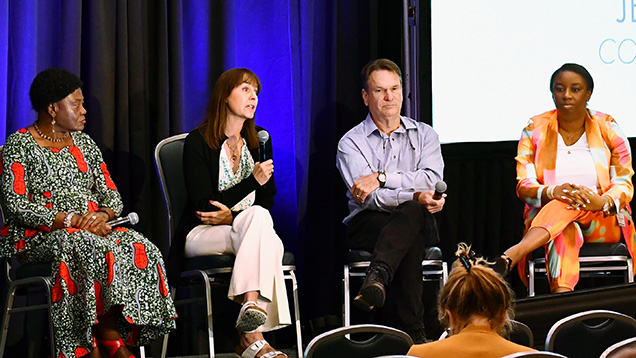
Brecken Branstrator (GemGuide) moderated a panel on working with source country gem traders (figure 1). Eric Braunwart (Columbia Gem House), Ola Erogbogbo-Oyeniyi (Deinte Designs Limited), Pauline Mundia, Stuart Pool (Nineteen48), and Susan Wheeler shared key takeaways, including the importance of understanding the local market and legal system, supply chain analysis, and working with local partners. Erogbogbo-Oyeniyi said that helping a community and weaving that into a gem’s story is a great benefit.
Anna Bario described founding jewelry company Bario Neal with fellow designer Page Neal in 2008 and developing a responsible supply chain. Early on, they connected with Ethical Metalsmiths, the Alliance for Responsible Mining (ARM), and artisanal miners in Tanzania and Peru. They built relationships with ethical suppliers over the next decade and in 2019 hired a consultant to help establish a process based on the UN SDGs and OECD Due Diligence Guidance for Responsible Business Conduct. This includes a code of conduct they share with suppliers, supplier interviews, and an eight-step partner and material evaluation process. In 2020, the company released its first biannual sustainability report, possibly the first by a small independent jeweler. Their next goal is Climate Neutral certification.
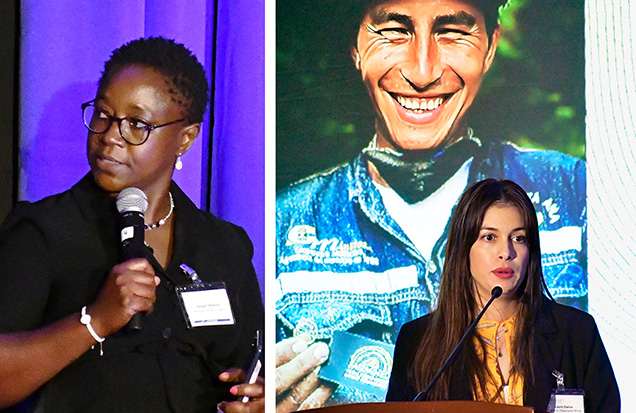
A panel on sex trafficking in Marange, Zimbabwe, moderated by Brandee Dallow (Grandview Klein Diamond Group), began with a documentary clip of survivors’ stories. The area has been fraught with conflict and violence since the discovery of diamonds there in 2006. The U.S. has banned imports of Marange diamonds due to reports of forced labor. According to Abigail Sibanda (Marange Women’s Alliance, MWA) (figure 2, left), the military, police, mine guards, and informal miners collaborate to smuggle diamonds out and exploit women and girls. Vulnerability to trafficking stems from Zimbabwe’s high poverty, and many victims are lured by the promise of mining work. The community questions where the diamond revenue goes because there is no development, Sibanda said. Susan Wheeler noted that RJT and MWA have facilitated support for survivors through court advocacy, but prosecution is still very limited. MWA helps survivors with peer-to-peer counseling and other support and empowers all women to speak out, holding weekly meetings on WhatsApp. The group has been planning to purchase a chicken coop to develop consistent income and pay for their cellular data, which RJT currently covers. MWA is also creating a billboard campaign for Marange to highlight the issue. “We protect the diamonds. Why don’t we protect the women?” remarked Sibanda, who has relocated outside of Zimbabwe because her activism has put her at risk.
Roy Maconachie (University of Bath, England) described the relationship between mining and agriculture in Sierra Leone based on his research there since 2003, after the civil war. Most mining occurs in the dry season, with income used to farm in the rainy season. Over the last decade, artisanal miners have shifted to gold because most alluvial diamond deposits are mined out. Artisanal gold mining here is dominated by women and provides a reliable income. The interconnected nature of farming and mining can help rebuild agricultural institutions destroyed during the war, he said, but miners still need basic infrastructure, access to markets and credit, and technology.
Laura Galvis (ARM) (figure 2, right) detailed three Fairmined-certified projects—the Íquira cooperative, La Gabriela, and the Chede mine—that support almost 200 workers and show how small-scale gold mining and agriculture coexist in Colombia. The Fairmined label certifies gold, silver, and platinum from small-scale mining organizations using responsible practices, and it comes with the Fairmined Premium, an economic incentive. The Chede mine committee will use this year’s premium to sponsor a coffee brand sourced by miners farming coffee; they have 5,600 Fairmined credits and need 20,000 for this project. Businesses can buy Fairmined credits to support the project of their choice.
Sarah Yood (Jewelers Vigilance Committee) and Andrea Hill (Hill Management Group) discussed U.S. sanctions against Russian diamonds due to the war in Ukraine. Yood explained that because diamonds are considered a product of the country in which they are cut—with 90% cut in India—Russian diamonds can still reach the U.S. She acknowledged India’s difficult position and the issue of protecting jobs there. The EU and the G7 countries are working to stop the flow of Russian diamonds. (At press time, an announcement was expected shortly.) Yood said that starting in 2024, G7 countries will likely require diamonds of one carat or larger to carry proof they were not mined in Russia (the size threshold will be progressively lowered). Hill said that in theory, it will eventually be clear if a diamond originated in Russia or Zimbabwe.
Saleem Ali (University of Delaware and UN International Resource Panel, IPA) presented an IPA report analyzing resource rushes in Africa, which found that mineral resources can lead to migration within Africa and prevent migration to Europe. A key message of the report was that property rights to resources can reduce forced migration. Ali suggested jewelry companies partner with the UN High Commission on Refugees to train refugees in jewelry making.
Natasha and Eric Braunwart (Columbia Gem House), Megan Cochran (Megan Cochran Jewelry Design), and Hannah Smythe (Toast Fine Jewelry) discussed how responsibly sourced designs can engage consumers. The MJSA 2023 Design Challenge, sponsored by Columbia Gem House, asks for designs based on a set of gemstones and a fictional client story. The Jewelry for Wildlife raffle of selected pieces benefits CRRIFS, a wildlife rescue, rehabilitation, and research center in Guaymas, Mexico.
Shannon Kurzyniec and Chelsea Rowe of the Ethical Metalsmiths Student Committee introduced 2023’s So Fresh + So Clean online responsible jewelry exhibition, which asked artists to consider the life cycle of their creations. This year’s awards went to Rashele Alradaideh (Virginia Commonwealth University), Amy Beeler (Bowling Green State University), and Maria Hammond (Manchester Metropolitan University, England), with cash prizes sponsored by Hoover & Strong, Rio Grande, and Earthworks.
The conference also included a collaborative session on advancing the UN SDGs through jewelry supply chains. Sunday offered a Responsible Gem Boutique with eight suppliers, co-located with the InStore Show. After Saturday’s sessions, Anna Samsonova announced that attendee donations had fully funded the Marange Women’s Alliance’s chicken coop project.
Erin Hogarth is senior writer and editor in Learning Design and Development, and assistant editor for Gems & Gemology, at GIA in Carlsbad, California.
The seventh annual Chicago Responsible Jewelry Conference (CRJC) was held August 11–13, 2023, in Rosemont, Illinois. Susan Wheeler, Responsible Jewelry Transformative (RJT) founder and Virtu Gem cofounder, opened by highlighting efforts to further the United Nations Sustainable Development Goals (SDGs) and the UN Women’s Generation Equality campaign. The first of the 17 SDGs is to end poverty, which disproportionately affects the roughly 40 million artisanal and small-scale miners worldwide. Wheeler said poverty poses a risk to the jewelry industry because consumers do not want to perpetuate it. Responsible supply chains can help lift miners from poverty, she noted, and the industry can make great strides toward the UN’s goals.
Anna Samsonova (Samsonova Consulting) moderated a panel on opening markets for artisanal gemstone miners in East Africa. Pauline Mundia (Virtu Gem Zambia), Jessica Hudson (Virtu Gem), Sejal Karavadia (Brilliant Earth), and Cristina Villegas (PACT and Moyo Gems) discussed the importance of information exchange with miners and cutters, developing trust with the help of local associations, creating sourcing standards, and training and education. Karavadia said customers are very receptive to a gem’s mine-to-market story. Sixty percent of the miners in Moyo’s supply chain are women, Villegas said, and they have begun incorporating young woman cutters. “For many years, Africa was exporting raw unprocessed materials,” she said. “Now it’s high-end beautiful faceted gemstones, and we should celebrate that.”
Deep-sea biologist Lisa Levin (Scripps Institution of Oceanography, University of California, San Diego) explained how deep-sea mining of minerals, including gold and silver, would disrupt ecosystems. The International Seabed Authority (ISA) has approved 31 mining exploration contracts in international waters as of January 2023 and is developing regulations. Deep-sea ecosystems host abundant life, with interdependent species that depend on specific hydrologic and geochemical properties, she said, and provide many benefits to the broader ocean. The deep sea is also home to bacteria that consume methane, a driver of global warming. Levin said mining could cause extinctions and risks destruction of deep-sea biodiversity. Additionally, scientists believe that post-mining restoration is not possible on the seafloor. Since the definition of serious harm remains unclear and much about these ecosystems is still unknown, she said, there is insufficient knowledge for evidence-based decision making by the ISA.
Holly McHugh (Mejuri, Inc.) moderated a panel on responsible silver sourcing. Panelists noted an increase in high-level guidance for responsible sourcing. Examining this market is complex because more than 70% of silver production is a byproduct of other mining, panelists said, while artisanal and small-scale mining is challenging because silver requires so much mining effort. Torry Hoover said Hoover & Strong’s refined metals are now 100% recycled, and Will Nevins-Alderfer’s W.R. Metalarts uses Fairmined silver for its alloys. Many of the Richline Group’s larger customers now ask about sourcing, said Mark Hanna, and the company has begun tracking silver with blockchain. He emphasized knowing your supplier and customer to ensure ethical products.
Susan Wheeler and Virtu Gem’s Chiko Manda (via video message) discussed Malawi’s gem trade. The country exports hundreds of kilograms of high-quality aquamarine annually but is one of the poorest in the world. Manda said very few gems mined in Malawi are processed there due to lack of expertise and equipment, compounded by smuggling problems, and data indicate that less than 1% of its aquamarine is legally exported. He asked jewelry companies to allocate a small percentage of their budgets to buy cut stones from source countries to motivate cutters to improve their skills. Wheeler added that this would improve traceability. “If you support the gem processing industry in Africa, you empower a lot of people,” Manda said.
In a virtual presentation, Mkhululi Nkosilamandla Ncube (African Minerals Development Center, AMDC) introduced the African Mining Vision (AMV), a project of the UN. The AMV aims to transform the paradox of mineral wealth and dire poverty through equitable mineral exploitation. The AMDC’s methods to implement the AMV include community engagement, training, technology, and financial support. As part of the approach, the Africa Gemstones and Jewellery Exhibition and Conference (AGJEC) series promotes the trade of African gemstones within the continent. The first event was held in Zambia in July; upcoming events will take place in Nigeria and Ghana this fall.
Brecken Branstrator (GemGuide) moderated a panel on working with source country gem traders (figure 1). Eric Braunwart (Columbia Gem House), Ola Erogbogbo-Oyeniyi (Deinte Designs Limited), Pauline Mundia, Stuart Pool (Nineteen48), and Susan Wheeler shared key takeaways, including the importance of understanding the local market and legal system, supply chain analysis, and working with local partners. Erogbogbo-Oyeniyi said that helping a community and weaving that into a gem’s story is a great benefit.
Anna Bario described founding jewelry company Bario Neal with fellow designer Page Neal in 2008 and developing a responsible supply chain. Early on, they connected with Ethical Metalsmiths, the Alliance for Responsible Mining (ARM), and artisanal miners in Tanzania and Peru. They built relationships with ethical suppliers over the next decade and in 2019 hired a consultant to help establish a process based on the UN SDGs and OECD Due Diligence Guidance for Responsible Business Conduct. This includes a code of conduct they share with suppliers, supplier interviews, and an eight-step partner and material evaluation process. In 2020, the company released its first biannual sustainability report, possibly the first by a small independent jeweler. Their next goal is Climate Neutral certification.
A panel on sex trafficking in Marange, Zimbabwe, moderated by Brandee Dallow (Grandview Klein Diamond Group), began with a documentary clip of survivors’ stories. The area has been fraught with conflict and violence since the discovery of diamonds there in 2006. The U.S. has banned imports of Marange diamonds due to reports of forced labor. According to Abigail Sibanda (Marange Women’s Alliance, MWA) (figure 2, left), the military, police, mine guards, and informal miners collaborate to smuggle diamonds out and exploit women and girls. Vulnerability to trafficking stems from Zimbabwe’s high poverty, and many victims are lured by the promise of mining work. The community questions where the diamond revenue goes because there is no development, Sibanda said. Susan Wheeler noted that RJT and MWA have facilitated support for survivors through court advocacy, but prosecution is still very limited. MWA helps survivors with peer-to-peer counseling and other support and empowers all women to speak out, holding weekly meetings on WhatsApp. The group has been planning to purchase a chicken coop to develop consistent income and pay for their cellular data, which RJT currently covers. MWA is also creating a billboard campaign for Marange to highlight the issue. “We protect the diamonds. Why don’t we protect the women?” remarked Sibanda, who has relocated outside of Zimbabwe because her activism has put her at risk.
Roy Maconachie (University of Bath, England) described the relationship between mining and agriculture in Sierra Leone based on his research there since 2003, after the civil war. Most mining occurs in the dry season, with income used to farm in the rainy season. Over the last decade, artisanal miners have shifted to gold because most alluvial diamond deposits are mined out. Artisanal gold mining here is dominated by women and provides a reliable income. The interconnected nature of farming and mining can help rebuild agricultural institutions destroyed during the war, he said, but miners still need basic infrastructure, access to markets and credit, and technology.
Laura Galvis (ARM) (figure 2, right) detailed three Fairmined-certified projects—the Íquira cooperative, La Gabriela, and the Chede mine—that support almost 200 workers and show how small-scale gold mining and agriculture coexist in Colombia. The Fairmined label certifies gold, silver, and platinum from small-scale mining organizations using responsible practices, and it comes with the Fairmined Premium, an economic incentive. The Chede mine committee will use this year’s premium to sponsor a coffee brand sourced by miners farming coffee; they have 5,600 Fairmined credits and need 20,000 for this project. Businesses can buy Fairmined credits to support the project of their choice.
Sarah Yood (Jewelers Vigilance Committee) and Andrea Hill (Hill Management Group) discussed U.S. sanctions against Russian diamonds due to the war in Ukraine. Yood explained that because diamonds are considered a product of the country in which they are cut—with 90% cut in India—Russian diamonds can still reach the U.S. She acknowledged India’s difficult position and the issue of protecting jobs there. The EU and the G7 countries are working to stop the flow of Russian diamonds. (At press time, an announcement was expected shortly.) Yood said that starting in 2024, G7 countries will likely require diamonds of one carat or larger to carry proof they were not mined in Russia (the size threshold will be progressively lowered). Hill said that in theory, it will eventually be clear if a diamond originated in Russia or Zimbabwe.
Saleem Ali (University of Delaware and UN International Resource Panel, IPA) presented an IPA report analyzing resource rushes in Africa, which found that mineral resources can lead to migration within Africa and prevent migration to Europe. A key message of the report was that property rights to resources can reduce forced migration. Ali suggested jewelry companies partner with the UN High Commission on Refugees to train refugees in jewelry making.
Natasha and Eric Braunwart (Columbia Gem House), Megan Cochran (Megan Cochran Jewelry Design), and Hannah Smythe (Toast Fine Jewelry) discussed how responsibly sourced designs can engage consumers. The MJSA 2023 Design Challenge, sponsored by Columbia Gem House, asks for designs based on a set of gemstones and a fictional client story. The Jewelry for Wildlife raffle of selected pieces benefits CRRIFS, a wildlife rescue, rehabilitation, and research center in Guaymas, Mexico.
Shannon Kurzyniec and Chelsea Rowe of the Ethical Metalsmiths Student Committee introduced 2023’s So Fresh + So Clean online responsible jewelry exhibition, which asked artists to consider the life cycle of their creations. This year’s awards went to Rashele Alradaideh (Virginia Commonwealth University), Amy Beeler (Bowling Green State University), and Maria Hammond (Manchester Metropolitan University, England), with cash prizes sponsored by Hoover & Strong, Rio Grande, and Earthworks.
The conference also included a collaborative session on advancing the UN SDGs through jewelry supply chains. Sunday offered a Responsible Gem Boutique with eight suppliers, co-located with the InStore Show. After Saturday’s sessions, Anna Samsonova announced that attendee donations had fully funded the Marange Women’s Alliance’s chicken coop project.
Erin Hogarth is senior writer and editor in Learning Design and Development, and assistant editor for Gems & Gemology, at GIA in Carlsbad, California.