
Natural gemstones form under very intense conditions that allow for a wide range of interesting phenomena and inclusions to occur within them. Environmental conditions within the earth’s crust influence the types and amounts of inclusions that occur. Various categories of inclusions, such as crystals or structural defects, for example, are widespread among almost all gem species. On the other hand, there are less frequent types of inclusions that form only under specific geological conditions and are found only in certain gem species. Although less common, it is possible to observe up to three phases of matter within a single inclusion suite.
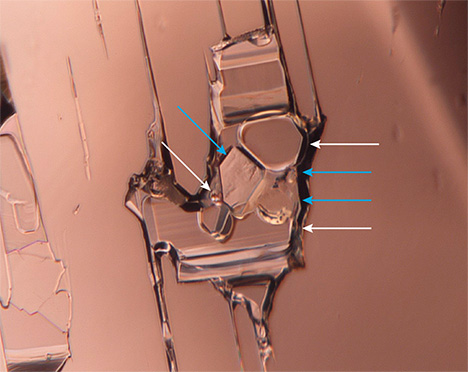
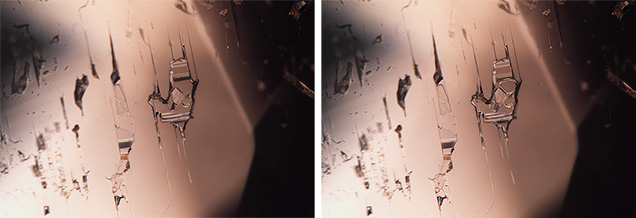
At conditions slightly above room temperature (i.e., in the well light of a gemological microscope), the largest jagged cavity pictured here contains multiple separate crystals and a transparent colorless fluid (figure 1). At a temperature below 31.2°C, the fluid separates into liquid and multiple bubbles of carbon dioxide gas are released (figure 2). Differences in environmental conditions during formation influence the amount of static pressure within the stone, which explains why some three-phase inclusions are visible at room temperature while others are only visible at lower temperatures (see J.I. Koivula, “Carbon dioxide fluid inclusions as proof of natural-colored corundum,” Fall 1986 G&G;, pp. 152–155). Despite the shape and the relief of the crystals present, the overall appearance of this alexandrite’s multiphase inclusion is comparable to the typical jagged three-phase inclusions that are distinctive for Colombian emerald.
Natural gemstones form under very intense conditions that allow for a wide range of interesting phenomena and inclusions to occur within them. Environmental conditions within the earth’s crust influence the types and amounts of inclusions that occur. Various categories of inclusions, such as crystals or structural defects, for example, are widespread among almost all gem species. On the other hand, there are less frequent types of inclusions that form only under specific geological conditions and are found only in certain gem species. Although less common, it is possible to observe up to three phases of matter within a single inclusion suite.
At conditions slightly above room temperature (i.e., in the well light of a gemological microscope), the largest jagged cavity pictured here contains multiple separate crystals and a transparent colorless fluid (figure 1). At a temperature below 31.2°C, the fluid separates into liquid and multiple bubbles of carbon dioxide gas are released (figure 2). Differences in environmental conditions during formation influence the amount of static pressure within the stone, which explains why some three-phase inclusions are visible at room temperature while others are only visible at lower temperatures (see J.I. Koivula, “Carbon dioxide fluid inclusions as proof of natural-colored corundum,” Fall 1986 G&G;, pp. 152–155). Despite the shape and the relief of the crystals present, the overall appearance of this alexandrite’s multiphase inclusion is comparable to the typical jagged three-phase inclusions that are distinctive for Colombian emerald.