
Natural blister pearls and natural shell blisters have long been a subject of debate for gemologists and can be very challenging to definitively identify (see G&G Lab Notes from Fall 1992, Spring 1995, Winter 1996, Winter 2015, Summer 2016, and Spring 2018). According to the World Jewellery Confederation (CIBJO), a natural blister pearl forms when a natural pearl detaches itself from the pearl sac and attaches to the inner wall of the shell, while a natural shell blister is an internal protuberance that forms on a shell’s inner surface. It is usually caused by a foreign object accidentally finding its way into the space between the mantle and shell surface.
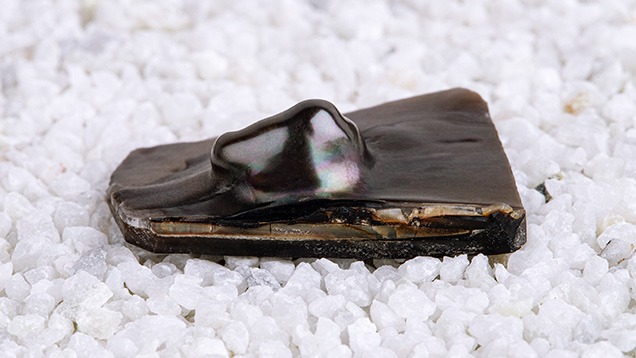
GIA’s Mumbai laboratory recently examined an interesting dark greenish brown baroque-shaped blister attached to a portion of shell weighing 2.60 g (13.00 ct) total and measuring approximately 25.54 × 18.11 × 7.79 mm (figure 1).

Examination under 40× magnification revealed a graduated hexagonal structure on the shell base (figure 2, A and B). The shell was cut and worked around the edges, and growth layers were visible when the cut surfaces were examined. Exposure to X-ray fluorescence yielded no reaction for the shell blister. Energy-dispersive X-ray fluorescence spectrometry on two areas (top and base) revealed manganese levels below the detection limit, and strontium levels of 1470 ppm (top) and 2431 ppm (base) were consistent with those expected for saltwater pearls.

Real-time microradiography (RTX), shown in the top row of figure 3, revealed a pleasant surprise. An obvious and intriguing gastropod shell was hidden beneath the overlying layers, which resulted in further study using X-ray computed microtomography (μ-CT) (figure 3, bottom row). The minute details of a unique marine gastropod exoskeleton measuring approximately 8.30 × 5.75 mm were observed within a void feature, and the overlying growth layers on the face side (the surface that grew within the mollusk it formed in) revealed minimal growth arcs. Marine gastropods are known to vary in size, and the class consists of many thousands of species (A. Nutzel., “Larval ecology and morphology in fossil gastropods,” Paleontology, Vol. 57, No. 3, 2014, pp. 479–503). These observations provided enough evidence to make a clear distinction between a shell blister, such as this sample, and a shell blister pearl (“Natural shell blisters and blister pearls: What’s the difference?” GIA Research News, August 26, 2019).
The ultraviolet/visible reflectance spectra showed a prominent feature at around 450 nm and weaker features at 320, 330, 450, and 460 nm proving that the sample’s color was natural and lacked any treatment. Raman analysis using 514 nm laser excitation showed a series of peaks at 158, 186, 204, and 213 cm–1; a weak peak at 280 cm–1; a doublet peak around 701–704 cm–1; and a strong peak at 1085 cm–1. These were indicative of aragonite. The photoluminescence spectra were also consistent with the Raman and displayed high fluorescence and aragonite-related peaks. These results were unexpected given the cellular-looking structure observed through the microscope, as this type of structure usually results in Raman spectra indicative of calcite.
While the lustrous dark color and the cellular-looking structure indicated the host shell was likely a species from the Pinnidae family, it was not clear given the spectral data collected (N. Sturman et al., “Observations on pearls reportedly from the Pinnidae family (pen pearls),” Fall 2014 G&G, pp. 202–215). When the surface structures were compared to photomicrographs of known Pinna species shell from GIA’s Bangkok laboratory (figure 2, C and D), the results showed some similarity. However, Raman spectra indicative of calcite were obtained for the Bangkok research collection samples, which differed from the sample studied here. The Atrina vexillum species may have been responsible for producing the natural shell blister, and this would explain the aragonite-related Raman peaks since this mollusk is known to produce pearls with an aragonitic structure. However, since Atrina species pearls are often nacreous when aragonite is present and the sample in question was non-nacreous, the contradicting data still leaves some doubt as to the true identity of the host. Nevertheless, this example of a shell blister encompassing a gastropod shell represents a noteworthy phenomenon of nature that is rarely encountered.
Natural blister pearls and natural shell blisters have long been a subject of debate for gemologists and can be very challenging to definitively identify (see G&G Lab Notes from Fall 1992, Spring 1995, Winter 1996, Winter 2015, Summer 2016, and Spring 2018). According to the World Jewellery Confederation (CIBJO), a natural blister pearl forms when a natural pearl detaches itself from the pearl sac and attaches to the inner wall of the shell, while a natural shell blister is an internal protuberance that forms on a shell’s inner surface. It is usually caused by a foreign object accidentally finding its way into the space between the mantle and shell surface.
GIA’s Mumbai laboratory recently examined an interesting dark greenish brown baroque-shaped blister attached to a portion of shell weighing 2.60 g (13.00 ct) total and measuring approximately 25.54 × 18.11 × 7.79 mm (figure 1).
Examination under 40× magnification revealed a graduated hexagonal structure on the shell base (figure 2, A and B). The shell was cut and worked around the edges, and growth layers were visible when the cut surfaces were examined. Exposure to X-ray fluorescence yielded no reaction for the shell blister. Energy-dispersive X-ray fluorescence spectrometry on two areas (top and base) revealed manganese levels below the detection limit, and strontium levels of 1470 ppm (top) and 2431 ppm (base) were consistent with those expected for saltwater pearls.
Real-time microradiography (RTX), shown in the top row of figure 3, revealed a pleasant surprise. An obvious and intriguing gastropod shell was hidden beneath the overlying layers, which resulted in further study using X-ray computed microtomography (μ-CT) (figure 3, bottom row). The minute details of a unique marine gastropod exoskeleton measuring approximately 8.30 × 5.75 mm were observed within a void feature, and the overlying growth layers on the face side (the surface that grew within the mollusk it formed in) revealed minimal growth arcs. Marine gastropods are known to vary in size, and the class consists of many thousands of species (A. Nutzel., “Larval ecology and morphology in fossil gastropods,” Paleontology, Vol. 57, No. 3, 2014, pp. 479–503). These observations provided enough evidence to make a clear distinction between a shell blister, such as this sample, and a shell blister pearl (“Natural shell blisters and blister pearls: What’s the difference?” GIA Research News, August 26, 2019).
The ultraviolet/visible reflectance spectra showed a prominent feature at around 450 nm and weaker features at 320, 330, 450, and 460 nm proving that the sample’s color was natural and lacked any treatment. Raman analysis using 514 nm laser excitation showed a series of peaks at 158, 186, 204, and 213 cm–1; a weak peak at 280 cm–1; a doublet peak around 701–704 cm–1; and a strong peak at 1085 cm–1. These were indicative of aragonite. The photoluminescence spectra were also consistent with the Raman and displayed high fluorescence and aragonite-related peaks. These results were unexpected given the cellular-looking structure observed through the microscope, as this type of structure usually results in Raman spectra indicative of calcite.
While the lustrous dark color and the cellular-looking structure indicated the host shell was likely a species from the Pinnidae family, it was not clear given the spectral data collected (N. Sturman et al., “Observations on pearls reportedly from the Pinnidae family (pen pearls),” Fall 2014 G&G, pp. 202–215). When the surface structures were compared to photomicrographs of known Pinna species shell from GIA’s Bangkok laboratory (figure 2, C and D), the results showed some similarity. However, Raman spectra indicative of calcite were obtained for the Bangkok research collection samples, which differed from the sample studied here. The Atrina vexillum species may have been responsible for producing the natural shell blister, and this would explain the aragonite-related Raman peaks since this mollusk is known to produce pearls with an aragonitic structure. However, since Atrina species pearls are often nacreous when aragonite is present and the sample in question was non-nacreous, the contradicting data still leaves some doubt as to the true identity of the host. Nevertheless, this example of a shell blister encompassing a gastropod shell represents a noteworthy phenomenon of nature that is rarely encountered.