
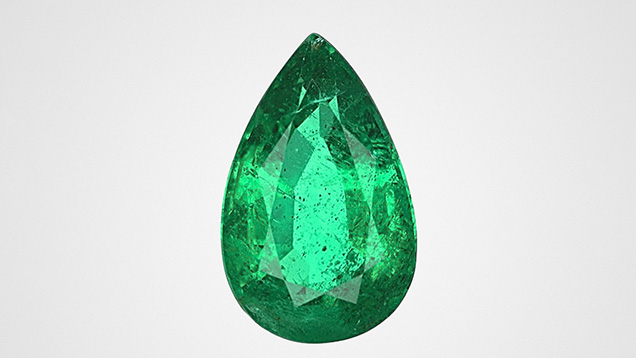
Recently, a 1.86 ct transparent green pear mixed cut (figure 1) was submitted for identification to the Carlsbad laboratory. Initial testing produced the following results: refractive index values of 1.582–1.590, birefringence of 0.008, doubly refractive, and a hydrostatic specific gravity of 2.73. The long-wave UV reaction was red with a blue fluorescence in surface-reaching fractures from the clarity enhancement. These results were consistent with natural emerald. Trace element chemistry of the host emerald collected via laser ablation–inductively coupled plasma–mass spectrometry (LA-ICP-MS) matched well with GIA’s Russian emerald chemistry reference data.
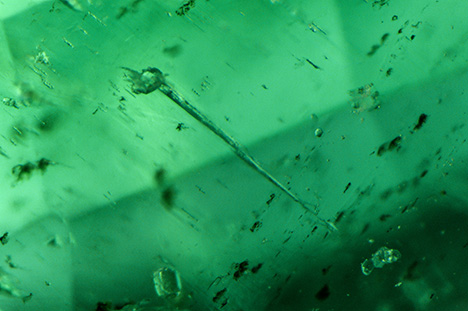
While the identification of any gem requires further testing with a variety of instruments, in most cases the stone’s natural or synthetic origin can be determined conclusively by features seen under magnification. Nail-head spicules are typically associated with synthetic hydrothermal (and occasionally flux-grown) emerald and synthetic quartz, but they are also occasionally found in natural gems such as beryl, sapphire, spinel, tourmaline, and quartz (G. Choudhary and C. Golecha, “A study of nail-head spicule inclusions in natural gemstones,” Fall 2007 G&G;, pp. 228–235; K. Schmetzer et al., “Multicomponent inclusions in Nacken synthetic emeralds,” Journal of Gemmology, Vol. 26, No. 8, 1999, pp. 487–500). Nail-head spicules are wedge-shaped two-phase (liquid and gas) inclusions capped by crystals that act as growth obstacles (figure 2). During growth of the host crystal, a small crystal or platelet is deposited on its surface. As the crystal continues to grow past the inclusion, a tapered void is created, which traps the hydrothermal growth medium such that, upon cooling, it becomes two phases consisting of liquid and a gas bubble (Choudhary and Golecha, 2007).
Recently, a 1.86 ct transparent green pear mixed cut (figure 1) was submitted for identification to the Carlsbad laboratory. Initial testing produced the following results: refractive index values of 1.582–1.590, birefringence of 0.008, doubly refractive, and a hydrostatic specific gravity of 2.73. The long-wave UV reaction was red with a blue fluorescence in surface-reaching fractures from the clarity enhancement. These results were consistent with natural emerald. Trace element chemistry of the host emerald collected via laser ablation–inductively coupled plasma–mass spectrometry (LA-ICP-MS) matched well with GIA’s Russian emerald chemistry reference data.
While the identification of any gem requires further testing with a variety of instruments, in most cases the stone’s natural or synthetic origin can be determined conclusively by features seen under magnification. Nail-head spicules are typically associated with synthetic hydrothermal (and occasionally flux-grown) emerald and synthetic quartz, but they are also occasionally found in natural gems such as beryl, sapphire, spinel, tourmaline, and quartz (G. Choudhary and C. Golecha, “A study of nail-head spicule inclusions in natural gemstones,” Fall 2007 G&G;, pp. 228–235; K. Schmetzer et al., “Multicomponent inclusions in Nacken synthetic emeralds,” Journal of Gemmology, Vol. 26, No. 8, 1999, pp. 487–500). Nail-head spicules are wedge-shaped two-phase (liquid and gas) inclusions capped by crystals that act as growth obstacles (figure 2). During growth of the host crystal, a small crystal or platelet is deposited on its surface. As the crystal continues to grow past the inclusion, a tapered void is created, which traps the hydrothermal growth medium such that, upon cooling, it becomes two phases consisting of liquid and a gas bubble (Choudhary and Golecha, 2007).