
Russian emeralds have been mined since the mid-nineteenth century near Yekaterinburg in the Ural Mountains. They are classified as schist-related emeralds, meaning they formed in the reaction zone of a pegmatite intruding into schists. Similar emeralds are found in Zambia, Brazil, and Ethiopia. All of these deposits can show a similar inclusion scene (S. Saeseaw et al., “Geographic origin determination of emerald,” Winter 2019 G&G, pp. 614–646).
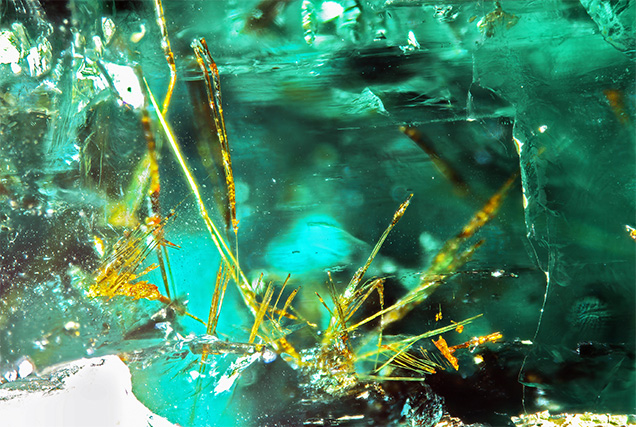
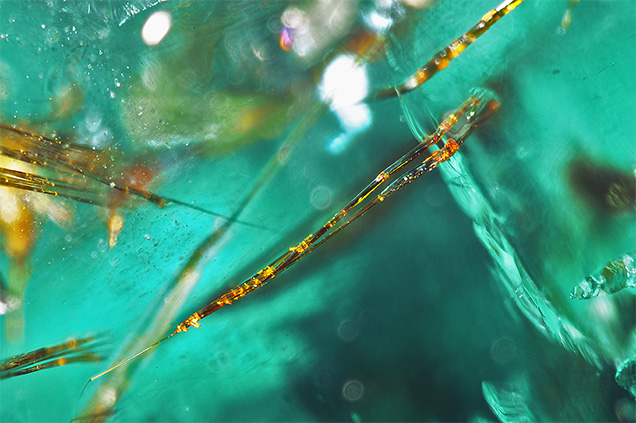
A 1.489 ct Russian emerald crystal collected by GIA at the Mariinsky Priisk mine showed several interesting included crystals. The crystals appeared as long yellowish brown rods (figure 1). In some cases, they appeared as a group of disordered coarse needles (figure 2). They were identified by Raman spectroscopy as rutile. Although rutile crystal inclusions are common in schist-related emeralds, this crystal morphology is unusual and has not previously been mentioned in the literature. Therefore, this inclusion might be unique and different from the other schist-related emerald sources. These unusual patterns could potentially be an indicator of Russian origin.
Russian emeralds have been mined since the mid-nineteenth century near Yekaterinburg in the Ural Mountains. They are classified as schist-related emeralds, meaning they formed in the reaction zone of a pegmatite intruding into schists. Similar emeralds are found in Zambia, Brazil, and Ethiopia. All of these deposits can show a similar inclusion scene (S. Saeseaw et al., “Geographic origin determination of emerald,” Winter 2019 G&G, pp. 614–646).
A 1.489 ct Russian emerald crystal collected by GIA at the Mariinsky Priisk mine showed several interesting included crystals. The crystals appeared as long yellowish brown rods (figure 1). In some cases, they appeared as a group of disordered coarse needles (figure 2). They were identified by Raman spectroscopy as rutile. Although rutile crystal inclusions are common in schist-related emeralds, this crystal morphology is unusual and has not previously been mentioned in the literature. Therefore, this inclusion might be unique and different from the other schist-related emerald sources. These unusual patterns could potentially be an indicator of Russian origin.