
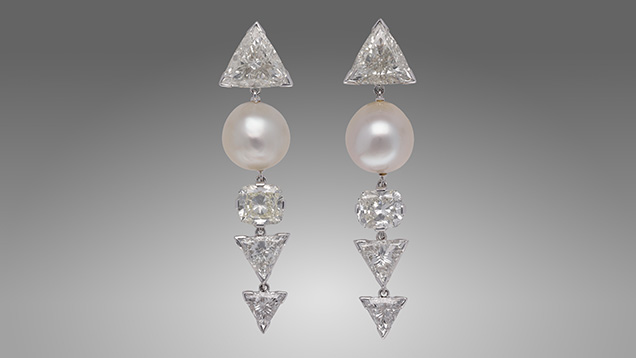
Recently, GIA’s Mumbai laboratory received an intriguing pair of mounted pearl earrings, which were later unmounted for identification and concluded as assembled pearls. Both button-shaped pearls were partially drilled and exhibited a light cream hue. Pearl A measured 12.19 × 11.88 × 7.38 mm and weighed 7.40 ct, and pearl B measured 12.58 × 12.06 × 9.18 mm and weighed 9.37 ct (figure 1).
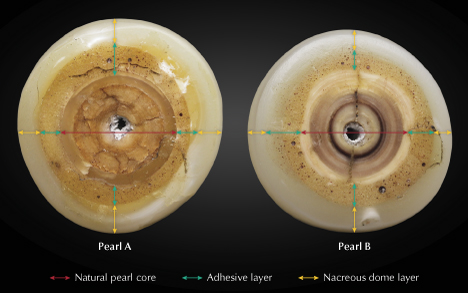
The face of each pearl appeared smooth and showed typical fine overlapping aragonite platelets, while each base exhibited prominent layering of materials used in the assembly process. The inner layers revealed a concentric acicular core with significant cracks typically seen in a natural pearl growth structure. This was surrounded by a layer of yellowish translucent material consisting of brown bubble-like spots, likely the adhesive material used in bonding the inner core with the outer nacreous dome (figure 2).
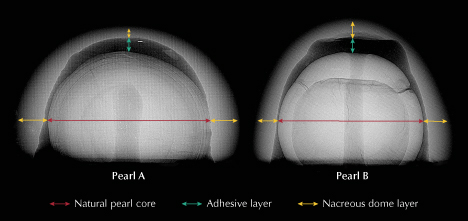
Real-time X-ray microradiography (RTX) imaging of the two pearls revealed similar unusual internal compositions (figure 3). The inner cores were distinctly rounded and exhibited growth features consistent with those of natural pearl. The outer domes appeared more button shaped, featuring a straight profile that flared outward toward the base and lacked a defined growth structure. These features suggested they may be blister materials, as indicated by the visible dark conchiolin layer and open skirts. However, whether these nacre domes were shell blisters, blister pearls, or cut whole pearls, and whether they were naturally formed or cultured could not be determined. Therefore, their exact identity remains inconclusive (Fall 2015 Lab Notes, p. 318). Notably, each pearl showed a wide opening at the end of its drill hole. RTX imaging indicated that pearl A was partially drilled and pearl B was fully drilled prior to assembly. Both surface evidence and RTX imaging suggest that these natural cores had been bonded with the nacre domes using a radiolucent adhesive material. The natural cores and nacre domes may or may not belong to the same pearl. In addition, both pearls presented a significant internal void, which is a typical characteristic of assembled pearls or materials such as mabe pearl.
When exposed to X-ray fluorescence, the faces of the pearls displayed a very weak greenish reaction, while the bases showed a weak greenish yellow reaction for the outer nacre domes and the inner cores remained inert. Energy-dispersive X-ray fluorescence analysis on the face of each pearl revealed no trace of manganese and high strontium levels of 1353 ppm and 1532 ppm, respectively, indicating a saltwater origin. Under long-wave (365 nm) ultraviolet radiation, the top surface of both pearls exhibited a moderate bluish reaction, while the inner bottom layers displayed a weak yellowish green to light orangy red. A weaker overall reaction was observed under short-wave (254 nm) ultraviolet radiation.
The specific type of assembled pearl observed in this pair of earrings, in which natural pearl cores are used to simulate the appearance of natural pearl growth, is uncommon. Such items require comprehensive laboratory testing for accurate identification, as once mounted, these assembled pearls can easily deceive the human eye.
Roxane Bhot Jain is manager of pearl, melee, and AGSI technical and market development at GIA in Mumbai. Abeer Al-Alawi is a consultant to GIA. Chunhui Zhou is senior manager of pearl identification at GIA in New York.
Recently, GIA’s Mumbai laboratory received an intriguing pair of mounted pearl earrings, which were later unmounted for identification and concluded as assembled pearls. Both button-shaped pearls were partially drilled and exhibited a light cream hue. Pearl A measured 12.19 × 11.88 × 7.38 mm and weighed 7.40 ct, and pearl B measured 12.58 × 12.06 × 9.18 mm and weighed 9.37 ct (figure 1).
The face of each pearl appeared smooth and showed typical fine overlapping aragonite platelets, while each base exhibited prominent layering of materials used in the assembly process. The inner layers revealed a concentric acicular core with significant cracks typically seen in a natural pearl growth structure. This was surrounded by a layer of yellowish translucent material consisting of brown bubble-like spots, likely the adhesive material used in bonding the inner core with the outer nacreous dome (figure 2).
Real-time X-ray microradiography (RTX) imaging of the two pearls revealed similar unusual internal compositions (figure 3). The inner cores were distinctly rounded and exhibited growth features consistent with those of natural pearl. The outer domes appeared more button shaped, featuring a straight profile that flared outward toward the base and lacked a defined growth structure. These features suggested they may be blister materials, as indicated by the visible dark conchiolin layer and open skirts. However, whether these nacre domes were shell blisters, blister pearls, or cut whole pearls, and whether they were naturally formed or cultured could not be determined. Therefore, their exact identity remains inconclusive (Fall 2015 Lab Notes, p. 318). Notably, each pearl showed a wide opening at the end of its drill hole. RTX imaging indicated that pearl A was partially drilled and pearl B was fully drilled prior to assembly. Both surface evidence and RTX imaging suggest that these natural cores had been bonded with the nacre domes using a radiolucent adhesive material. The natural cores and nacre domes may or may not belong to the same pearl. In addition, both pearls presented a significant internal void, which is a typical characteristic of assembled pearls or materials such as mabe pearl.
When exposed to X-ray fluorescence, the faces of the pearls displayed a very weak greenish reaction, while the bases showed a weak greenish yellow reaction for the outer nacre domes and the inner cores remained inert. Energy-dispersive X-ray fluorescence analysis on the face of each pearl revealed no trace of manganese and high strontium levels of 1353 ppm and 1532 ppm, respectively, indicating a saltwater origin. Under long-wave (365 nm) ultraviolet radiation, the top surface of both pearls exhibited a moderate bluish reaction, while the inner bottom layers displayed a weak yellowish green to light orangy red. A weaker overall reaction was observed under short-wave (254 nm) ultraviolet radiation.
The specific type of assembled pearl observed in this pair of earrings, in which natural pearl cores are used to simulate the appearance of natural pearl growth, is uncommon. Such items require comprehensive laboratory testing for accurate identification, as once mounted, these assembled pearls can easily deceive the human eye.
Roxane Bhot Jain is manager of pearl, melee, and AGSI technical and market development at GIA in Mumbai. Abeer Al-Alawi is a consultant to GIA. Chunhui Zhou is senior manager of pearl identification at GIA in New York.