
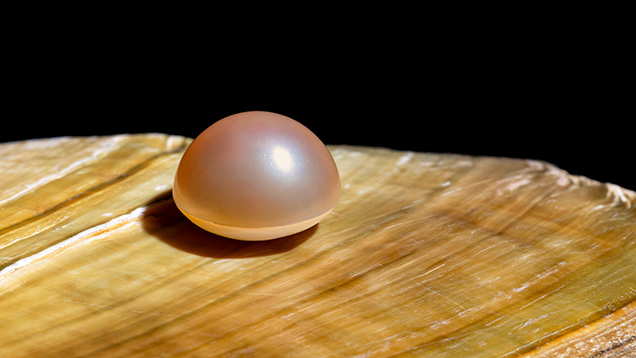
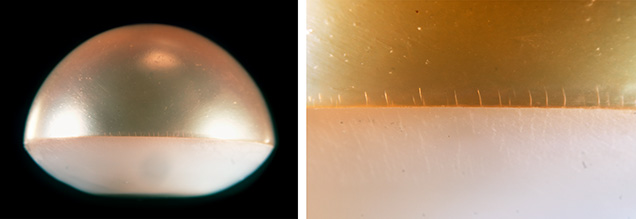
Recently, the Carlsbad laboratory received for identification a loose, undrilled button-shaped item weighing 9.51 ct and measuring 12.56 × 12.45 × 8.87 mm (figure 1). This item appeared to be a typical mabe, the term for an assembled cultured shell blister, due to its composite nature and distinct seamline between a pinkish orange nacre dome top and a white mother-of-pearl shell base (figure 2, left). This type of assemblage is commonly manufactured from a thin nacre dome of a cultured shell blister cut from the shell surface with the half-dome implanted nucleus removed. Then the nacre dome is cleaned, filled, and sometimes colored with various kinds of artificial materials such as resin and backed with a piece of polished shell for stability.
Upon microscopic observation, the top dome portion appeared to be a thick nacre material due to the opaqueness of the nacreous surface, unlike the thin translucent nacre dome typically observed on most mabe materials. The surface contained common pits and scratches. However, many short vertical fractures were present within the surface of the top dome along the boundary (figure 2, right), an uncommon characteristic for mabe. The pinkish orange color appeared uniform, and a lack of unusual color concentrations suggested a natural color origin. This was subsequently confirmed with Raman spectroscopy using a 514 nm laser excitation, revealing two natural polyenic pigments at 1134 and 1526 cm–1 along with aragonite peaks.
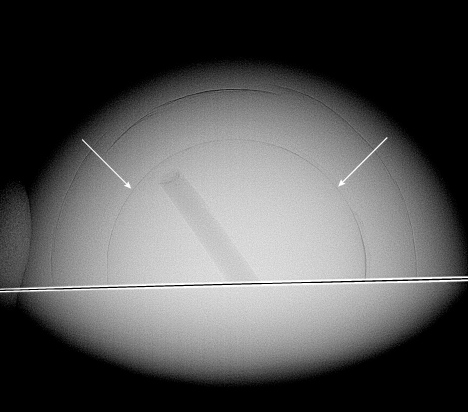
The boundary between the two sections was clearly visible in the real-time X-ray microradiography (RTX) image, and glue material appeared as bright radiopaque lines. Surprisingly, the top nacre dome had a thick nacre layer containing a few growth arcs within, and a semi-spherical demarcation of a bead nucleus (indicated by arrows in figure 3) was present. The structure resembled a typical bead cultured pearl. Further, the drilled bead nucleus, a common feature in freshwater pearls, suggested the bead cultured pearl was of freshwater origin (Summer 2017 Gem News International, pp. 255–256; A. Abduriyim, “Cultured pearls from Lake Kasumigaura: Production and gemological characteristics,” Summer 2018 G&G, pp. 166–183). Energy-dispersive X-ray fluorescence chemical analysis of both the nacre dome top and shell base also indicated freshwater origin. The shell base showed a tight structure with very faint banding.
These findings indicated that the item was not a mabe as initially believed but rather an assembled freshwater bead cultured half-pearl. The vertical fractures shown under high magnification were likely caused by the sawing process (see again figure 2, right). This unique discovery was a first for GIA, demonstrating the importance of microradiography imaging in pearl identification.
Recently, the Carlsbad laboratory received for identification a loose, undrilled button-shaped item weighing 9.51 ct and measuring 12.56 × 12.45 × 8.87 mm (figure 1). This item appeared to be a typical mabe, the term for an assembled cultured shell blister, due to its composite nature and distinct seamline between a pinkish orange nacre dome top and a white mother-of-pearl shell base (figure 2, left). This type of assemblage is commonly manufactured from a thin nacre dome of a cultured shell blister cut from the shell surface with the half-dome implanted nucleus removed. Then the nacre dome is cleaned, filled, and sometimes colored with various kinds of artificial materials such as resin and backed with a piece of polished shell for stability.
Upon microscopic observation, the top dome portion appeared to be a thick nacre material due to the opaqueness of the nacreous surface, unlike the thin translucent nacre dome typically observed on most mabe materials. The surface contained common pits and scratches. However, many short vertical fractures were present within the surface of the top dome along the boundary (figure 2, right), an uncommon characteristic for mabe. The pinkish orange color appeared uniform, and a lack of unusual color concentrations suggested a natural color origin. This was subsequently confirmed with Raman spectroscopy using a 514 nm laser excitation, revealing two natural polyenic pigments at 1134 and 1526 cm–1 along with aragonite peaks.
The boundary between the two sections was clearly visible in the real-time X-ray microradiography (RTX) image, and glue material appeared as bright radiopaque lines. Surprisingly, the top nacre dome had a thick nacre layer containing a few growth arcs within, and a semi-spherical demarcation of a bead nucleus (indicated by arrows in figure 3) was present. The structure resembled a typical bead cultured pearl. Further, the drilled bead nucleus, a common feature in freshwater pearls, suggested the bead cultured pearl was of freshwater origin (Summer 2017 Gem News International, pp. 255–256; A. Abduriyim, “Cultured pearls from Lake Kasumigaura: Production and gemological characteristics,” Summer 2018 G&G, pp. 166–183). Energy-dispersive X-ray fluorescence chemical analysis of both the nacre dome top and shell base also indicated freshwater origin. The shell base showed a tight structure with very faint banding.
These findings indicated that the item was not a mabe as initially believed but rather an assembled freshwater bead cultured half-pearl. The vertical fractures shown under high magnification were likely caused by the sawing process (see again figure 2, right). This unique discovery was a first for GIA, demonstrating the importance of microradiography imaging in pearl identification.