

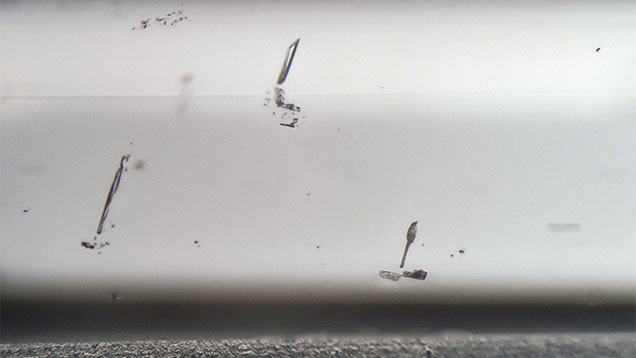
A 0.59 ct near-colorless octagonal step-cut stone was recently submitted to the Carlsbad laboratory (figure 1). Standard gemological testing measured a refractive index of 1.550–1.555 (birefringence of 0.005), a biaxial optic figure, and a hydrostatic specific gravity of 2.77. Microscopic examination revealed negative crystals (figure 2), colorless particles, and a small fingerprint breaking the pavilion surface. These properties were consistent with those reported for armenite. The submitted stone was then compared to a near-colorless armenite reference specimen belonging to the GIA Museum, which showed a similar microscopic appearance along with internal stress fractures. Raman and infrared spectra collected on both stones were a near-perfect match, further supporting the armenite identity of the stone.
Armenite is a rare orthorhombic silicate with a formula of BaCa2Al6Si9O30•2(H2O). Originally identified in Norway in 1939, it has since been found in Canada (Quebec), Australia (New South Wales), Scotland, the Czech Republic, Switzerland, the United States (Washington), and Italy (Sardinia). It usually forms as veins within host rocks, including metasomatic basic to intermediate igneous rocks, mineralized skarn and hornfels, and gneisses. The data gathered from this first-time submission of armenite will assist in future identifications.
Britni LeCroy is a senior staff gemologist at GIA in Carlsbad, California.
A 0.59 ct near-colorless octagonal step-cut stone was recently submitted to the Carlsbad laboratory (figure 1). Standard gemological testing measured a refractive index of 1.550–1.555 (birefringence of 0.005), a biaxial optic figure, and a hydrostatic specific gravity of 2.77. Microscopic examination revealed negative crystals (figure 2), colorless particles, and a small fingerprint breaking the pavilion surface. These properties were consistent with those reported for armenite. The submitted stone was then compared to a near-colorless armenite reference specimen belonging to the GIA Museum, which showed a similar microscopic appearance along with internal stress fractures. Raman and infrared spectra collected on both stones were a near-perfect match, further supporting the armenite identity of the stone.
Armenite is a rare orthorhombic silicate with a formula of BaCa2Al6Si9O30•2(H2O). Originally identified in Norway in 1939, it has since been found in Canada (Quebec), Australia (New South Wales), Scotland, the Czech Republic, Switzerland, the United States (Washington), and Italy (Sardinia). It usually forms as veins within host rocks, including metasomatic basic to intermediate igneous rocks, mineralized skarn and hornfels, and gneisses. The data gathered from this first-time submission of armenite will assist in future identifications.
Britni LeCroy is a senior staff gemologist at GIA in Carlsbad, California.