
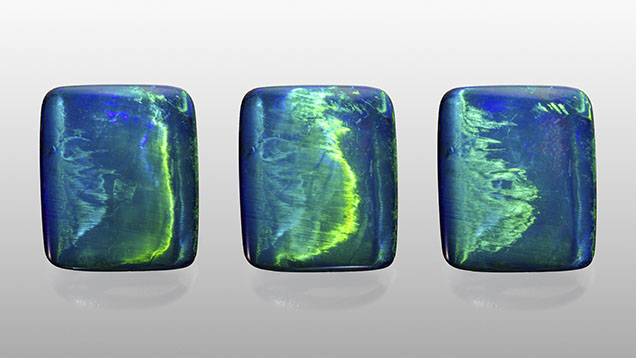
The Carlsbad laboratory recently encountered a 4.80 ct cushion-shaped double cabochon, measuring 11.65 × 9.87 × 4.71 mm, submitted for identification. The cabochon’s specific gravity measured 2.68 with a spot refractive index reading of 1.44, consistent with boulder opal. The stone was characterized as a translucent precious cat’s-eye boulder opal with an opaque ironstone matrix base. Its dark gray bodycolor was influenced by a cloudy layer of minute inclusions at the precious opal–ironstone matrix boundary. The uneven boundary and color pattern indicated the stone’s natural creation, showing no evidence of assembly or treatment and no fluorescence when exposed to ultraviolet light. The chatoyant play-of-color band stayed dominantly green as a light source moved across the stone, with flashes of blue play-of-color mingling with the green (see above). Chatoyant bands in precious cat’s-eye opal are not always one color; while more centered and well-defined in comparison to this boulder opal, a solid green chatoyant band has been similarly observed, displaying an “opening” of the eye under two light sources (Summer 2003 Lab Notes, p. 148).
Precious opal is often associated with unique mosaic patterns attributed to its play-of-color. This material can also display other phenomena such as asterism (Summer 2014 Lab Notes, pp. 152–153) or chatoyancy. Both phenomena are quite uncommon due to opal’s lack of a definite repeating crystal structure (J.V. Sanders, “The structure of star opals,” Acta Crystallographica, Vol. A32, 1976, pp. 334–338). Most cat’s-eye opals on the market today lack play-of-color; these are referred to as common opals and tend to have a brownish yellow bodycolor. Chatoyancy in common opal is caused by light reflecting off numerous parallel fibrous inclusions, as it is in most other cat’s-eye gemstones. Common cat’s-eye opal can originate from countries such as Tanzania and Brazil.
GIA laboratories occasionally examine rare precious cat’s-eye opals with misalignments in their structure generating linearly arranged play-of-color patches. Precious cat’s-eye opal has been sourced from various countries including the United States and Mexico (Winter 1990 Gem News, p. 304), with the sharpness of the eyes and the spectral colors observed varying greatly. Chatoyancy in precious opal can be affected by the cutting quality and orientation.
This cat’s-eye boulder opal was reportedly sourced from the Opalton mining area, a locality in Queensland, Australia. Precious opal in boulder rough is rarely visible on the exterior of ironstone concretions. A periphery saw blade impregnated with industrial diamond is used to carefully slice at the edges of the concretion, exposing the opal. Slow grinding with the wheel when fashioning the stone gives definition to the cat’s-eye, or “rolling flash” play-of-color pattern.
As the cat’s-eye dissipated toward one side of the stone, a broad stroke of bluish green play-of-color resembling an aurora or bioluminescent ocean wave during an algae bloom took form. This unique type of boulder opal is a visually impressive and rare example of precious cat’s-eye opal viewed from any face-up angle.
Jeffrey Hernandez is an advanced staff gemologist at GIA in Carlsbad, California.
The Carlsbad laboratory recently encountered a 4.80 ct cushion-shaped double cabochon, measuring 11.65 × 9.87 × 4.71 mm, submitted for identification. The cabochon’s specific gravity measured 2.68 with a spot refractive index reading of 1.44, consistent with boulder opal. The stone was characterized as a translucent precious cat’s-eye boulder opal with an opaque ironstone matrix base. Its dark gray bodycolor was influenced by a cloudy layer of minute inclusions at the precious opal–ironstone matrix boundary. The uneven boundary and color pattern indicated the stone’s natural creation, showing no evidence of assembly or treatment and no fluorescence when exposed to ultraviolet light. The chatoyant play-of-color band stayed dominantly green as a light source moved across the stone, with flashes of blue play-of-color mingling with the green (see above). Chatoyant bands in precious cat’s-eye opal are not always one color; while more centered and well-defined in comparison to this boulder opal, a solid green chatoyant band has been similarly observed, displaying an “opening” of the eye under two light sources (Summer 2003 Lab Notes, p. 148).
Precious opal is often associated with unique mosaic patterns attributed to its play-of-color. This material can also display other phenomena such as asterism (Summer 2014 Lab Notes, pp. 152–153) or chatoyancy. Both phenomena are quite uncommon due to opal’s lack of a definite repeating crystal structure (J.V. Sanders, “The structure of star opals,” Acta Crystallographica, Vol. A32, 1976, pp. 334–338). Most cat’s-eye opals on the market today lack play-of-color; these are referred to as common opals and tend to have a brownish yellow bodycolor. Chatoyancy in common opal is caused by light reflecting off numerous parallel fibrous inclusions, as it is in most other cat’s-eye gemstones. Common cat’s-eye opal can originate from countries such as Tanzania and Brazil.
GIA laboratories occasionally examine rare precious cat’s-eye opals with misalignments in their structure generating linearly arranged play-of-color patches. Precious cat’s-eye opal has been sourced from various countries including the United States and Mexico (Winter 1990 Gem News, p. 304), with the sharpness of the eyes and the spectral colors observed varying greatly. Chatoyancy in precious opal can be affected by the cutting quality and orientation.
This cat’s-eye boulder opal was reportedly sourced from the Opalton mining area, a locality in Queensland, Australia. Precious opal in boulder rough is rarely visible on the exterior of ironstone concretions. A periphery saw blade impregnated with industrial diamond is used to carefully slice at the edges of the concretion, exposing the opal. Slow grinding with the wheel when fashioning the stone gives definition to the cat’s-eye, or “rolling flash” play-of-color pattern.
As the cat’s-eye dissipated toward one side of the stone, a broad stroke of bluish green play-of-color resembling an aurora or bioluminescent ocean wave during an algae bloom took form. This unique type of boulder opal is a visually impressive and rare example of precious cat’s-eye opal viewed from any face-up angle.
Jeffrey Hernandez is an advanced staff gemologist at GIA in Carlsbad, California.