

It is widely recognized that some gem minerals often occur together in various localities—either in the same host rock or in the same deposit. Gem minerals each require a certain set of physical and chemical conditions for their formation. This edition of the Colored Stones Unearthed column will explore where specific gem minerals are found together and the conditions that produce these distinct geological settings.
BACKGROUND
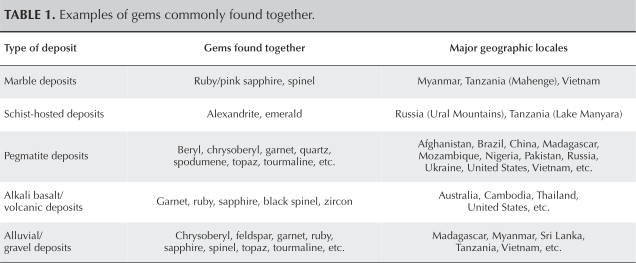
The most significant historic deposit of fine ruby is undeniably the Mogok Valley in Myanmar (formerly Burma). Yet, this deposit is recognized not only for yielding some of the world’s most important ruby, but also for a myriad of other fine gems (figure 1) from blue sapphire to peridot to spinel. Was it a stroke of luck that this relatively small region in Southeast Asia just happens to produce such an amazing diversity of gemstones, or is something more happening beneath the surface? The previous installment of Colored Stones Unearthed covered gems found in pegmatites. These pegmatitic deposits virtually always yield a number of different gemstones in the same deposit, rather than being single gem sources. In contrast, some gem deposits are known for producing almost exclusively one species of gemstone (e.g., the Mozambique ruby deposits, the Zambian emerald deposits, the Australian opal fields). In fact, it is quite common for multiple gems to be found in a single deposit (table 1). This contribution to Colored Stones Unearthed investigates deposits known for producing multiple gemstone species and places these deposits in a broader geological context. deposits in a broader geological context.
WHY ARE SOME GEMS FOUND TOGETHER
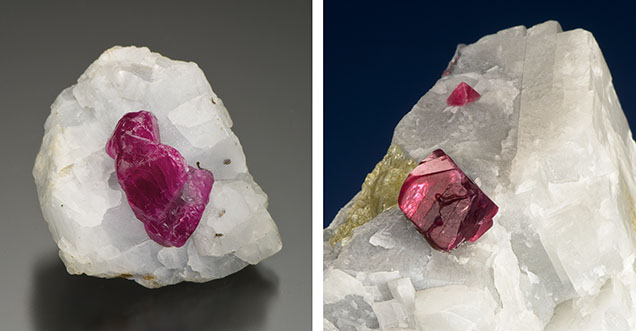
The assemblage of minerals that form in any situation is determined by the specific geological conditions including pressure, temperature, and local chemical environment. One instance of multiple gem species being found in the same deposit occurs when these species have overlapping chemical components but overall different chemical compositions. The simplest example is the Mogok Valley in Myanmar. Most of the major deposits here are alluvial. While the most well-known gem produced here is ruby, in many of the deposits, ruby and pink or red spinel are found in abundance. Though it is often stated anecdotally that ruby and spinel were indistinguishable until fairly recent mineralogical advancements, local mining communities in Mogok certainly understood these two mineral species were distinct and could distinguish between the two based on crystal morphology and other properties such as hardness. The chemical formulae for ruby (the red variety of corundum) and spinel are Al2O3 and MgAl2O4, respectively. Essentially the only chemical difference between ruby and red spinel, both colored by the presence of trace chromium, is the addition of magnesium to the nearly pure aluminum oxide comprising corundum (ruby). Fine mineral specimens of ruby and red spinel in marble are routinely recovered in Mogok (figure 2). The spinel-bearing specimens occur in a calcite (CaCO3) and dolomite (CaMg(CO3)2) marble, while ruby-bearing specimens occur in a marble that is nearly pure calcite. These specimens virtually never contain both ruby and spinel due to the fact that spinel crystallizes in these environments at the expense of corundum (ruby) when too much magnesium is present for corundum itself to form.
1Some exceptional cases of coexisting corundum and quartz assemblages have been documented, although it is unclear if these represent equilibrium or non-equilibrium mineralogical assemblages (Guiraud et al., 1996; Tsunogae and van Reenen, 2006).
The following section describes several instances in which different gemstones form in a single deposit due to diversity in the chemical environment. The next section covers volcanic deposits, where multiple gems are brought to the surface from great depths by basaltic or other volcanic eruptions. In these cases, the ultimate origin of the different gems found in the same deposit are not clearly understood, but there is almost certainly some genetic link. The final section discusses alluvial or secondary deposits, in which intense, usually tropical, weathering pulls gemstones from multiple geological formations across a broad area, gathering several different gem species together. In many cases, the gems found in these secondary deposits clearly have disparate geological origins involving entirely different formation conditions. The clearest example of this is gem-bearing gravels containing both corundum (ruby or sapphire) and gemmy quartz (figure 3). Under most circumstances, this is impossible as corundum and quartz cannot form in equilibrium at most conditions within the earth’s crust1.
DIFFERENT GEM SPECIES DUE TO CHEMICAL VARIATIONS
The chemical forces controlling mineralization within the earth have been studied systematically and extensively by geoscientists for more than 100 years. The thermodynamics dictating which minerals form where have largely been unraveled by scientists in experimental laboratories. Geochemists make sense of the results from these lab experiments using tools called phase diagrams, which help visualize the relationships among chemical composition and formation temperature and pressure (depth in the earth). One of the simplest of such diagrams is for the aluminosilicate minerals kyanite, sillimanite, and andalusite, all with the chemical formula Al2SiO5 but with different crystal structures. Whether one of these minerals forms instead of another depends on the pressure and temperature of formation. Figure 4 shows the phase diagram for these minerals; if the exact pressure and temperature of formation are known, they can be plotted on this diagram to reveal which of these minerals would have formed in any given geological environment.
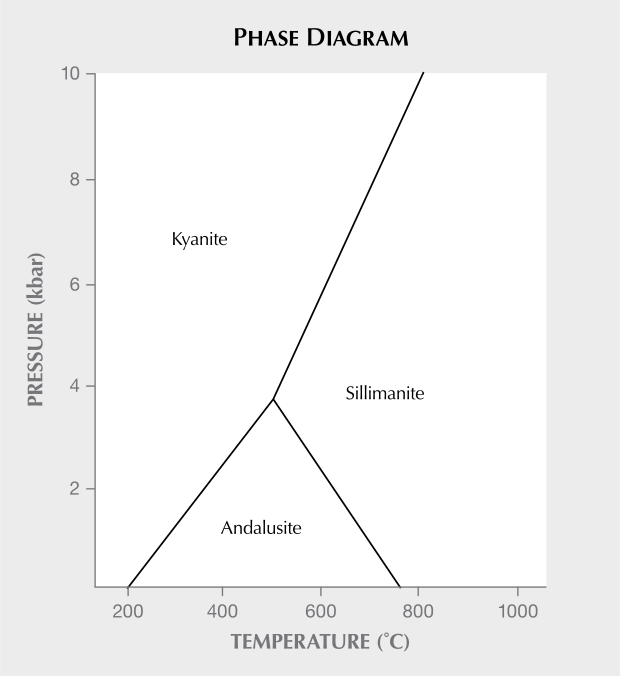
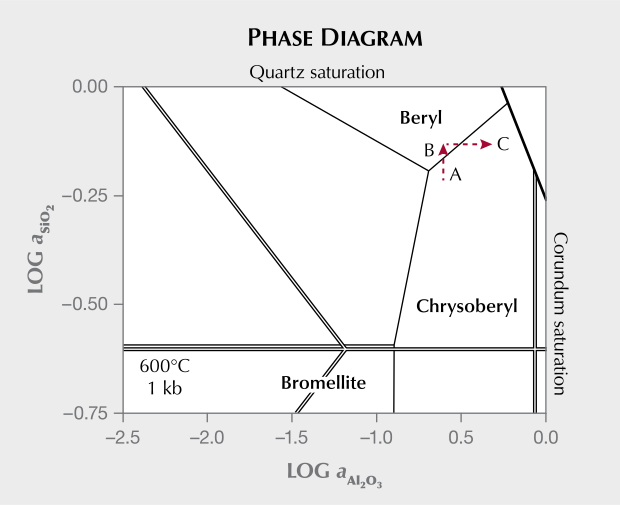
Figure 5 shows a more complex phase diagram, determining which beryllium mineral will be stable at a specified temperature and pressure, but with variations in chemical environment. Changes in chemistry are described with the variables aSiO2 and aAl2O3. These variables are called the “activity” (a) of the chemical components (species)—in this case SiO2 and Al2O3—and are essentially measures of their concentrations or driving forces. For example, the right side of the diagram displays a field for chrysoberyl and a field for beryl. Focusing on the line between the two, if the concentration of SiO2 at point A in the diagram is increased (or the activity of SiO2 is increased), the position on the diagram will move to point B, and beryl becomes the stable phase as opposed to chrysoberyl. Once beryl is stable, the concentration of Al2O3 could also be increased, causing chrysoberyl to become stable again (point B to point C).
The emerald and alexandrite deposits in the Ural Mountains in Russia near Ekaterinburg provide a relevant geological example. Emerald was first discovered here in the 1830s, and later the color-change variety of chrysoberyl, alexandrite, was found and described from the same region (figure 6). Although there are several historic deposits in the area, mining mainly occurs at the Mariinsky-Priisk (formerly Malysheva) mine where emerald is the primary product, with some alexandrite produced as a byproduct. Anecdotal evidence indicates that some deposits were more well known for producing emerald and some more known for alexandrite. While the phase diagram in figure 5 may not exactly correspond to the conditions of formation here, it can serve as a general explanation for how deposits like this form multiple different gem species. Figure 5 indicates that only very special geochemical conditions would allow for both alexandrite and emerald to be produced at the same time, and those conditions exist right along the boundary between the emerald (beryl) and alexandrite (chrysoberyl) fields. Once on that boundary, pushing the concentrations of SiO2 or Al2O3 in either direction will cause either emerald or alexandrite to become unstable, leaving only one of these gems to be formed. It is likely that variations in the chemical conditions from one location in these pegmatite-related, schist-hosted deposits to another resulted in zones of both emerald and alexandrite. The same geological forces were also at play at Lake Manyara in Tanzania, which is mostly known as an alexandrite deposit but also produces emerald. Additionally, recent anecdotal evidence also suggests that some Brazilian emerald mines have started producing small amounts of alexandrite, and the same geological forces may be responsible in those cases.
The previous Colored Stones Unearthed installment focused on pegmatites, which can be referenced for a more detailed discussion than what is covered here (Palke and Shigley, 2025). In brief, pegmatitic gem deposits represent a slightly different scenario than described above in that the gems in a pegmatite are generally all found together in the same pockets. One of the distinguishing factors with these pegmatite gemstones is that they all typically have significantly different chemistries. The pegmatitic fluids forming the stones have very unique chemical profiles and contain higher concentrations of many exotic components such as boron, fluorine, and lithium that are not enriched in most geological environments. Therefore, gem minerals such as elbaite tourmaline (Na(Li1.5Al1.5)Al6(Si6O18)(BO3)3(OH)3(OH)), topaz (Al2(SiO4)(F,OH)2), and spodumene (LiAlSi2O6) will all form simultaneously as the fluids have all the necessary components for their concurrent formations
DIFFERENT GEM SPECIES IN VOLCANIC DEPOSITS
Some of the world’s most important colored stone deposits were formed when magmas picked up gems from deep in the earth, later reaching the surface in violent volcanic eruptions. A prime example is basalt-related sapphire found in numerous locales, but most importantly Australia (figure 7), Thailand, Cambodia, Nigeria, and more recently Ethiopia. A ubiquitous mineralogical association in these deposits is gemmy zircon (ZrSiO4). While the zircon found in these deposits is typically dark brown, some of the material is suitable for faceting and finds its way into the gem market. One exception among these deposits is Ratanakiri in Cambodia, which is recognized for yielding gem-quality zircon that can be heated to produce an attractive blue color (figure 8). While Ratanakiri mostly produces gem zircon, subordinate sapphire production also occurs. Though the geological origins of sapphire and zircon are not fully understood, they are generally thought to have formed from some alkali-rich (but not mafic) magmas such as syenites. The formation of zircon and sapphire is likely linked in some way. However, some studies have shown differences in ages and trace element compositions of zircon inclusions in sapphire and the megacrystic zircon, indicating a complex but likely connected genesis (Abduriyim et al., 2012; Sutherland et al., 2015a,b; Vu et al., 2023). While basalt-related sapphire gems are the most common for this type of deposit, Montana sapphire is also of volcanic origin. These secondary Montana sapphire deposits also produce gemmy garnet that, although uncommon in the trade, occasionally end up as gemstones in the hands of avid collectors.
DIFFERENT GEM SPECIES IN SECONDARY DEPOSITS
Probably the most relevant type of deposit producing multiple different gem species are secondary deposits. In these deposits, gems have been released from their host rocks by long-term weathering and erosion. This process destroys much of the rock but has less of an effect on gems (which are durable by definition), effectively freeing them. During this process, they are transported by gravity, commonly aided by the flow of water, and end up in river systems, where they can concentrate and eventually get trapped. This can result in high volumes of gem-quality material found in easily accessible locations.
Some of the richest colored stone deposits can be traced back to major orogenic events when massive continents collided, burying rocks to great depths and creating extreme conditions of pressure and temperature. During these collisional events, multiple different rock formations were buried within the earth, with fluid flow within and between these formations facilitating the transfer of different chemical components needed to form gems. These conditions, in many cases, were perfect for forming a diverse set of gem materials including ruby, sapphire, chrysoberyl, spinel, and garnet. Additionally, these orogenic deposits are typically associated with pegmatitic intrusions, in which case the entire suite of pegmatitic gemstones can be expected (e.g., beryl, topaz, tourmaline, feldspar, and quartz).
Over the span of millions of years, these mountain chains were worn down by weathering and erosion, sometimes leaving more durable minerals concentrated at or near the surface. The presence of multiple different geological formations with distinct chemical and mineralogical compositions in these eroded mountains is the fundamental reason for the diversity of gemstones found in secondary deposits. A generalized geological map of the Mogok region in Myanmar is shown in figure 9. In Mogok, ruby and spinel form in marble (shown in blue in the map), whereas sapphire and other gems are derived from syenites and charnockites (shown in yellow). Pegmatite formations supply additional suites of gemstones. In this type of deposit, the gemstones are produced all together as prolonged periods of weathering break down gem-bearing rocks and concentrate the wear-resistant gems in gravels, often in low-lying valleys or ancient riverbeds. In this case, the gems found in these deposits, such as ruby and blue sapphire, are not necessarily directly related geologically, but are found together simply because distinct geological formations weather and break down into the same local sedimentary catchments (figure 10). These deposits are most prevalent throughout East Africa, Southeast Asia, and Sri Lanka.
SUMMARY
The world’s colored stone deposits are not equally distributed geographically but often concentrated in specific geological terranes. Many of these fortuitous occurrences are further blessed with not only the presence of gemstones, but also with a large diversity of gem species. These deposits are not purely random, but the product of a unique geological history in which natural forces created just the right conditions for the crystallization, concentration, and preservation of gemstones.
Aaron C. Palke is senior manager of research, and James E. Shigley is distinguished research fellow, at GIA in Carlsbad, California. Wim Vertriest is manager of field gemology at GIA in Bangkok.
It is widely recognized that some gem minerals often occur together in various localities—either in the same host rock or in the same deposit. Gem minerals each require a certain set of physical and chemical conditions for their formation. This edition of the Colored Stones Unearthed column will explore where specific gem minerals are found together and the conditions that produce these distinct geological settings.
BACKGROUND
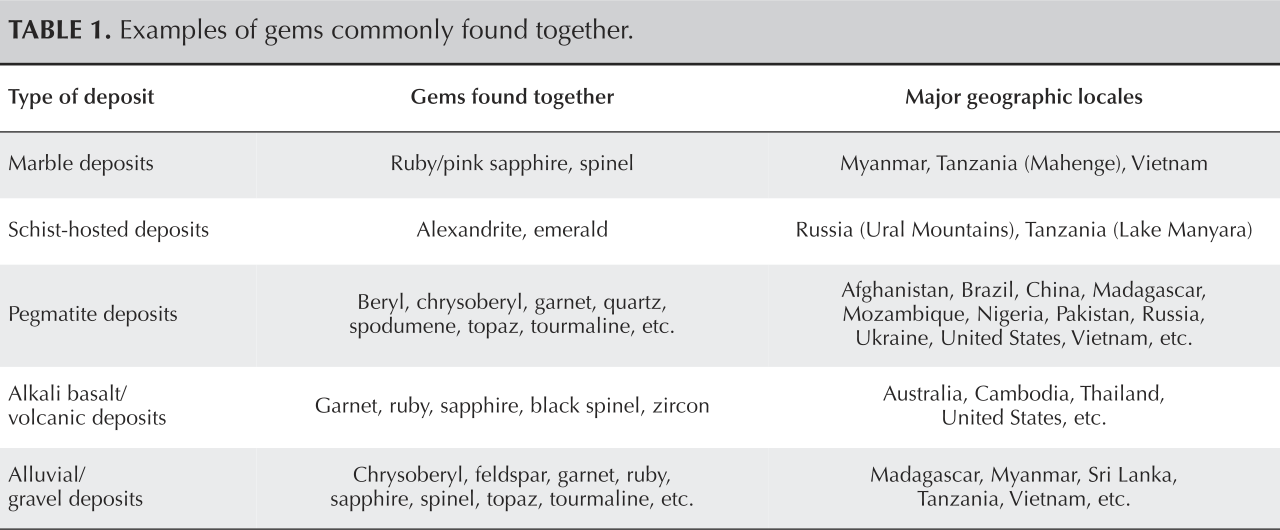
The most significant historic deposit of fine ruby is undeniably the Mogok Valley in Myanmar (formerly Burma). Yet, this deposit is recognized not only for yielding some of the world’s most important ruby, but also for a myriad of other fine gems (figure 1) from blue sapphire to peridot to spinel. Was it a stroke of luck that this relatively small region in Southeast Asia just happens to produce such an amazing diversity of gemstones, or is something more happening beneath the surface? The previous installment of Colored Stones Unearthed covered gems found in pegmatites. These pegmatitic deposits virtually always yield a number of different gemstones in the same deposit, rather than being single gem sources. In contrast, some gem deposits are known for producing almost exclusively one species of gemstone (e.g., the Mozambique ruby deposits, the Zambian emerald deposits, the Australian opal fields). In fact, it is quite common for multiple gems to be found in a single deposit (table 1). This contribution to Colored Stones Unearthed investigates deposits known for producing multiple gemstone species and places these deposits in a broader geological context. deposits in a broader geological context.
WHY ARE SOME GEMS FOUND TOGETHER
The assemblage of minerals that form in any situation is determined by the specific geological conditions including pressure, temperature, and local chemical environment. One instance of multiple gem species being found in the same deposit occurs when these species have overlapping chemical components but overall different chemical compositions. The simplest example is the Mogok Valley in Myanmar. Most of the major deposits here are alluvial. While the most well-known gem produced here is ruby, in many of the deposits, ruby and pink or red spinel are found in abundance. Though it is often stated anecdotally that ruby and spinel were indistinguishable until fairly recent mineralogical advancements, local mining communities in Mogok certainly understood these two mineral species were distinct and could distinguish between the two based on crystal morphology and other properties such as hardness. The chemical formulae for ruby (the red variety of corundum) and spinel are Al2O3 and MgAl2O4, respectively. Essentially the only chemical difference between ruby and red spinel, both colored by the presence of trace chromium, is the addition of magnesium to the nearly pure aluminum oxide comprising corundum (ruby). Fine mineral specimens of ruby and red spinel in marble are routinely recovered in Mogok (figure 2). The spinel-bearing specimens occur in a calcite (CaCO3) and dolomite (CaMg(CO3)2) marble, while ruby-bearing specimens occur in a marble that is nearly pure calcite. These specimens virtually never contain both ruby and spinel due to the fact that spinel crystallizes in these environments at the expense of corundum (ruby) when too much magnesium is present for corundum itself to form.
1Some exceptional cases of coexisting corundum and quartz assemblages have been documented, although it is unclear if these represent equilibrium or non-equilibrium mineralogical assemblages (Guiraud et al., 1996; Tsunogae and van Reenen, 2006).
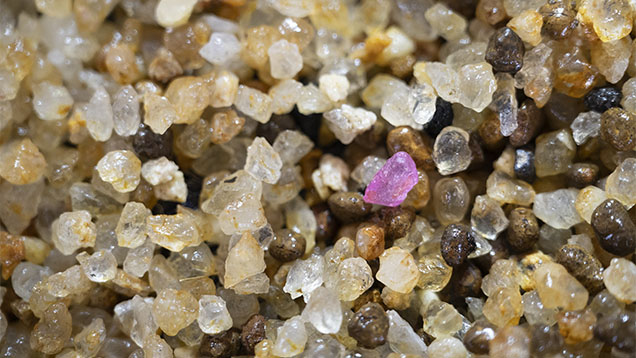
The following section describes several instances in which different gemstones form in a single deposit due to diversity in the chemical environment. The next section covers volcanic deposits, where multiple gems are brought to the surface from great depths by basaltic or other volcanic eruptions. In these cases, the ultimate origin of the different gems found in the same deposit are not clearly understood, but there is almost certainly some genetic link. The final section discusses alluvial or secondary deposits, in which intense, usually tropical, weathering pulls gemstones from multiple geological formations across a broad area, gathering several different gem species together. In many cases, the gems found in these secondary deposits clearly have disparate geological origins involving entirely different formation conditions. The clearest example of this is gem-bearing gravels containing both corundum (ruby or sapphire) and gemmy quartz (figure 3). Under most circumstances, this is impossible as corundum and quartz cannot form in equilibrium at most conditions within the earth’s crust1.
DIFFERENT GEM SPECIES DUE TO CHEMICAL VARIATIONS
The chemical forces controlling mineralization within the earth have been studied systematically and extensively by geoscientists for more than 100 years. The thermodynamics dictating which minerals form where have largely been unraveled by scientists in experimental laboratories. Geochemists make sense of the results from these lab experiments using tools called phase diagrams, which help visualize the relationships among chemical composition and formation temperature and pressure (depth in the earth). One of the simplest of such diagrams is for the aluminosilicate minerals kyanite, sillimanite, and andalusite, all with the chemical formula Al2SiO5 but with different crystal structures. Whether one of these minerals forms instead of another depends on the pressure and temperature of formation. Figure 4 shows the phase diagram for these minerals; if the exact pressure and temperature of formation are known, they can be plotted on this diagram to reveal which of these minerals would have formed in any given geological environment.
Figure 5 shows a more complex phase diagram, determining which beryllium mineral will be stable at a specified temperature and pressure, but with variations in chemical environment. Changes in chemistry are described with the variables aSiO2 and aAl2O3. These variables are called the “activity” (a) of the chemical components (species)—in this case SiO2 and Al2O3—and are essentially measures of their concentrations or driving forces. For example, the right side of the diagram displays a field for chrysoberyl and a field for beryl. Focusing on the line between the two, if the concentration of SiO2 at point A in the diagram is increased (or the activity of SiO2 is increased), the position on the diagram will move to point B, and beryl becomes the stable phase as opposed to chrysoberyl. Once beryl is stable, the concentration of Al2O3 could also be increased, causing chrysoberyl to become stable again (point B to point C).
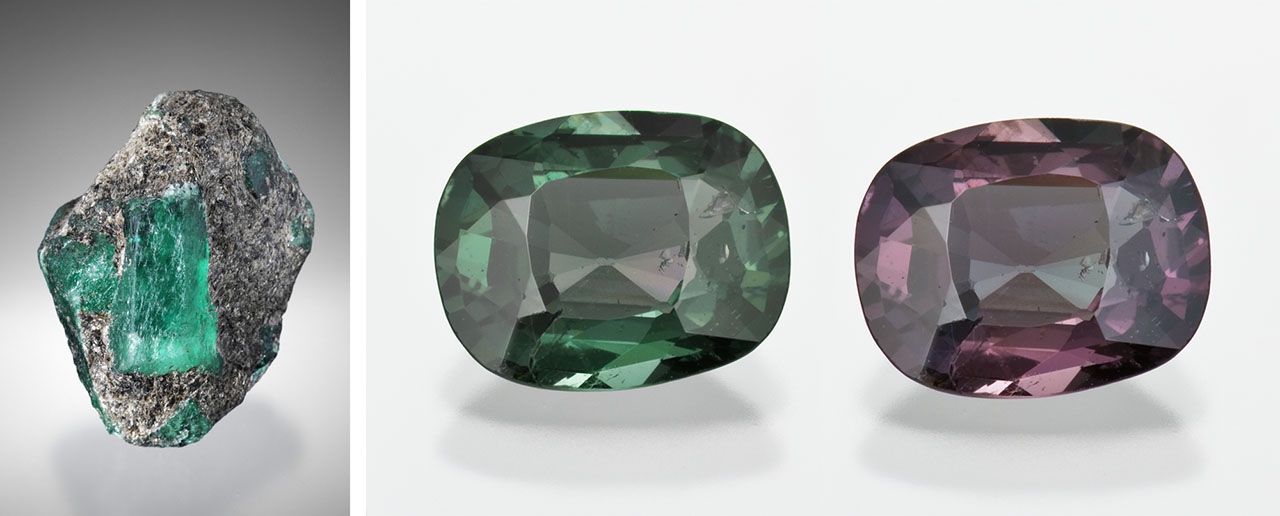
The emerald and alexandrite deposits in the Ural Mountains in Russia near Ekaterinburg provide a relevant geological example. Emerald was first discovered here in the 1830s, and later the color-change variety of chrysoberyl, alexandrite, was found and described from the same region (figure 6). Although there are several historic deposits in the area, mining mainly occurs at the Mariinsky-Priisk (formerly Malysheva) mine where emerald is the primary product, with some alexandrite produced as a byproduct. Anecdotal evidence indicates that some deposits were more well known for producing emerald and some more known for alexandrite. While the phase diagram in figure 5 may not exactly correspond to the conditions of formation here, it can serve as a general explanation for how deposits like this form multiple different gem species. Figure 5 indicates that only very special geochemical conditions would allow for both alexandrite and emerald to be produced at the same time, and those conditions exist right along the boundary between the emerald (beryl) and alexandrite (chrysoberyl) fields. Once on that boundary, pushing the concentrations of SiO2 or Al2O3 in either direction will cause either emerald or alexandrite to become unstable, leaving only one of these gems to be formed. It is likely that variations in the chemical conditions from one location in these pegmatite-related, schist-hosted deposits to another resulted in zones of both emerald and alexandrite. The same geological forces were also at play at Lake Manyara in Tanzania, which is mostly known as an alexandrite deposit but also produces emerald. Additionally, recent anecdotal evidence also suggests that some Brazilian emerald mines have started producing small amounts of alexandrite, and the same geological forces may be responsible in those cases.
The previous Colored Stones Unearthed installment focused on pegmatites, which can be referenced for a more detailed discussion than what is covered here (Palke and Shigley, 2025). In brief, pegmatitic gem deposits represent a slightly different scenario than described above in that the gems in a pegmatite are generally all found together in the same pockets. One of the distinguishing factors with these pegmatite gemstones is that they all typically have significantly different chemistries. The pegmatitic fluids forming the stones have very unique chemical profiles and contain higher concentrations of many exotic components such as boron, fluorine, and lithium that are not enriched in most geological environments. Therefore, gem minerals such as elbaite tourmaline (Na(Li1.5Al1.5)Al6(Si6O18)(BO3)3(OH)3(OH)), topaz (Al2(SiO4)(F,OH)2), and spodumene (LiAlSi2O6) will all form simultaneously as the fluids have all the necessary components for their concurrent formations
DIFFERENT GEM SPECIES IN VOLCANIC DEPOSITS
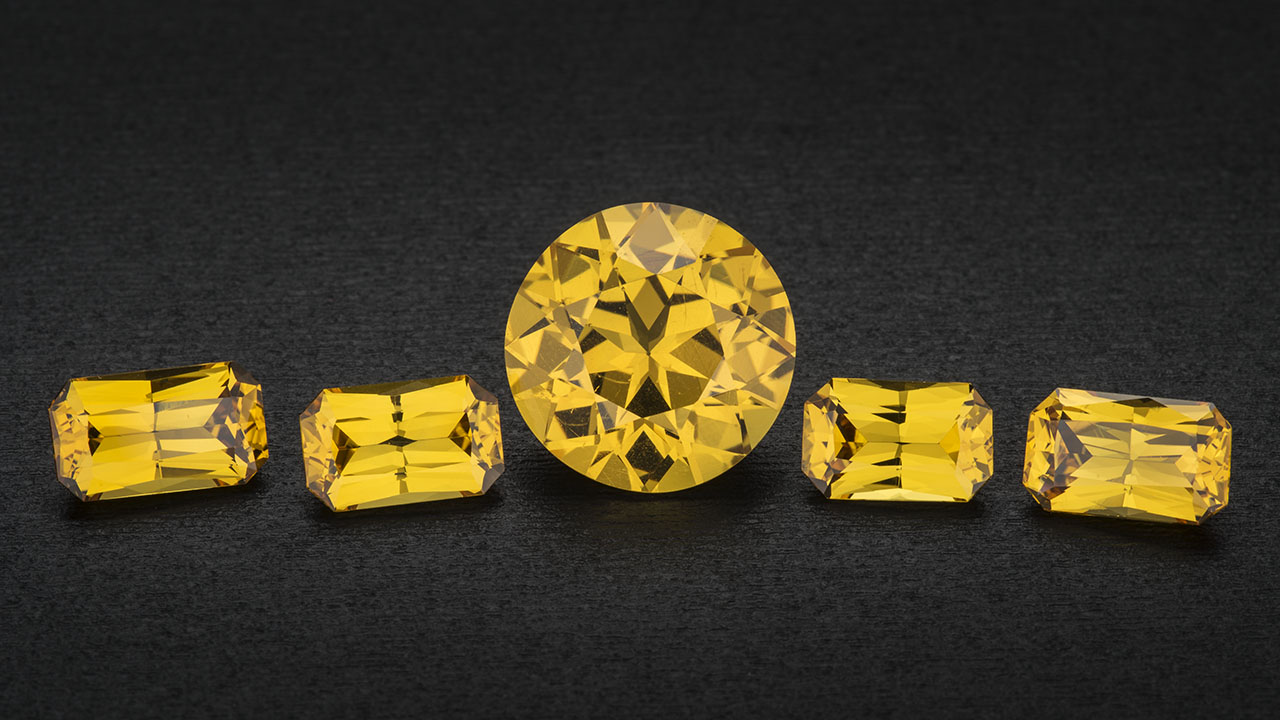
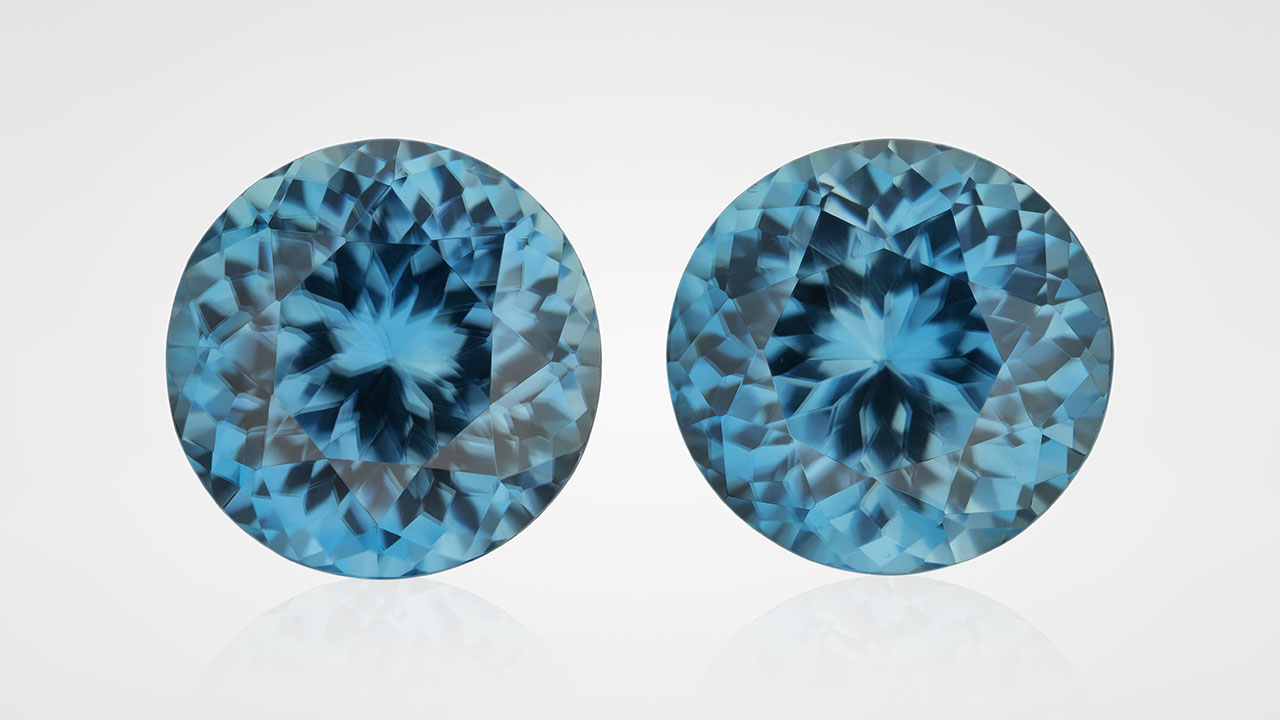
Some of the world’s most important colored stone deposits were formed when magmas picked up gems from deep in the earth, later reaching the surface in violent volcanic eruptions. A prime example is basalt-related sapphire found in numerous locales, but most importantly Australia (figure 7), Thailand, Cambodia, Nigeria, and more recently Ethiopia. A ubiquitous mineralogical association in these deposits is gemmy zircon (ZrSiO4). While the zircon found in these deposits is typically dark brown, some of the material is suitable for faceting and finds its way into the gem market. One exception among these deposits is Ratanakiri in Cambodia, which is recognized for yielding gem-quality zircon that can be heated to produce an attractive blue color (figure 8). While Ratanakiri mostly produces gem zircon, subordinate sapphire production also occurs. Though the geological origins of sapphire and zircon are not fully understood, they are generally thought to have formed from some alkali-rich (but not mafic) magmas such as syenites. The formation of zircon and sapphire is likely linked in some way. However, some studies have shown differences in ages and trace element compositions of zircon inclusions in sapphire and the megacrystic zircon, indicating a complex but likely connected genesis (Abduriyim et al., 2012; Sutherland et al., 2015a,b; Vu et al., 2023). While basalt-related sapphire gems are the most common for this type of deposit, Montana sapphire is also of volcanic origin. These secondary Montana sapphire deposits also produce gemmy garnet that, although uncommon in the trade, occasionally end up as gemstones in the hands of avid collectors.
DIFFERENT GEM SPECIES IN SECONDARY DEPOSITS
Probably the most relevant type of deposit producing multiple different gem species are secondary deposits. In these deposits, gems have been released from their host rocks by long-term weathering and erosion. This process destroys much of the rock but has less of an effect on gems (which are durable by definition), effectively freeing them. During this process, they are transported by gravity, commonly aided by the flow of water, and end up in river systems, where they can concentrate and eventually get trapped. This can result in high volumes of gem-quality material found in easily accessible locations.
Some of the richest colored stone deposits can be traced back to major orogenic events when massive continents collided, burying rocks to great depths and creating extreme conditions of pressure and temperature. During these collisional events, multiple different rock formations were buried within the earth, with fluid flow within and between these formations facilitating the transfer of different chemical components needed to form gems. These conditions, in many cases, were perfect for forming a diverse set of gem materials including ruby, sapphire, chrysoberyl, spinel, and garnet. Additionally, these orogenic deposits are typically associated with pegmatitic intrusions, in which case the entire suite of pegmatitic gemstones can be expected (e.g., beryl, topaz, tourmaline, feldspar, and quartz).
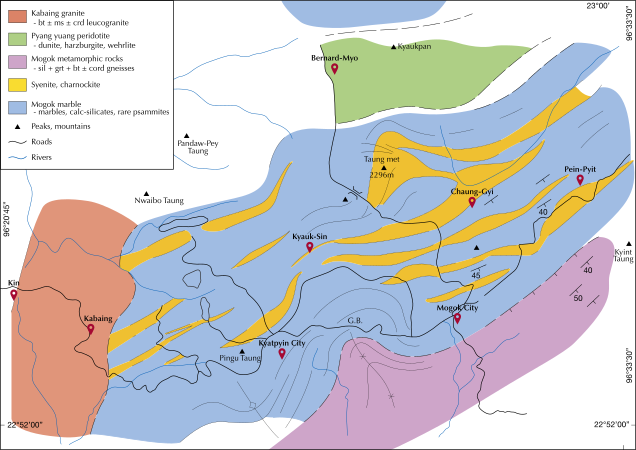
Over the span of millions of years, these mountain chains were worn down by weathering and erosion, sometimes leaving more durable minerals concentrated at or near the surface. The presence of multiple different geological formations with distinct chemical and mineralogical compositions in these eroded mountains is the fundamental reason for the diversity of gemstones found in secondary deposits. A generalized geological map of the Mogok region in Myanmar is shown in figure 9. In Mogok, ruby and spinel form in marble (shown in blue in the map), whereas sapphire and other gems are derived from syenites and charnockites (shown in yellow). Pegmatite formations supply additional suites of gemstones. In this type of deposit, the gemstones are produced all together as prolonged periods of weathering break down gem-bearing rocks and concentrate the wear-resistant gems in gravels, often in low-lying valleys or ancient riverbeds. In this case, the gems found in these deposits, such as ruby and blue sapphire, are not necessarily directly related geologically, but are found together simply because distinct geological formations weather and break down into the same local sedimentary catchments (figure 10). These deposits are most prevalent throughout East Africa, Southeast Asia, and Sri Lanka.
SUMMARY
The world’s colored stone deposits are not equally distributed geographically but often concentrated in specific geological terranes. Many of these fortuitous occurrences are further blessed with not only the presence of gemstones, but also with a large diversity of gem species. These deposits are not purely random, but the product of a unique geological history in which natural forces created just the right conditions for the crystallization, concentration, and preservation of gemstones.
Aaron C. Palke is senior manager of research, and James E. Shigley is distinguished research fellow, at GIA in Carlsbad, California. Wim Vertriest is manager of field gemology at GIA in Bangkok.