
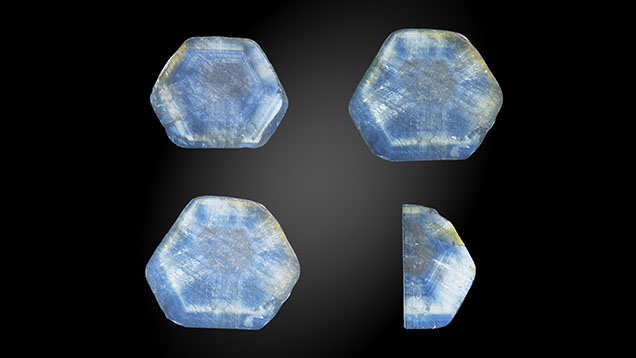
Trapiche-like sapphires with hexagonal color zoning have been found in the Changle area of Shandong Province, China. Samples examined by the authors possessed a brown-black hexagonal core and a distinct six-rayed pattern (figure 1). The six rays or fibrous arms were oriented perpendicular to the sides of the core and the hexagonal growth structure. Graphite was randomly distributed in the dark core region in this sapphire, identified by Raman spectroscopy.

Through further microscopic observation, we found that these fibrous arms were composed of thin-film fluid inclusions and fine fissures generally parallel to their elongation direction (figure 2). Many of these inclusions were two-phase, containing both gas and liquid, and a few were gas-liquid-solid three-phase. Interestingly, the fissures were triangular, scalloped, striped, or irregular in shape and about 10 to 40 μm in size, with spectral interference colors (figure 2A). With overhead lighting, the internal features presented a dramatic scene reminiscent of a post-eruption volcano surrounded by overlapping hills and rivers (figure 2B). In transmitted light, however, the same features resembled a Chinese landscape painting, and the previous “rivers” looked more like clouds surrounding the volcano and hills (figure 2C). The internal features found in this sapphire are interesting to gemologists both scientifically and artistically.
Trapiche-like sapphires with hexagonal color zoning have been found in the Changle area of Shandong Province, China. Samples examined by the authors possessed a brown-black hexagonal core and a distinct six-rayed pattern (figure 1). The six rays or fibrous arms were oriented perpendicular to the sides of the core and the hexagonal growth structure. Graphite was randomly distributed in the dark core region in this sapphire, identified by Raman spectroscopy.
Through further microscopic observation, we found that these fibrous arms were composed of thin-film fluid inclusions and fine fissures generally parallel to their elongation direction (figure 2). Many of these inclusions were two-phase, containing both gas and liquid, and a few were gas-liquid-solid three-phase. Interestingly, the fissures were triangular, scalloped, striped, or irregular in shape and about 10 to 40 μm in size, with spectral interference colors (figure 2A). With overhead lighting, the internal features presented a dramatic scene reminiscent of a post-eruption volcano surrounded by overlapping hills and rivers (figure 2B). In transmitted light, however, the same features resembled a Chinese landscape painting, and the previous “rivers” looked more like clouds surrounding the volcano and hills (figure 2C). The internal features found in this sapphire are interesting to gemologists both scientifically and artistically.