Grossular with Strong Red Fluorescence
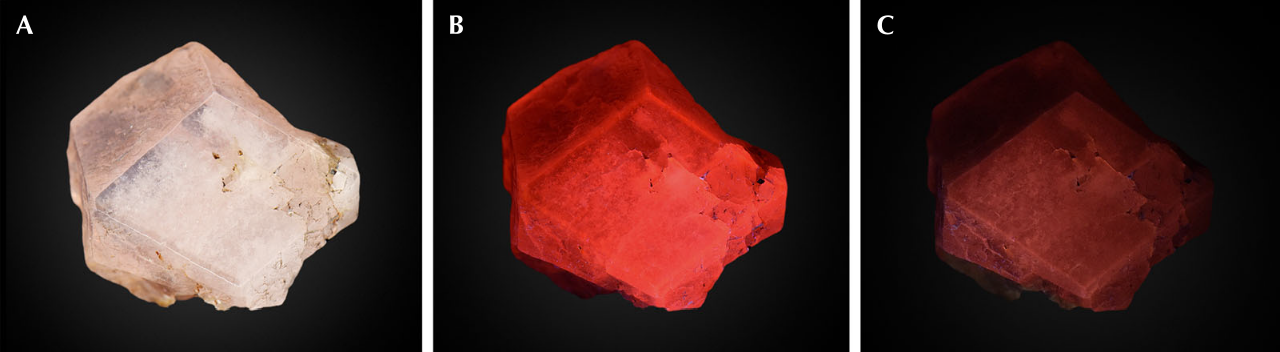
The authors recently encountered a pink garnet rough reportedly from Mogok, Myanmar. The garnet was characterized by a light pink color in daylight, and it showed unusual strong red fluorescence under long-wave ultraviolet radiation and a weak chalky red reaction under short-wave UV (figure 1). A previously published report on grossular garnet showed similar fluorescence under long-wave UV, but the short-wave UV reaction was very different (M.S. Krzemnicki, “Pink grossular garnet from Mogok,” Facette, No. 26, 2020, pp. 26).

Raman spectroscopy identified the garnet as grossular. Electron probe microanalysis determined that the composition was consistent with that of nearly pure grossular with major elements of calcium, aluminum, and silicon (Ca3.114Al2.003Si2.883O12), and laser ablation–inductively coupled plasma–mass spectrometry (LA-ICP-MS) testing revealed trace elements of titanium, vanadium, manganese, and others (table 1). The pink coloration was due to two weak bands between 470 and 600 nm in the UV/visible absorption spectrum; Geiger et al. (1999) suggested they are related to Mn3+ (C.A. Geiger et al., “Raspberry-red grossular from Sierra de Cruces Range, Coahuila, Mexico,” European Journal of Mineralogy, Vol. 11, No. 6, 1999, pp. 1109–1113).

A photoluminescence spectrum recorded with 325 nm laser excitation displayed a strong narrow band at 604 nm accompanied by some weaker bands at 583, 595, 617, 631, 645, and 660 nm (figure 2). Gaft et al. (2013, 2022) published two papers about the luminescence of grossular (M. Gaft et al., “Laser-induced time resolved luminescence of natural grossular Ca3Al2(SiO4)3,” Journal of Luminescence, Vol. 137, 2013, pp. 43–53; M. Gaft et al., “Zero-phonon Mn2+ luminescence in natural grossular Ca3Al2(SiO4)3,” Journal of Luminescence, Vol. 248, 2022, article no. 119001). Our result is consistent with their 2022 result. They proposed that such luminescence emission may be related to the presence of Mn2+.

In order to describe the pink grossular fluorescence features in detail, 3D fluorescence spectral data (i.e., excitation-emission mapping or EEM) was collected at room temperature using a Jasco FP-8500 fluorescence spectrometer (figure 3). The excitation wavelengths varied from 350 to 630 nm, with a step size of 1 nm and an excitation bandwidth of 5 nm. The emission spectra were collected from 400 to 680 nm, with the bandwidth set to 2.5 nm and a data interval of 0.1 nm, showing five obvious emission wavelengths at 604, 617, 631, 645, and 660 nm and their corresponding optimal excitation wavelength at 388 nm.
To our knowledge, this is the first time a detailed fluorescence analysis of pink grossular has been documented.