
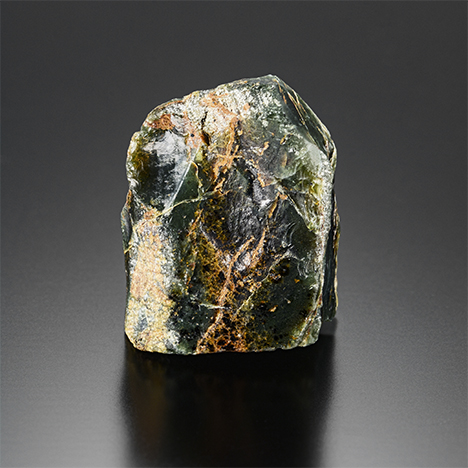
Recently the Carlsbad laboratory examined a mottled grayish green partially polished rough stone for identification services. The stone measured 21.01 × 16.13 × 15.50 mm and weighed 28.16 ct (figure 1). The stone showed a vitreous luster and prominent reddish orange staining in surface-reaching fractures and cavities.
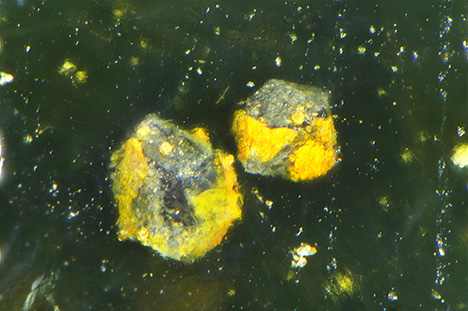
Standard gemological testing revealed a refractive index of 1.450 measured on a polished flat surface and a specific gravity of 2.07 obtained hydrostatically. No play-of-color was observed, and all properties were consistent with common opal. Weak chromium lines were seen with the handheld spectroscope as well as a weak pink Chelsea color filter reaction. Microscopic analysis using fiber-optic lighting showed minute mineral grains scattered throughout the opal. Several well-formed black opaque octahedral inclusions with yellow staining (figure 2) were confirmed by Raman spectroscopy to be predominantly chromite (FeCr2O4), a member of the spinel group (C. Klein and B. Dutrow, The Manual of Mineral Science, 23rd ed., 2007, pp. 387–388).

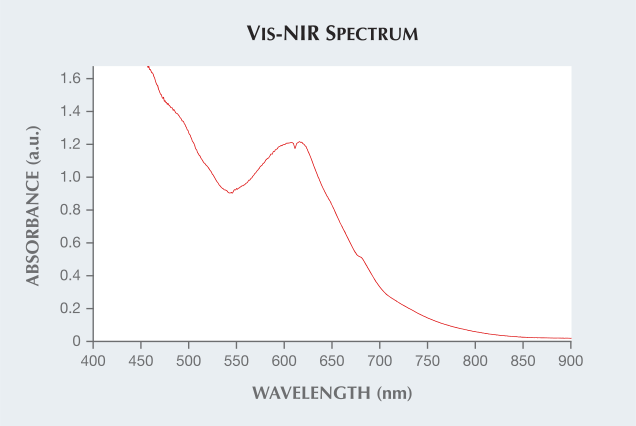
Additional information on the chromite inclusions and the green bodycolor of the opal was collected by further advanced testing with LA-ICP-MS (table 1) and Vis-NIR (figure 3). The visible-range spectrum shows a broad absorption band centered at 610 nm and a smaller band at 680 nm, which may result from minute inclusions of chromium-colored serpentine (E. Fritsch et al., “Cr3+-green common opal from Turnali, north-eastern Turkey,” 32nd International Gemmological Conference, Interlaken, Switzerland, 2011, pp. 165–166). LA-ICP-MS trace element chemistry showed the black inclusions were predominantly a mixture of magnesiochromite (24.19 mol.%), chromite (42.94 mol.%), hercynite (FeAl2O4, 17.99 mol.%), and spinel (MgAl2O4, 10.12 mol.%). ICP data showed a high amount of chromium ranging from 936–1110 ppmw with an average of 1042 ppmw.
Although the location or geological occurrence of this particular sample is unknown, a previous publication on Turkish green common opal colored by Cr3+ discussed the occurrence in deposits of serpentinized peridotite with the color being attributed to minute inclusions of chromium-colored serpentine. This interesting common opal was a welcome gem material to study in the GIA lab.
Recently the Carlsbad laboratory examined a mottled grayish green partially polished rough stone for identification services. The stone measured 21.01 × 16.13 × 15.50 mm and weighed 28.16 ct (figure 1). The stone showed a vitreous luster and prominent reddish orange staining in surface-reaching fractures and cavities.
Standard gemological testing revealed a refractive index of 1.450 measured on a polished flat surface and a specific gravity of 2.07 obtained hydrostatically. No play-of-color was observed, and all properties were consistent with common opal. Weak chromium lines were seen with the handheld spectroscope as well as a weak pink Chelsea color filter reaction. Microscopic analysis using fiber-optic lighting showed minute mineral grains scattered throughout the opal. Several well-formed black opaque octahedral inclusions with yellow staining (figure 2) were confirmed by Raman spectroscopy to be predominantly chromite (FeCr2O4), a member of the spinel group (C. Klein and B. Dutrow, The Manual of Mineral Science, 23rd ed., 2007, pp. 387–388).
Additional information on the chromite inclusions and the green bodycolor of the opal was collected by further advanced testing with LA-ICP-MS (table 1) and Vis-NIR (figure 3). The visible-range spectrum shows a broad absorption band centered at 610 nm and a smaller band at 680 nm, which may result from minute inclusions of chromium-colored serpentine (E. Fritsch et al., “Cr3+-green common opal from Turnali, north-eastern Turkey,” 32nd International Gemmological Conference, Interlaken, Switzerland, 2011, pp. 165–166). LA-ICP-MS trace element chemistry showed the black inclusions were predominantly a mixture of magnesiochromite (24.19 mol.%), chromite (42.94 mol.%), hercynite (FeAl2O4, 17.99 mol.%), and spinel (MgAl2O4, 10.12 mol.%). ICP data showed a high amount of chromium ranging from 936–1110 ppmw with an average of 1042 ppmw.
Although the location or geological occurrence of this particular sample is unknown, a previous publication on Turkish green common opal colored by Cr3+ discussed the occurrence in deposits of serpentinized peridotite with the color being attributed to minute inclusions of chromium-colored serpentine. This interesting common opal was a welcome gem material to study in the GIA lab.