
Gemstone assemblages, composed of two or more materials fused or bonded together, have long been used to imitate a variety of natural gemstones. These composite constructs are regularly encountered in gemological laboratories, where they are identified by their component parts and may be referred to as imitations of various natural stones. Assembled stones designed to mimic emeralds have historically been constructed using colorless spinel with colored cement, layered glass, or beryl doublets/triplets. One of the most widely encountered assembled emerald imitations is the soudé emerald, which entered mass production in the early twentieth century. Over time, its construction evolved from the use of rock crystal to colorless synthetic spinel, and later to colorless beryl or pale aquamarine.
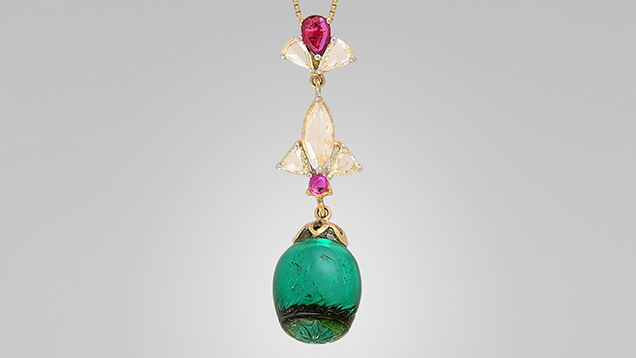
GIA’s New York laboratory recently examined a green stone mounted in a necklace with a total weight of 7.84 grams (figure 1). While the deep green color of this stone suggested it may be an emerald, a spot refractive index measurement yielded a value of 1.54, indicating the stone was likely quartz. Under both long- and short-wave ultraviolet radiation, the assemblage exhibited a whitish fluorescence, which was confined to an internal layer within the stone. Raman spectroscopy using a 514 nm laser further confirmed the identification of the material as quartz.
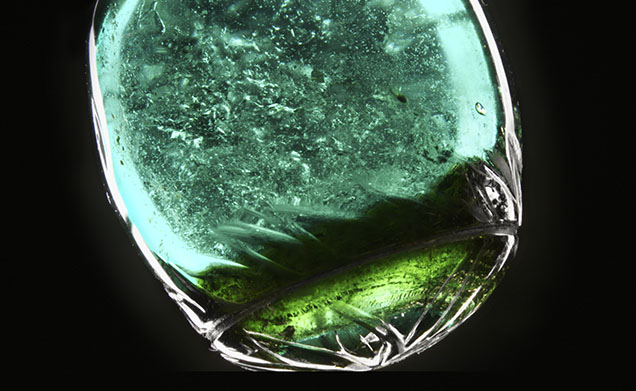
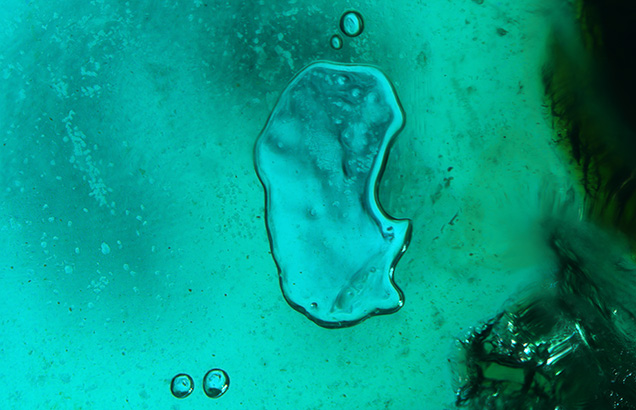
Initial microscopic examination of the green stone revealed a separation plane near the carved top, along with numerous gas bubbles, and some large air-filled voids that blocked the cement, creating colorless zones (figure 2). These colorless voids reinforced the observation that the green color appeared to be confined to the cement layer (figure 3). Further inspection under the microscope revealed natural fluid inclusions, supporting the identification of natural rock crystal quartz.
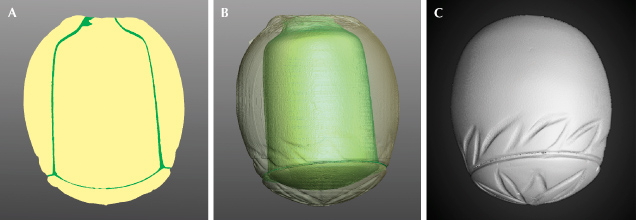
This detailed examination of the green stone exposed three sections of colorless natural quartz in various thicknesses joined with a green-colored cement, prompting the authors to collect X-ray tomography images to investigate how the green stone was assembled. The X-ray computed tomography showed three distinct quartz components connected by a cement layer with an average thickness of 0.20 mm along a clearly defined interface (figure 4). The exceptionally precise machining of the parts of this assemblage makes this piece a particularly sophisticated assembled stone.
Loading video player...
Quartz Assemblage Imitating Emerald
Hannah Wiggins is a staff gemologist, and Ezgi Kiyak is a senior staff gemologist, at GIA in New York.
Gemstone assemblages, composed of two or more materials fused or bonded together, have long been used to imitate a variety of natural gemstones. These composite constructs are regularly encountered in gemological laboratories, where they are identified by their component parts and may be referred to as imitations of various natural stones. Assembled stones designed to mimic emeralds have historically been constructed using colorless spinel with colored cement, layered glass, or beryl doublets/triplets. One of the most widely encountered assembled emerald imitations is the soudé emerald, which entered mass production in the early twentieth century. Over time, its construction evolved from the use of rock crystal to colorless synthetic spinel, and later to colorless beryl or pale aquamarine.
GIA’s New York laboratory recently examined a green stone mounted in a necklace with a total weight of 7.84 grams (figure 1). While the deep green color of this stone suggested it may be an emerald, a spot refractive index measurement yielded a value of 1.54, indicating the stone was likely quartz. Under both long- and short-wave ultraviolet radiation, the assemblage exhibited a whitish fluorescence, which was confined to an internal layer within the stone. Raman spectroscopy using a 514 nm laser further confirmed the identification of the material as quartz.
Initial microscopic examination of the green stone revealed a separation plane near the carved top, along with numerous gas bubbles, and some large air-filled voids that blocked the cement, creating colorless zones (figure 2). These colorless voids reinforced the observation that the green color appeared to be confined to the cement layer (figure 3). Further inspection under the microscope revealed natural fluid inclusions, supporting the identification of natural rock crystal quartz.
This detailed examination of the green stone exposed three sections of colorless natural quartz in various thicknesses joined with a green-colored cement, prompting the authors to collect X-ray tomography images to investigate how the green stone was assembled. The X-ray computed tomography showed three distinct quartz components connected by a cement layer with an average thickness of 0.20 mm along a clearly defined interface (figure 4). The exceptionally precise machining of the parts of this assemblage makes this piece a particularly sophisticated assembled stone.
Loading video player...
Quartz Assemblage Imitating Emerald
Hannah Wiggins is a staff gemologist, and Ezgi Kiyak is a senior staff gemologist, at GIA in New York.