
Väyrynenite was officially described as a mineral in 1954, based on samples from the Viitaniemi pegmatite field in central Finland. The rare phosphate mineral (BeMn2+(PO4)(OH)) was named after professor H.A. Väyrynen. Nearly all the material was initially found as opaque, fine-grained aggregates, lacking any euhedral crystal formation.
It wasn’t until the 1970s that the mineral gained popularity with the discovery of well-formed crystals in the Chitral area of Pakistan. Initially, most of the interest was in mineral specimens. Occasionally, material suitable for faceting was recovered, but it was often included and limited to sizes under 1 carat, making väyrynenite a true collector’s stone. Some small faceted material was recently reported from Afghanistan as well (Spring 2025 GNI, p. 102).
Since fall 2024, larger stones have been seen in the trade, including multiple clean faceted gems over 10 ct. These are reportedly from Nasarawa State in Nigeria, near the village of Angwan Doka, roughly 20 km southeast of the city of Keffi. The area around Keffi is well known for pegmatite-related gems, especially pink, green, and bicolor tourmalines. In mid-2024, at a site previously mined for tourmaline, artisanal miners struck a pocket of unknown orange to orangy pink material later identified as väyrynenite. Väyrynenite occurs as an alteration product in certain types of pegmatites.
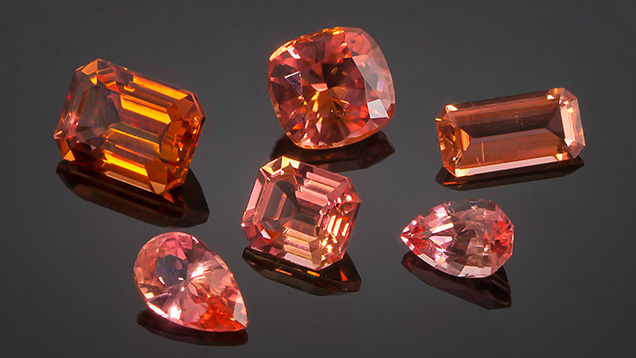
GIA recently studied a set of stones, weighing 0.72 to 2.45 ct, from the new Nigerian source loaned from Mark Smith of Thai Lanka Trading in Bangkok (see above). All properties matched previously known väyrynenite: refractive index of 1.639–1.676 with a birefringence ranging from 0.025–0.027, biaxial optical figure, and a density of 3.22–3.25. Its orangy pink color sometimes ranged into a pure orange. Using a dichroscope, the stones showed trichroism (pinkish orange–pure pink–yellowish orange). None of the stones showed fluorescence under long-wave (365 nm) or short-wave (254 nm) UV. Raman spectroscopy confirmed their identity as well.
All stones were eye-clean but showed strong doubling of the pavilion facets under 10× magnification. Inclusions were limited to healed fractures with two-phase fluid inclusions.
While its mineral properties and colors are similar to those of the Pakistani material, the new material from Nigeria exhibits larger crystal sizes and higher clarities. This is exciting news for the gem world, where väyrynenite is becoming more accessible in higher qualities.
Väyrynenite was officially described as a mineral in 1954, based on samples from the Viitaniemi pegmatite field in central Finland. The rare phosphate mineral (BeMn2+(PO4)(OH)) was named after professor H.A. Väyrynen. Nearly all the material was initially found as opaque, fine-grained aggregates, lacking any euhedral crystal formation.
It wasn’t until the 1970s that the mineral gained popularity with the discovery of well-formed crystals in the Chitral area of Pakistan. Initially, most of the interest was in mineral specimens. Occasionally, material suitable for faceting was recovered, but it was often included and limited to sizes under 1 carat, making väyrynenite a true collector’s stone. Some small faceted material was recently reported from Afghanistan as well (Spring 2025 GNI, p. 102).
Since fall 2024, larger stones have been seen in the trade, including multiple clean faceted gems over 10 ct. These are reportedly from Nasarawa State in Nigeria, near the village of Angwan Doka, roughly 20 km southeast of the city of Keffi. The area around Keffi is well known for pegmatite-related gems, especially pink, green, and bicolor tourmalines. In mid-2024, at a site previously mined for tourmaline, artisanal miners struck a pocket of unknown orange to orangy pink material later identified as väyrynenite. Väyrynenite occurs as an alteration product in certain types of pegmatites.
GIA recently studied a set of stones, weighing 0.72 to 2.45 ct, from the new Nigerian source loaned from Mark Smith of Thai Lanka Trading in Bangkok (see above). All properties matched previously known väyrynenite: refractive index of 1.639–1.676 with a birefringence ranging from 0.025–0.027, biaxial optical figure, and a density of 3.22–3.25. Its orangy pink color sometimes ranged into a pure orange. Using a dichroscope, the stones showed trichroism (pinkish orange–pure pink–yellowish orange). None of the stones showed fluorescence under long-wave (365 nm) or short-wave (254 nm) UV. Raman spectroscopy confirmed their identity as well.
All stones were eye-clean but showed strong doubling of the pavilion facets under 10× magnification. Inclusions were limited to healed fractures with two-phase fluid inclusions.
While its mineral properties and colors are similar to those of the Pakistani material, the new material from Nigeria exhibits larger crystal sizes and higher clarities. This is exciting news for the gem world, where väyrynenite is becoming more accessible in higher qualities.