Neptunite Inclusions in Rare Poudretteite
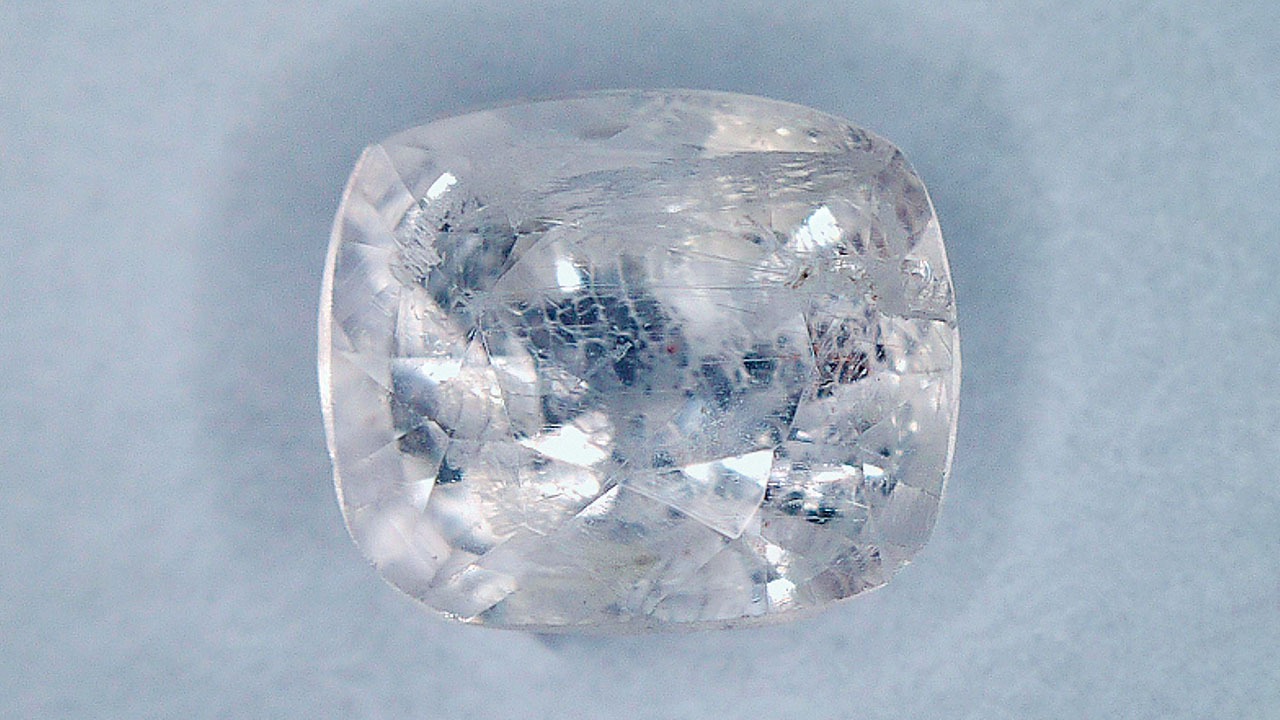
The authors recently found a 0.20 ct faceted transparent, colorless poudretteite (figure 1) resembling colorless spinel or taaffeite at a jewelry market in China’s Yunnan Province. Poudretteite is a rare hexagonal silicate gemstone variety with the chemical formula KNa2(B3Si12)O30 (J.D. Grice et al., “Poudretteite, KNa2(B3Si12)O30, a new member of the osumilite group from Mont Saint-Hilaire, Quebec, and its crystal structure,” Canadian Mineralogist, Vol. 25, No. 4, 1987, pp. 763–766). It is found primarily in the Quebec province of Canada and in Mogok, Myanmar (C.P. Smith et al., “Poudretteite: A rare gem species from the Mogok Valley,” Spring 2003 G&G, pp. 24–31). Northern Myanmar, which borders China’s Yunnan Province, is perhaps the most likely origin of this sample. Standard gemological testing revealed a refractive index of 1.513–1.533 and a hydrostatic specific gravity of 2.51. The stone was uniaxial positive, and its ultraviolet fluorescence was inert. Raman spectroscopy confirmed the sample was poudretteite.


Three reddish brown crystal inclusions were observed within the stone (figure 2). Raman spectroscopy identified them as the rare mineral neptunite (KNa2Li(Fe2+,Mn)2 Ti2Si8O24) (figure 3; B. Lafuente et al., 2015, https://rruff.info/about/downloads/HMC1-30.pdf), which has been found in Greenland, Canada, and the United States (Summer 2021 G&G Micro-World, pp. 160–161). To the best of our knowledge, this is the first recorded occurrence of neptunite inclusions in poudretteite.