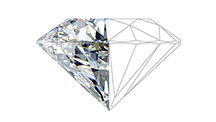

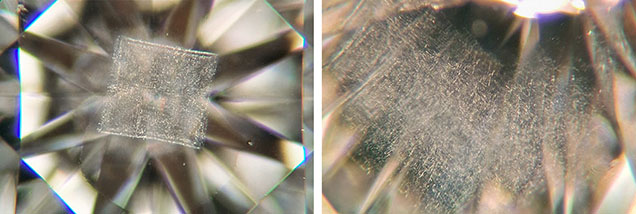
Polishers occasionally recognize a distinctive inclusion within a rough diamond and orient the faceting to highlight the unusual feature. One such example is the recently examined 0.34 ct round brilliant with I color shown in the figure above. Due to the prominent square-shaped cloud under the table (figure above, left), the clarity grade of the stone was SI2. Previously, gemologists have reported other natural diamonds with nominally similar-looking clouds oriented under the table facet (N. Renfro et al., “Inclusions in natural, synthetic, and treated diamond,” Winter 2018 G&G, pp. 428–429; Spring 2021 G&G Micro-World, pp. 65–66).
The cloud appeared as a perfect square shape (the measured length along one side of the square was ~0.9 mm) when viewed through the table facet, but it appeared significantly more scattered when viewed through the pavilion (figure above, right). Such features highlight the beneficial synergy between natural inclusions and skilled polishers.
Deepak Raj is a training specialist, and Hardik Rathod is a diamond grader, at GIA in Surat, India. Sally Eaton-Magaña is senior manager of diamond identification at GIA in Carlsbad, California.
Polishers occasionally recognize a distinctive inclusion within a rough diamond and orient the faceting to highlight the unusual feature. One such example is the recently examined 0.34 ct round brilliant with I color shown in the figure above. Due to the prominent square-shaped cloud under the table (figure above, left), the clarity grade of the stone was SI2. Previously, gemologists have reported other natural diamonds with nominally similar-looking clouds oriented under the table facet (N. Renfro et al., “Inclusions in natural, synthetic, and treated diamond,” Winter 2018 G&G, pp. 428–429; Spring 2021 G&G Micro-World, pp. 65–66).
The cloud appeared as a perfect square shape (the measured length along one side of the square was ~0.9 mm) when viewed through the table facet, but it appeared significantly more scattered when viewed through the pavilion (figure above, right). Such features highlight the beneficial synergy between natural inclusions and skilled polishers.
Deepak Raj is a training specialist, and Hardik Rathod is a diamond grader, at GIA in Surat, India. Sally Eaton-Magaña is senior manager of diamond identification at GIA in Carlsbad, California.