
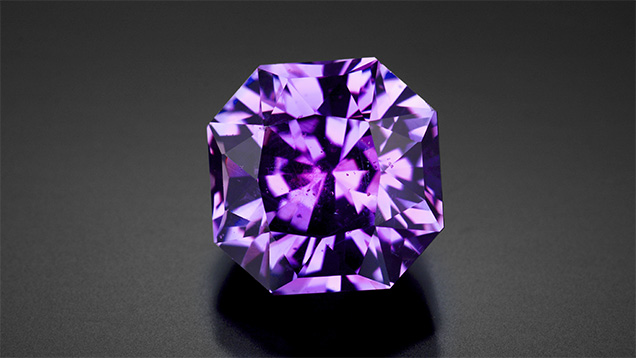
The Carlsbad laboratory recently received a 10.47 ct purple octagonal modified brilliant-cut sapphire (figure 1) for an identification and origin report. Standard gemological testing gave a 1.762 to 1.770 refractive index, indicating corundum, and a hydrostatic specific gravity (SG) of 4.00. The stone displayed no fluorescence under long-wave and short-wave UV.
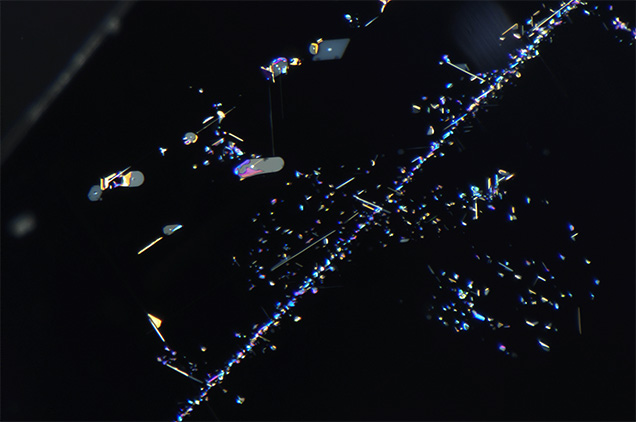
Microscopic examination showed an interesting combination of inclusions, including an iridescent healed fissure surrounding a crystal, particulate clouds with intact and unaltered rutile needles/silk, flaky stringers, and twinning with intersection tubules (figure 2). This inclusion scene is consistent with unheated corundum from Montana (Winter 2018 Lab Notes, pp. 434–435).
Laser ablation–inductively coupled plasma–mass spectrometry (LA-ICP-MS) was used to conclusively determine the stone’s trace element chemistry, and the results were compared to corundum samples from GIA’s colored stone reference collection. Trace element measurements indicated ranges of 13.6–15.0 ppma Mg, 13.1–15.0 ppma Ti, 7.76–8.36 ppma V, 38.3–39.4 ppma Cr, 1560–1600 ppma Fe, and 16.5–17.0 ppma Ga. The chemistry matched well with reference stones GIA has collected from Montana’s secondary deposits. With a combination of microscopic observation, advanced testing, and GIA’s reference collection, we were able to confirm the geographic origin of this sapphire.
Of all North American corundum localities, Montana reigns supreme. While rubies are only rarely found, facet-quality sapphire is mined at a number of different locations. Fine blue and purple gems have been mined at Yogo Gulch in central Montana, but cut gems over one carat are rare. Fancy sapphires are found associated with the placers of Missouri River and at Dry Cottonwood Creek and Rock Creek. These deposits produce larger material, but the colors tend to be pale. The successful development of heat treatment technology there has renewed interest in Montana sapphire.
This particular gem is consistent with those found in Montana’s secondary deposits. It is a particularly fine example due to its saturated purple color, large size, and absence of heat treatment.
The Carlsbad laboratory recently received a 10.47 ct purple octagonal modified brilliant-cut sapphire (figure 1) for an identification and origin report. Standard gemological testing gave a 1.762 to 1.770 refractive index, indicating corundum, and a hydrostatic specific gravity (SG) of 4.00. The stone displayed no fluorescence under long-wave and short-wave UV.
Microscopic examination showed an interesting combination of inclusions, including an iridescent healed fissure surrounding a crystal, particulate clouds with intact and unaltered rutile needles/silk, flaky stringers, and twinning with intersection tubules (figure 2). This inclusion scene is consistent with unheated corundum from Montana (Winter 2018 Lab Notes, pp. 434–435).
Laser ablation–inductively coupled plasma–mass spectrometry (LA-ICP-MS) was used to conclusively determine the stone’s trace element chemistry, and the results were compared to corundum samples from GIA’s colored stone reference collection. Trace element measurements indicated ranges of 13.6–15.0 ppma Mg, 13.1–15.0 ppma Ti, 7.76–8.36 ppma V, 38.3–39.4 ppma Cr, 1560–1600 ppma Fe, and 16.5–17.0 ppma Ga. The chemistry matched well with reference stones GIA has collected from Montana’s secondary deposits. With a combination of microscopic observation, advanced testing, and GIA’s reference collection, we were able to confirm the geographic origin of this sapphire.
Of all North American corundum localities, Montana reigns supreme. While rubies are only rarely found, facet-quality sapphire is mined at a number of different locations. Fine blue and purple gems have been mined at Yogo Gulch in central Montana, but cut gems over one carat are rare. Fancy sapphires are found associated with the placers of Missouri River and at Dry Cottonwood Creek and Rock Creek. These deposits produce larger material, but the colors tend to be pale. The successful development of heat treatment technology there has renewed interest in Montana sapphire.
This particular gem is consistent with those found in Montana’s secondary deposits. It is a particularly fine example due to its saturated purple color, large size, and absence of heat treatment.